
The most advanced hiking gear shouldn't actually look like hiking gear. You need a system that transitions from a sunrise summit to a city transit hub without missing a beat. Finding the best daypacks for hiking often involves navigating neon colors and excessive straps. It's frustrating to invest in a technical bag only to feel out of place off the trail.
We agree that purposeful adventurers demand more than just storage. You want a streamlined experience. No more disorganized pockets. No more materials that fail under pressure. This guide reveals the ultimate fusion of technical performance and minimalist design for 2026. Discover how your gear can marry tactical-grade durability with a refined, urban-ready silhouette.
Expect a curated selection that prioritizes long-term utility and sophisticated aesthetics. We'll explore everything from ultralight 14-ounce frames to high-capacity 30-liter systems with integrated ventilation. This is your roadmap to a more efficient and elevated journey.
Key Takeaways
- Transition seamlessly between environments with a modern 15L to 30L vessel designed for both trail self-sufficiency and urban integration.
- Understand the architecture of durability by evaluating high-denier fabrics and advanced weatherproofing systems.
- Identify the best daypacks for hiking by comparing technical minimalist designs against rugged all-rounders tailored to your specific mission profile.
- Master a selection framework that balances your base carry needs with climate variables for a more efficient journey.
- Elevate your outdoor experience through a tactical-inspired design philosophy that prioritizes organized calm and functional excellence.
The Evolution of the Hiking Daypack: Beyond the Trail
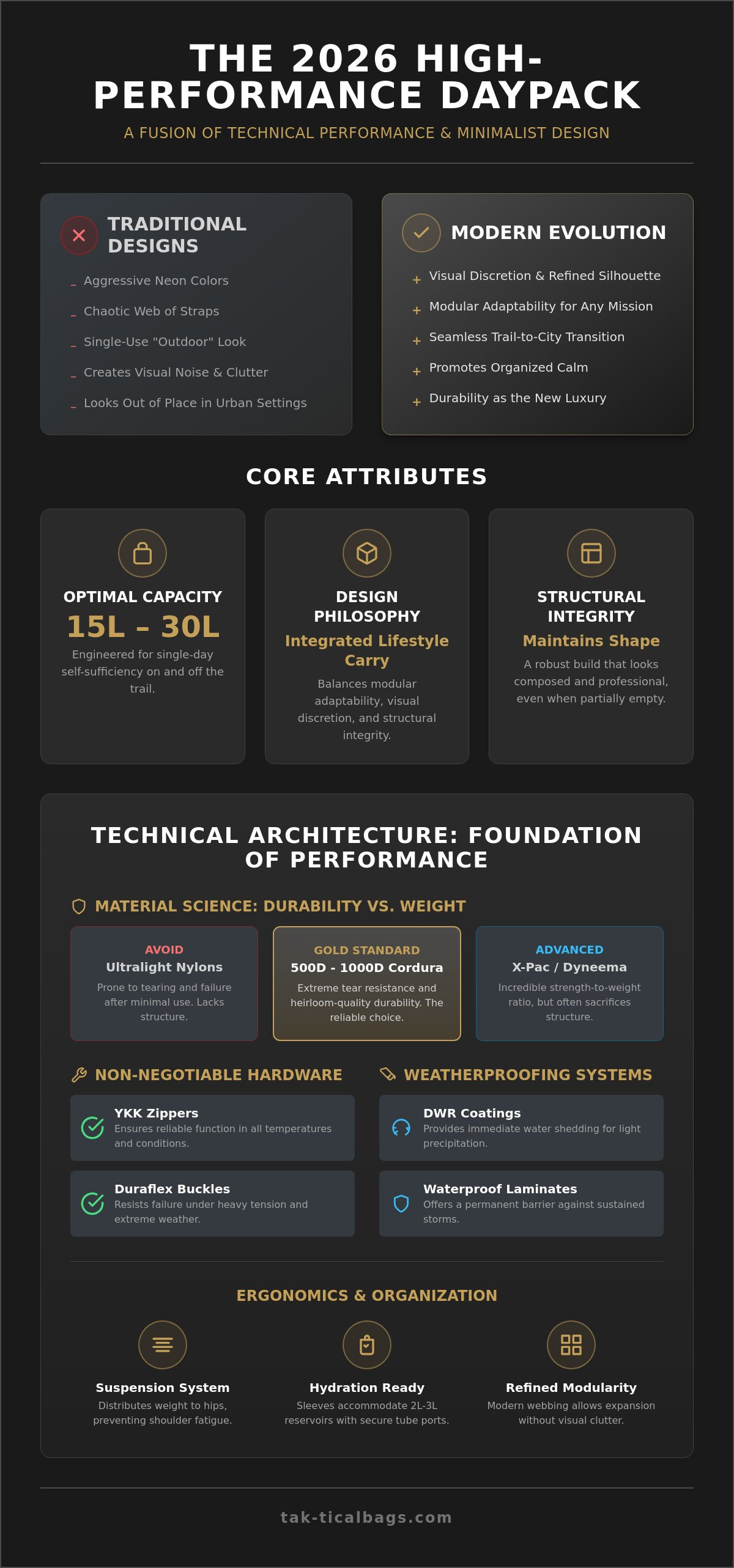
Modern exploration requires a specific type of vessel. We define the contemporary hiking daypack as a 15L to 30L container engineered for single-day self-sufficiency. It is no longer just a sack for the woods. The industry has shifted away from clunky, single-use outdoor gear toward what we call integrated lifestyle carry. This evolution reflects a new reality for the modern professional. Your bag must survive a technical summit and a high-stakes commute with equal grace. Identifying the best daypacks for hiking in 2026 requires looking past the marketing fluff and focusing on purposeful readiness.
To understand why this matters, we must look at The Evolution of the Modern Daypack, which moved us from heavy external frames to the streamlined, internal-support systems we rely on today. This history informs our current selection metrics. We look for gear that offers:
- Modular Adaptability: The ability to scale capacity based on the mission.
- Visual Discretion: A silhouette that doesn't scream "tourist" in an urban setting.
- Structural Integrity: Designs that maintain their shape even when half-empty.
The Problem with Traditional Sporty Designs
Traditional outdoor designs often rely on aggressive neon colors and a chaotic web of excessive straps. These elements scream for attention. In a city environment, they look out of place and create unnecessary visual noise. A minimalist carry system offers a significant psychological benefit. It provides a sense of organized calm. When your gear is streamlined, your mind follows. You can transition from the trail to a gallery or a meeting without a gear change. It is about being prepared without looking like you are lost in the wilderness.
Why Durability is the New Luxury
We are seeing a necessary rejection of disposable, paper-thin gear. In the current landscape, durability is the new luxury. Purposeful adventurers now seek heirloom-quality materials over the latest ultralight trend that fails after one season. Robust construction does more than just prolong the life of the bag. It reduces trail anxiety. You don't have to worry about a strap snapping or a seam bursting miles from civilization. The best daypacks for hiking use materials that age with character rather than wearing out.
Technical refinement is the intentional fusion of high-grade utility and minimalist aesthetics to create gear that performs without distraction.
Technical Architecture: What Defines a High-Performance Daypack
High-performance design starts with the foundation. The best daypacks for hiking rely on high-denier fabrics to withstand abrasive granite and dense brush. While ultralight trends favor thin nylons, 500D to 1000D Cordura remains the gold standard for reliability. It offers a perfect balance of weight and extreme tear resistance. Hardware is equally vital. We consider YKK zippers and Duraflex buckles non-negotiable. These components ensure your pack remains functional in freezing temperatures or under heavy tension. They don't fail when you're miles from the trailhead.
Ergonomics transform a simple bag into a high-performance tool. Modern framesheets and suspension systems distribute weight directly to your hips. This prevents shoulder fatigue during long ascents. Weatherproofing adds another layer of security. DWR coatings provide immediate water shedding. Waterproof laminates offer a permanent barrier against sustained storms. Choosing the right architecture ensures your gear works as hard as you do.
Advanced Material Science for 2026
We see a rise in technical fabrics like X-Pac and Dyneema. These materials offer incredible strength-to-weight ratios. However, we prioritize functional durability over trendy, paper-thin fabrics that lack structure. A high-performance pack should maintain a minimalist exterior while hiding its technical complexity. This design philosophy ensures your bag looks as good in a boardroom as it does on a ridge line. If you value this balance of aesthetics and utility, explore our collection of refined hiking bags designed for the modern adventurer.
Hydration and External Integration
Organization is about more than just pockets. Internal sleeves must accommodate 2L or 3L reservoirs with secure ports for hydration tubes. This keeps you moving without stopping for water. External integration has also evolved. Traditional military Molle webbing is now a tool for refined modularity. It allows for a clean look when empty but offers expansion when needed. It's about having the capacity without the clutter.
Strategic attachment points are essential for carrying The Ten Essentials, including trekking poles and extra layers. These points should be low-profile to maintain the bag's sleek silhouette. The best daypacks for hiking integrate these features seamlessly. They ensure you're always ready for the unexpected without sacrificing your aesthetic standards. Every strap and loop must serve a specific purpose.
The 2026 Daypack Roundup: Purpose-Built Carry for Every Terrain
Choosing the best daypacks for hiking involves more than just picking a brand. You must match your bag to your specific mission profile. We categorize carry systems by their intended terrain and load requirements. This ensures your gear remains an asset rather than a distraction. Whether you are navigating a well-maintained coastal path or a jagged mountain ridge, your pack must provide stability and accessibility. Our analysis covers five core trail profiles: casual excursions, technical scrambles, fast-paced ascents, urban-trail hybrids, and multi-day travel.
Tak-tical hiking bags represent the premier choice for those seeking urban-outdoor hybridity. These systems provide the load-bearing capacity needed for rugged environments while maintaining the sophisticated aesthetic required for city life. It is the ultimate solution for the modern adventurer who refuses to compromise on style or performance. By focusing on load-bearing engineering, we ensure that even a fully loaded pack feels balanced and controlled during dynamic movement.
The Technical Minimalist: Best for Fast and Light
This profile is designed for speed. It features a sleek silhouette and precise internal organization. These packs are ideal for 5-10 mile trails where weight is the primary concern. They strip away unnecessary bulk to focus on the essentials. For those integrating their outdoor gear with daily routines, The Art of the Everyday Carry Backpack provides deeper context on purposeful readiness. A minimalist approach ensures you move faster and with more agility. It is about carrying exactly what you need; nothing more.
The Rugged All-Rounder: Best for Technical Scrambles
Technical scrambles demand high abrasion resistance. These packs feature reinforced external gear loops and enhanced harness systems. This architecture supports dynamic movement across unpredictable terrain. A tactical-style build excels here. It offers the structural integrity needed to withstand mountain weather and rough granite. You need a pack that stays secure against your body as you navigate steep inclines. Reliability is the only metric that matters when the environment becomes hostile. These bags are built to endure, not just to exist.
The Hybrid Commuter: Best for Travel and Trail
This is the ultimate "one-bag" solution for weekend adventure travel. These bags feature dedicated laptop protection alongside hydration compatibility. They allow you to move from the office to the airport and straight to the trailhead. It is a versatile system for those who value efficiency. If you need a professional crossover, check our guide on the Best Backpacks for Work 2026. The best daypacks for hiking in this category are those that disappear into their surroundings, regardless of the setting. They offer a refined transition between professional obligations and personal exploration.
The Selection Framework: How to Identify Your Ideal Hiking Capacity
Selecting a vessel is a matter of logic, not guesswork. The best daypacks for hiking are those that accommodate your specific load without adding unnecessary bulk. A structured framework ensures you remain organized and ready for the terrain ahead. Follow these five steps to define your requirements before making an investment.
- Step 1: Calculate your base carry. Start with the non-negotiables: water, nutrition, and a comprehensive first aid kit. These items form the core of every mission, and for those who want to discover Simplepack Ltd, you will find a company dedicated to the high-quality contract packing of such health and food essentials.
- Step 2: Account for climate variables. Consider the space needed for extra layers or a technical rain shell. Winter excursions demand significantly more volume than summer treks due to bulky insulation.
- Step 3: Determine your torso length. Proper harness alignment is essential for weight distribution. A pack that is too long or short will cause unnecessary shoulder fatigue.
- Step 4: Match terrain to durability. High-abrasion environments require the heavy-duty materials we analyzed in previous sections. Scrambling over jagged granite requires a higher denier than walking on groomed forest paths.
- Step 5: Finalise your aesthetic. Choose between a tactical-inspired build for maximum utility or a minimalist profile for urban integration.
If you are ready to find a system that meets these rigorous standards, browse our full range of hiking backpacks to secure your next piece of essential gear.
Capacity Breakdown: 15L to 30L
Volume dictates your capability. A 15L to 20L pack is ideal for peak bagging or short summer excursions where gear is minimal. The 20L to 25L range is the true sweet spot for most adventurers. It provides enough space for all-day adventures and variable weather shifts. For winter hiking or family-carry scenarios, a 25L to 30L system is vital. These larger volumes accommodate the extra supplies required for safety in colder, more demanding climates.
Fit and Ergonomics Checklist
A perfect fit starts with precise measurement. To measure your torso at home, find the bony bump at the base of your neck and trace down to the top of your hip bones. This distance determines your harness size. Once the pack is on, utilize load lifters and sternum straps to pull the weight closer to your center of gravity. This creates essential stability. We always test for the sway factor. A stable pack is a safe pack. If the bag shifts during dynamic movement, it compromises your balance on technical trails. Modern suspension systems should feel like an extension of your body. Every adjustment should aim for organized calm and total control.
Tak-tical Readiness: Elevating Your Outdoor Experience
Tactical-inspired design philosophy provides a level of predictability that traditional sporty gear cannot match. It isn't about looking like a soldier. It's about utilizing military-grade engineering to solve civilian problems. Traditional bags often fail because they prioritize weight savings over structural integrity. We choose the opposite path. Our commitment to functional excellence creates a foundation of organized calm. You know where your gear is. You know it won't fail. This is the standard for the best daypacks for hiking in 2026. When your equipment is reliable, you can focus entirely on the journey.
We believe in the value of buying once and trusting your gear implicitly. This is the hallmark of a premium carry system. It eliminates the anxiety of gear failure miles from the trailhead. By choosing a bag built for longevity, you are making a choice that respects both your time and the environment. High-quality craftsmanship is the ultimate form of sustainability. We invite you to view our current collection of hiking and tactical bags to see how we define modern readiness.
Design Without Compromise
Design without compromise means your bag looks intentional in every setting. It is the intersection of professional aesthetics and rugged utility. For the modern citizen, a Tak-tical bag is more than a purchase. It is a strategic investment. We reject the cycle of disposable gear. Our 2026 collection represents the pinnacle of this philosophy. It offers a refined silhouette that hides a complex, high-performance interior. Explore the full range today to find a system that transitions seamlessly from the boardroom to the basecamp.
Preparing for Your Next Summit
Readiness is a habit. Before you head out, ensure your system is optimized for the objective. Longevity is a product of both build quality and maintenance. To keep your system at peak performance, follow a disciplined routine. Use a soft brush to remove trail dust from zippers after every trip. Hand wash only with mild soap. Never use a dryer. These small acts preserve the integrity of the fabric fibers. Before your next summit, run through a final readiness check:
- Inspect all hardware and buckles for tension.
- Verify that hydration reservoir seals are watertight.
- Balance the internal load to keep the center of gravity close to your spine.
- Adjust load lifters to prevent the pack from pulling away from your shoulders.
The best daypacks for hiking deserve careful stewardship to ensure they perform for decades. If you're ready to elevate your carry, visit the Tak-tical shop to find your next partner in adventure among our curated hiking bags. Readiness starts with the right foundation. Build yours today.
Secure Your Next Objective
Secure your next objective with a system built for the long haul. We've analyzed how high-performance Cordura construction and mission-specific capacities define the modern carry standard. You now recognize that tactical-grade durability provides a silent confidence that traditional gear lacks. It's the foundation of organized calm in an unpredictable world. Every strap and seam should serve your journey without distraction.
Identifying the best daypacks for hiking is ultimately an exercise in intentionality. You need a vessel that transitions seamlessly between the rugged trail and the high-stakes urban commute. Our minimalist design philosophy ensures you remain ready for any environment without sacrificing your professional aesthetic. It's gear designed for the purposeful adventurer who values both utility and refinement in every environment.
Don't settle for disposable solutions that fail when the terrain gets tough. Explore our collection of functional hiking daypacks to find a partner that lasts a lifetime. Your next summit is waiting. Step forward with total readiness and quiet empowerment.
Frequently Asked Questions
What is the best capacity for a hiking daypack?
The ideal capacity for a hiking daypack ranges from 20 to 30 liters for most single day excursions. This volume provides enough room for hydration, nutrition, and essential layers without adding unnecessary bulk. Shorter, high intensity efforts may only require a 15 liter vessel. Conversely, winter trips or family outings often necessitate a 30 liter system to accommodate extra insulation and supplies.
Are tactical backpacks actually good for hiking?
Tactical backpacks are excellent for hiking due to their superior durability and modularity. These systems utilize high denier fabrics and reinforced stitching to withstand abrasive terrain that often destroys lighter gear. Their design philosophy prioritizes organized calm through strategic compartments and external attachment points. This makes them a reliable partner for those who value functional excellence and a minimalist, urban ready aesthetic.
How do I clean and maintain my hiking daypack?
Clean your daypack by hand using a soft brush and mild soap to preserve the technical integrity of the fabric. Avoid machine washing and never use a dryer, as high heat can damage weatherproofing laminates and hardware. Focus on removing trail dust from zippers after every trip to ensure smooth operation. Proper maintenance extends the life of your investment and ensures long term reliability in varied climates.
Should I choose a daypack with a frame or a frameless one?
Choose a daypack with an internal frame if you prioritize weight distribution and carrying comfort over long distances. Framesheets transfer the load to your hips, reducing shoulder fatigue during technical ascents. Frameless packs are reserved for ultralight, minimalist missions where the total weight is exceptionally low. Most of the best daypacks for hiking in 2026 integrate low profile frames to maintain stability during dynamic movement.
Can I use my work laptop backpack for hiking?
You can use a work laptop backpack for hiking only if it features an ergonomic harness and technical weatherproofing. Traditional office bags often lack the necessary suspension systems to handle heavy loads on uneven terrain. However, modern hybrid designs provide dedicated laptop protection alongside hydration compatibility. These versatile systems allow you to transition seamlessly from the office to the trailhead without a gear change.
What is the difference between a daypack and a rucksack?
A daypack is a smaller vessel designed for single day self sufficiency, while a rucksack is typically a larger, top loading bag built for heavy loads. Daypacks prioritize agility and streamlined organization for shorter durations. Rucksacks often feature more robust external attachment points for sleeping gear and tools. The modern daypack evolution has blurred these lines, resulting in high performance containers that offer rucksack grade durability in a compact silhouette.
Is waterproofing necessary for a hiking daypack?
High water resistance is essential for any reliable hiking daypack, though full waterproofing is often reserved for extreme environments. Most technical bags utilize DWR coatings or waterproof laminates to protect your gear from sudden storms. This level of protection ensures your electronics and extra layers remain dry during transit. For total immersion or sustained heavy rain, consider a dedicated rain cover or a bag with sealed seams.
How much should a good hiking daypack weigh?
A high quality hiking daypack typically weighs between 14 ounces and 3 pounds depending on its feature set. Minimalist models prioritize speed by stripping away non-essential hardware to reach that 14 ounce mark. Heavier systems provide enhanced suspension and thicker fabrics for carrying technical loads. Finding the best daypacks for hiking involves balancing this physical weight against the ergonomic benefits of a robust internal frame.