
The effortless glide of a premium roller bag feels like the ultimate travel luxury until you encounter a set of stairs or a crowded subway. In the high-stakes transit environment of 2026, your luggage is more than a container. It is a strategic tool for movement. The choice between a carry on backpack vs roller bag defines whether you navigate the world with agility or find yourself anchored by your gear. Airlines are enforcing stricter size limits and dynamic baggage pricing is now the industry standard. Your decision has never been more consequential.
We understand the pressure of maintaining a professional image while avoiding the anxiety of mandatory gate-checking. You need to transition from the airport lounge to the boardroom without missing a beat. This guide clarifies how to optimize your mobility and efficiency based on your specific travel profile. We will examine the functional excellence of both formats, ensuring you select the partner that best serves your journey, your body, and your professional reputation. Discover how to reclaim your transit time with a more purposeful approach to packing and a refined aesthetic that matches your ambition.
Key Takeaways
- Navigate the "cobblestone factor" by choosing agility over traditional wheels in historic or crowded urban environments.
- Identify specific scenarios where a roller bag's internal structure is vital for protecting professional garments and reducing physical load.
- Apply our strategic three-day itinerary rule to resolve the carry on backpack vs roller bag dilemma for your next business trip.
- Explore how modern tactical design creates a seamless transition from the airport terminal to high-level professional meetings.
- Gain total autonomy over your travel rhythm by adopting one-bag strategies that eliminate gate-check delays and rising baggage fees.
Defining Mobility: The Carry On Backpack vs Roller Bag Debate
Travel in 2026 is a series of rapid transitions. You move from a high-speed rail platform to a crowded terminal, then finally to an urban office. The shift toward one-bag travel has accelerated because modern professionals prioritize speed and autonomy. Choosing between a carry on backpack vs roller bag isn't just a matter of storage. It dictates your travel rhythm. It determines whether you are the person waiting at the baggage carousel or the one already checking into the hotel.
The "Last Mile" problem remains the ultimate test of any luggage. This is the stretch between the airport terminal and your final destination. While a roller bag glides on polished marble, it often struggles on the uneven pavement, stairs, and gravel common in global cities. A tactical carry philosophy prioritizes hands-free movement. It treats luggage as a mobile base of operations rather than a logistical anchor. This perspective shifts the focus from how much you can fit to how fast you can move.
The Evolution of the Modern Traveler
Remote work and hybrid schedules have blurred the lines between professional and personal gear. You need a bag that bridges the gap between a morning meeting and an evening flight. Minimalist design has become the global standard because it projects competence without the bulk of traditional luggage. Modern travelers demand integration. They want a sleek aesthetic that fits a corporate environment but retains the rugged durability needed for transit. This evolution favors gear that adapts to the environment rather than forcing the environment to accommodate the bag.
Capacity vs. Agility: The Core Conflict
Every ounce matters when you are moving through a transit hub. The core conflict in the carry on backpack vs roller bag debate is literal weight versus total agility. Standard U.S. carry-on limits are strictly enforced at 22 x 14 x 9 inches. A roller bag’s frame and wheels consume valuable space and add several pounds before you pack a single item. In contrast, a well-designed backpack offers a more efficient ratio of weight to utility. Consider these agility factors:
- Adaptive Compression: The ability to shrink the bag's profile when it is under-packed.
- Balanced Distribution: Ergonomic systems that move weight to the hips rather than straining the hands.
- Staircase Readiness: Immediate mobility on escalators, stairs, and public transport without stopping to lift.
Total mobility means you never have to think about your bag. It stays with you, moves with you, and never requires a detour. When you choose the right tool, you reclaim your focus for the journey ahead.
The Backpack Advantage: Unmatched Agility in Transit
True freedom in transit is found when your hands are empty. When you choose a carry on backpack vs roller bag, you gain the ability to navigate complex environments without friction. You can check a digital map, sip a coffee, and present a mobile boarding pass simultaneously. This level of autonomy is essential for the modern professional. Movement becomes fluid. You are no longer tethered to a handle or restricted by the path of least resistance.
The "Cobblestone Factor" is where the backpack proves its tactical worth. Wheels are a liability on the historic streets of Lisbon, the uneven pavement of London, or the gravel paths of a suburban estate. A backpack ignores these obstacles. It allows you to maintain your pace while others struggle with vibrations and stuck casters. This agility extends to the airport terminal. A streamlined profile lets you move through security and boarding gates faster. You avoid the "gate-check anxiety" that often plagues those with rigid, oversized rollers.
Mastering the Urban Landscape
Modern travel is rarely a straight line from point A to point B. It involves stairs, escalators, and crowded public transport. Keeping your gear on your person ensures it never leaves your sight. A high-quality travel backpack serves as the ultimate multi-modal tool. It adapts to the cramped confines of a train car or the overhead bin of a regional jet. Tactical organization means your laptop and essential electronics are always within reach via dedicated, quick-access compartments. You stay ready for work the moment you sit down.
Ergonomics and Long-Term Comfort
Agility requires a design that respects the human frame. Modern everyday carry backpacks utilize sophisticated suspension systems to distribute weight effectively across your core. Load-lifters and sternum straps prevent the bag from pulling away from your shoulders; this keeps your center of gravity stable. Breathable back panels are another critical feature, especially in humid climates where airflow prevents discomfort. This engineering ensures that even a fully loaded bag feels integrated with your body rather than a burden to be carried.
Choosing a tool that prioritizes your physical readiness is a strategic move. For those who value this level of integration, exploring purposeful carry solutions is the next step toward a more efficient journey.
The Roller Bag Reality: When Structure and Ease Prevail
While agility defines the backpack, the roller bag offers a different luxury: the total removal of weight from your person. On the polished floors of a modern terminal, a wheeled carry-on moves with a silent, effortless glide. This choice in the carry on backpack vs roller bag debate often comes down to physical preservation. For travelers navigating long check-in lines or extensive airport corridors, the ability to pull rather than carry reduces fatigue. It allows you to arrive at your gate feeling composed and physically fresh.
The psychological ease of a roller bag is undeniable. There is a sense of order in a bag that stands independently. It serves as a mobile desk or a resting point during transit delays. Beyond comfort, the rigid structure provides superior protection for high-value items. If you are transporting delicate equipment or prototypes, the hard-shell exterior of a premium roller acts as a protective vault. It offers a level of impact resistance that soft-sided bags struggle to match.
The Formal Travel Context
Corporate environments often dictate a specific aesthetic. A structured roller bag aligns with traditional professional expectations, projecting a sense of established stability. It is the ideal tool for maintaining a crisp appearance. Internal compression systems and flat packing surfaces ensure that suits and formal garments remain wrinkle-free. Many executives prefer pairing their wheeled luggage with sophisticated laptop bags. This creates a modular system where the laptop bag sits securely on the telescoping handle, allowing for a seamless transition from the aircraft cabin to a high-level boardroom.
Limitations of the Wheeled Approach
The wheeled approach has distinct trade-offs that appear the moment the pavement ends. You face the "Dead Weight" problem on stairs, curbs, or grass. Lifting a roller bag in these scenarios reveals its lack of true versatility. Internal volume is also compromised. The telescoping handle and wheel housing occupy significant space, typically reducing packing capacity by 10% to 15% compared to a backpack of the same external dimensions. Maintenance is another strategic risk. A single broken wheel or a jammed handle can turn a premium suitcase into a cumbersome weight, effectively ending its utility mid-journey. In the fast-paced transit world of 2026, a mechanical failure is a logistical crisis you cannot afford.
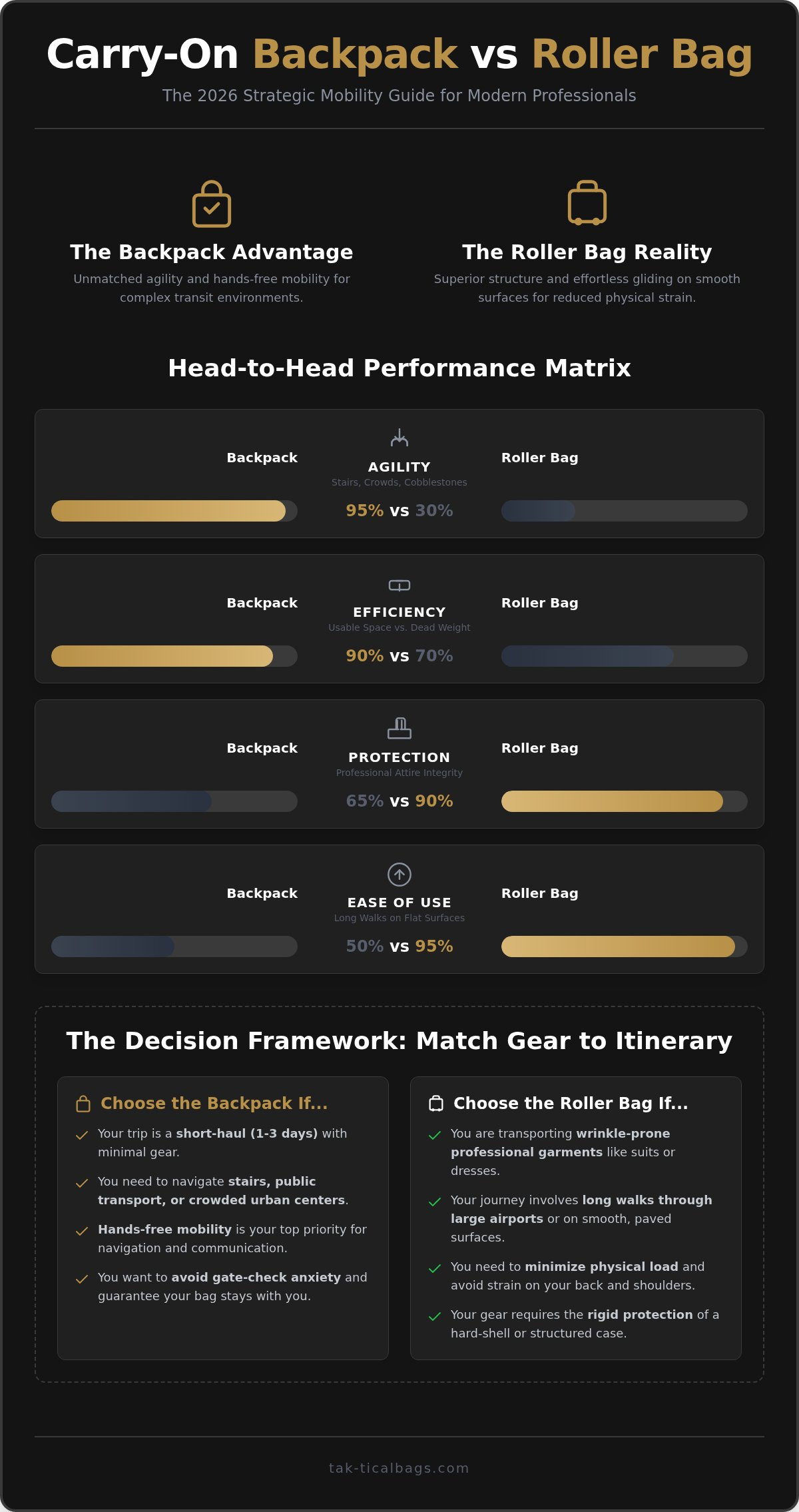
The Decision Framework: Matching Gear to Your Itinerary
Selecting the right tool requires a clear assessment of your mission. The carry on backpack vs roller bag debate is best resolved through a strategic decision matrix rather than personal preference alone. You must evaluate your itinerary against four primary pillars: duration, terrain, physical capacity, and professional image.
The three-day rule is a reliable benchmark for duration. For trips under 72 hours, a high-capacity backpack offers the most efficiency. It eliminates the need for checking bags and speeds up your exit from the terminal. Beyond three days, the volume requirements often favor the structured packing space of a roller bag. Terrain is the next critical factor. If your itinerary involves trains, ferries, or historic city centers, the agility of a backpack is non-negotiable. However, if your journey is a direct path from an airport taxi to a climate-controlled hotel lobby, the ease of wheels prevails.
Scenario Analysis: Which Wins Where?
Context dictates performance. In a 48-hour business blitz, a sleek backpack allows you to move directly from the plane to your first meeting. It projects a modern, integrated image. Conversely, a European rail adventure demands the mobility of a carry-on backpack to navigate narrow aisles and steep station stairs. For a luxury resort stay where bellhops and smooth pavement are guaranteed, the effortless convenience of a roller bag is the logical choice. Be honest about your physical carrying capacity. A backpack is only an advantage if you can comfortably support its weight for the duration of your transit.
Technical Specs to Consider
Weight efficiency is paramount in 2026. Consider the "tare weight" of your luggage. A typical roller bag starts at seven to nine pounds before you pack a single item. A premium backpack often weighs less than half that. This difference represents extra gear you can carry without exceeding strict airline weight limits. Organization also differs by format. Rollers often feature "open bucket" designs that require separate packing cubes. Modern backpacks prioritize integrated compartments. The inclusion of durable laptop bags for travel within the backpack's structure ensures your most valuable tools are protected and accessible at all times.
Ready to optimize your next journey? Explore our collection of purposeful carry solutions to find your ideal travel partner.
Elevating the Journey: Why Functional Design Wins
The Tak-tical approach centers on the intersection of minimalist aesthetics and maximum utility. In 2026, "tactical" no longer implies a rugged, military aesthetic. Instead, it represents a sophisticated commitment to organizational readiness and rapid access. It is a design philosophy for those who view travel as a series of high-stakes environments. High-denier fabrics like 1000D Cordura provide a level of durability that fast-fashion luggage cannot match. These materials ensure your gear withstands the abrasions of overhead bins and transit hubs while maintaining a professional silhouette. This is about future-proofing your journey.
True functional excellence is found in the details. It is the reinforced stitching on a handle and the silent glide of a weather-resistant zipper. These elements don't just protect your belongings. They provide a sense of organized calm. When your gear is built to a higher standard, you can focus on the mission at hand rather than worrying about equipment failure. Tactical design is about the system of organization; it ensures you can reach for a passport or a charging cable without unpacking the entire bag. This efficiency elevates the travel experience from a chore to a streamlined process.
The Integration of Tech and Travel
Modern travel is fundamentally digital. Dedicated, padded compartments for laptops and tablets are now standard requirements for the purposeful traveler. Weather resistance is a non-negotiable feature for the urban professional. You can't control the climate, but you can control the safety of your hardware. A tactical hiking backpack often provides the perfect blueprint for this. It offers the structural integrity needed for the trail with the refined organization required for city travel. This versatility allows you to transition from a morning hike to a downtown office without changing your gear.
Making the Final Choice
The carry on backpack vs roller bag debate ultimately rests on your specific need for autonomy. A backpack offers unmatched agility and hands-free freedom, allowing you to bypass the logistical hurdles of crowded cities and historic stations. A roller bag provides ease on flat surfaces and superior garment protection for formal events. Investing in craftsmanship means choosing gear that lasts for decades rather than a single season. Fast-fashion luggage may look appealing on a shelf, but it often fails under the pressure of real-world transit. Quality materials and reinforced stitching are the silent partners in a successful itinerary.
Audit your current travel wardrobe. Look for friction points in your transit history. If you find yourself struggling with stairs or waiting at carousels, it is time to pivot toward a more agile solution. Choose the gear that empowers your movement and reflects your professional ambition. Readiness is a choice. Efficiency is the result.
Master Your Movement
The decision in the carry on backpack vs roller bag debate ultimately defines your ability to respond to the unexpected. Whether you prioritize the hands-free agility of a backpack for historic city streets or the weightless glide of a roller bag for long terminal corridors, your choice should reflect your specific travel rhythm. Efficiency is the result of choosing tools that integrate seamlessly with your body and your itinerary. Each journey is a strategic exercise in mobility.
True readiness requires gear that matches your professional ambition. You need a solution that balances high-quality craftsmanship with a sleek, urban innovator aesthetic. By investing in functional excellence, you ensure that your gear never dictates your pace. It's time to adopt a carry system designed for the fast-paced mobile lifestyle of the modern professional. Your luggage should be a partner in your success, not a logistical anchor.
Explore Tak-tical’s collection of purposeful carry-on backpacks and redefine how you navigate the world. Your next journey begins with a commitment to better design and smarter movement. Travel with purpose.
Common Travel Inquiries
Is a backpack or a roller bag better for my back?
Roller bags are superior for spine health because they remove the entire load from your shoulders. They are the logical choice for travelers with existing back injuries. However, for those debating a carry on backpack vs roller bag, a modern backpack with a hip belt and load lifters is a viable alternative. It distributes weight across your core rather than your spine. This prevents the localized strain often caused by poor packing habits.
Can I use a carry-on backpack as my only bag for a week-long trip?
Yes, one bag travel for seven days is highly efficient with a 35 to 45 liter backpack. This strategy requires minimalist packing and the use of compression cubes to maximize internal volume. You gain total autonomy and avoid the rising baggage fees of 2026, which now reach $45 for a first checked bag on major U.S. carriers. This approach ensures your gear stays with you during every transit leg.
Do airlines prefer roller bags or backpacks for carry-on?
Airlines generally prefer backpacks because they are compressible and fit more easily into varied overhead configurations. Roller bags are more likely to be gate-checked on smaller regional jets due to their rigid frames and handles. In 2026, many carriers use automated gate scanners to enforce the 22 x 14 x 9 inch limit. A backpack's soft-sided nature allows it to pass these checks more frequently than a hard shell suitcase.
What is the best size for a carry-on backpack in 2026?
The optimal size is 22 x 14 x 9 inches. This complies with the strict standards of major U.S. airlines like American, Delta, and United. This dimension typically offers a capacity of 35 to 42 liters. Adhering to these measurements ensures you avoid the $100 fees associated with oversized baggage. It also guarantees your bag fits into the overhead bin of almost any narrow body aircraft in service today.
How do I make a backpack look professional for business travel?
Select a bag with a minimalist, structured silhouette and high quality materials like high denier nylon. Avoid excessive external straps or loud colors. A sleek, urban aesthetic in black, navy, or charcoal projects an image of organized calm. Tuck away loose straps and ensure the bag holds its shape when under-packed. This integration of tech and style rivals the professional appearance of any premium roller bag in a boardroom setting.
Are tactical backpacks allowed as carry-ons?
Yes, tactical style backpacks are permitted if they meet the airline's size dimensions. They are highly efficient for the carry on backpack vs roller bag comparison because of their modular organization and durability. Ensure your bag lacks prohibited items like integrated tools or sharp metal components. Modern tactical designs emphasize functional excellence without appearing overly military. This makes them a reliable partner for both professional settings and outdoor adventures during your travels.
What happens if my roller bag is too heavy for the overhead bin?
If a bag exceeds the 50 pound weight limit or the cabin's capacity, flight attendants will require it to be gate-checked. This often results in a fee, especially on budget carriers where last minute baggage charges range from $40 to $100. You also lose the benefit of immediate mobility upon landing. To avoid this, use a luggage scale and prioritize a lightweight frame to maximize your actual packing allowance for the trip.