
What if the best carry-on for your trip depends less on the flight and more on the ground beneath you? In the carry on backpack vs rolling luggage decision, that detail matters. A smooth airport terminal can make wheels feel effortless. A flight of stairs, crowded train, or uneven street can quickly change the calculation.
It’s a familiar trade-off: rolling luggage keeps the load off your shoulders, while a backpack offers hands-free movement and easier maneuvering through varied terrain. Neither is right for every route. The better fit depends on how far you’ll move between stops, what you need to pack, and how you prefer to carry it.
This guide compares comfort, capacity, organization, and airport handling to help you choose. You’ll see when a backpack or rolling bag makes more sense, and when a hybrid setup or separate personal item could make travel smoother. Start with your itinerary, then choose a carry-on that suits the way you’ll actually move.
Key Takeaways
- The carry on backpack vs rolling luggage choice comes down to your route, packed load, and preferred way to move.
- Compare comfort, access to your belongings, and overhead-bin handling before deciding.
- Map your transfers, stairs, and street conditions to see where carrying or rolling will be more practical.
- Factor in trip length, clothing, work gear, and airline carry-on rules to narrow your options.
- A hybrid setup or separate personal item can suit some itineraries, as long as it fits your needs and the airline’s allowance.
Carry-On Backpack vs. Rolling Luggage: The Differences
The core trade-off is simple: a carry-on backpack travels on your body, leaving your hands free, while rolling luggage moves weight across smooth ground. Neither format wins every trip. A backpack can make stairs and crowded transfers easier to manage, while wheels can spare your shoulders during long walks through level terminals.
In the carry on backpack vs rolling luggage comparison, start with the format, then consider the route. Capacity and organization vary by design, so don’t assume every backpack holds as much as every carry-on suitcase. For an overview of carry-on luggage regulations, see this background on hand luggage, then check the rules set by your operating airline. Size and allowance limits vary.
What counts as a carry-on backpack or rolling bag?
A travel backpack is luggage carried on the body, usually with shoulder straps. Rolling luggage travels upright on wheels and is pulled using a handle. These are bag formats, not guarantees of carry-on eligibility. Each airline sets its own limits, and bags that exceed them may not qualify. Check your operating airline’s current requirements and measure your packed bag before you leave.
| Factor | Carry-on backpack | Rolling luggage |
|---|---|---|
| Mobility | Hands-free once worn; easy to maneuver in tight spaces. | Easy to pull when there’s room to roll. |
| Access | Top- or front-opening designs offer different ways to reach contents. | Often opens into suitcase-style compartments. |
| Comfort | Weight rests on your body, so fit and packed load matter. | Shoulders stay clear, though pulling still takes effort. |
| Organization | Layout varies; packing choices affect how easy items are to find. | Compartments can separate belongings, depending on the design. |
| Terrain | Useful on stairs, transit, and uneven streets. | Most convenient on smooth, accessible surfaces. |
The quick answer: which travel style suits each?
Choose a backpack if your route includes frequent stairs, transit transfers, or stretches where pulling a bag would be awkward. Consider wheeled luggage when most of your movement is across smooth airport floors, station platforms, and accessible paths. Think beyond the terminal, too. The walk from a transit stop to your accommodation can shape the experience.
Route conditions often determine convenience more than the bag itself. Picture each leg of your journey, from queues and overhead-bin handling to sidewalks and stairs. That route-first view gives you a practical starting point for choosing between the two.
How Backpacks and Rolling Luggage Differ in Comfort, Capacity, and Access
Comfort depends on how you move the load. A backpack keeps it on your body and leaves your hands free, but its weight rests on your shoulders and back. Rolling luggage spares you from carrying that weight, yet pulling or pushing it takes effort and can feel awkward in tight spaces. In the carry on backpack vs rolling luggage decision, neither is automatically easier. Your packed load, route, and personal comfort all matter.
Access works differently, too. A backpack may open from the top or front, depending on its design. With top access, you may need to shift items to reach something near the bottom. A front-opening design may let you see more of the contents at once. Rolling luggage often opens into suitcase-style compartments, which can make it easier to separate clothing and gear. In either format, items can shift during transit if there’s open space or they aren’t secured.
Don’t assume the formats have equal capacity. Actual capacity, empty weight, dimensions, and internal layout depend on the specific bag. Think through what you’ll pack, then compare usable space and access to essentials such as a charger, documents, or a change of clothes.
When does a backpack feel easier to carry?
A backpack can be practical during transfers and boarding because you can keep both hands free for tickets, handrails, or other belongings. That freedom comes with a trade-off: carrying a heavy bag for a long stretch may strain your shoulders or back. Pack deliberately. Keep heavier essentials close to your body, balance the load from side to side, and leave behind items you won’t use.
When does rolling luggage make packing simpler?
A structured interior can help keep clothing and gear in separate sections, making it easier to stay organized as you pack and unpack. On smooth, level surfaces, you can pull or push the bag instead of carrying its full weight. That ease can disappear on stairs, cobblestones, or crowded aisles, where wheels may be difficult to maneuver and you may need to lift the bag.
Before settling on a style, picture when you’ll need to access your belongings and how much effort you’re comfortable making. Travelers comparing backpacks and carry-on bags can use these practical needs to narrow the choice without assuming one format suits every journey.
Which Carry-On Works Better for Airports, Transit, and City Streets?
Airports are only one part of the journey. A rolling bag can glide through a long terminal corridor and wait beside you in a queue, but tight crowds may make it harder to maneuver. A backpack stays close as you move through busy spaces and keeps your hands free. At boarding, either bag needs to be lifted into an overhead bin if you’re bringing it onboard, so consider whether you can comfortably raise its packed weight.
Walking between terminals or connecting to a train adds another variable. Smooth floors favor wheels; stairs, crowded platforms, and limited storage can favor a bag carried on your back. The better choice depends on the transitions you’ll make, not just the distance you’ll roll or walk.
Choose for the full route, not only the airport
Trace your trip from home to your accommodation. Include the airport queue, train or bus transfers, the walk from a station, and the final approach to your lodging. A route with elevators and level paths may suit rolling luggage well. Stairs, uneven pavement, and crowded transit can make a backpack easier to manage, especially when you need one hand free for a rail or ticket.
Terrain and transfers often matter more than the terminal: the more stairs and uneven ground on your route, the more useful hands-free carrying can be.
How do two-wheel and four-wheel carry-ons fit in?
Wheel design affects how rolling luggage moves, but it doesn’t change the broader choice between carrying and rolling. Two-wheel bags are typically pulled behind you, which can be practical along a clear path. Four-wheel spinner bags can move in multiple directions on suitable floors, making them easier to reposition beside you in some spaces.
Neither design is effortless everywhere. Wheel behavior depends on the bag and surface, and rough pavement, thresholds, or a tightly packed aisle may interrupt smooth movement. Treat wheel count as a secondary decision: first decide whether rolling suits your route, then consider which wheel style fits the spaces you’ll cross.
For the carry on backpack vs rolling luggage choice, picture the busiest or least accessible stretch of your trip. A quiet, level terminal may make wheels convenient, while stairs or a crowded transit transfer can shift the advantage toward a backpack. Use that demanding segment as a practical test, then choose the format that keeps the whole journey manageable.
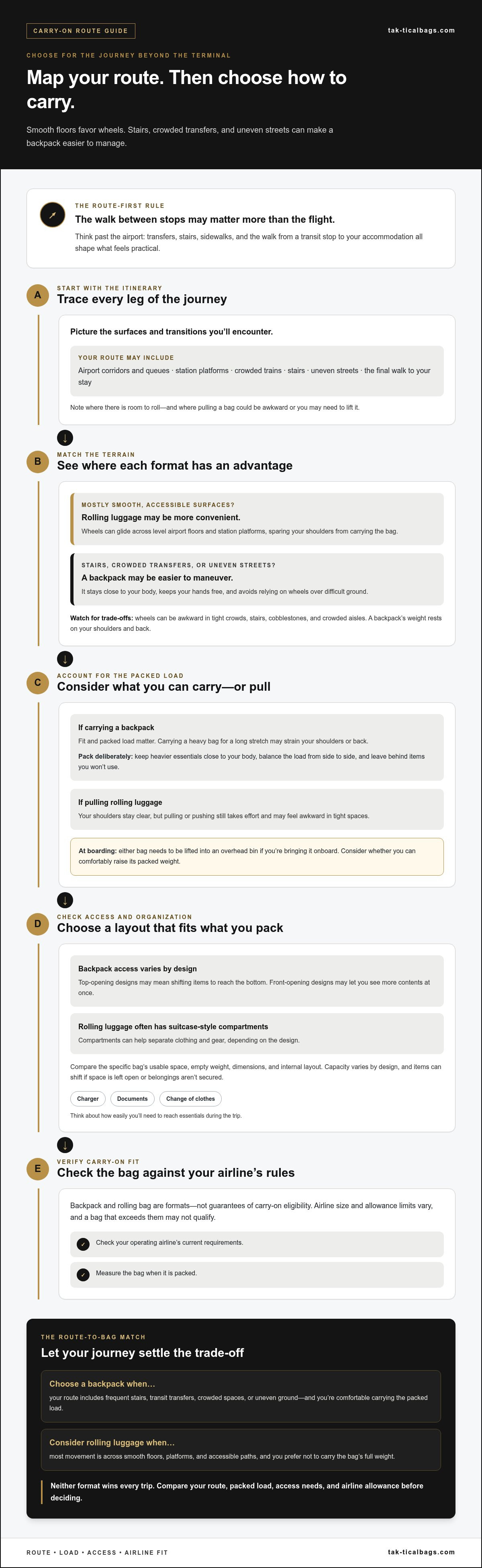
How to Choose Between a Carry-On Backpack and Rolling Luggage
Make the choice with your whole itinerary in view. The carry on backpack vs rolling luggage decision gets clearer when you consider the route, the weight you’ll carry, what you need to access, and the airline’s current rules.
1. Map the route. Trace your trip from departure to accommodation. Note stairs, transit changes, long walks, and smooth terminal stretches. Frequent transfers or uneven paths may favor a backpack; a mostly level, accessible route may suit rolling luggage.
2. Estimate the packed load. A short trip with a few clothing changes may fit comfortably in one bag. A longer journey, work equipment, or specialized gear can change the space and organization you need. Do a realistic test pack before choosing. Try carrying the loaded backpack for a while, or pull the packed rolling bag over a surface like the one you expect to encounter. Comfort depends on fit, total weight, and how long you’ll carry or pull the bag.
3. Assess access and separation. Consider what you’ll need during transit, such as a laptop, documents, or a change of clothes. A backpack may suit a traveler who values hands-free movement and quick access; rolling luggage may work better if you prefer a structured way to separate clothing and gear. For broader packing ideas, explore this carry-on travel guide.
4. Check airline rules. Review the operating airline’s latest carry-on and personal-item requirements before departure. Measure the packed bag as directed, including handles, wheels, and other protruding parts. Don’t assume a familiar bag format automatically qualifies.
Match luggage to your itinerary and packed weight
Trip length is only one part of the calculation. A short business trip may still need room for work gear, while a longer trip with light clothing needs may call for less space than expected. If you travel with a separate work device, a laptop bag can keep it distinct from clothing and other essentials. This laptop bag travel guide offers more context.
Check airline fit and plan a practical setup
Choose one backpack or rolling bag when it can hold your essentials without becoming awkward to carry or maneuver. A two-piece setup can make sense if separating work items or in-transit essentials adds real value, provided both bags fit the airline’s allowances and your route. Keep the setup intentional, not bulkier than the trip requires.
Ready to put your route-first decision into practice? Explore travel backpacks and carry-on bags suited to different ways of moving.
Build a Carry-On Setup That Moves with Your Travel Style
Let the route shape your final setup. A backpack is a natural fit for frequent transfers, stairs, and active city itineraries. Rolling luggage makes sense when most of the journey follows smooth, accessible paths. Tak-tical’s backpack and carry-on bag categories offer options for different travel preferences, without expecting one format to suit every trip.
When a carry-on backpack is the more natural fit
Choose a backpack when hands-free movement will make the day simpler. It can be easier to manage while changing trains, climbing stairs, or moving through a busy city with other essentials in hand. Before committing, pack it as you would for travel and consider both the total weight and how long you’ll carry it. A manageable load and comfortable fit matter as much as the route.
When rolling luggage or a mixed setup makes sense
For a route dominated by smooth floors and straightforward transfers, rolling luggage can make it easier to move a packed load without carrying it on your shoulders. Its structured interior may also suit travelers who want clothing and gear arranged in separate spaces.
A backpack-and-roller setup can work if you want essentials close at hand and clothing packed separately. For example, a backpack could hold items you’ll use during transit, while a rolling bag carries the rest. Keep the setup purposeful. Check that both bags fit your airline’s carry-on and personal-item allowances, and consider whether managing two pieces will feel convenient along your route.
The carry on backpack vs rolling luggage choice comes down to three questions: What terrain will you cross? How much will you pack? Which carrying style feels comfortable for the full journey? Answer those, then choose a setup that supports how you travel, not just how you board.
Explore Tak-tical bags and choose a purposeful carry-on setup for your next trip.
Choose the Carry-On That Fits Your Route
The carry on backpack vs rolling luggage decision comes down to how you’ll travel, not which format is universally better. A backpack supports hands-free movement through transfers, stairs, and active itineraries. Rolling luggage can feel more practical on smooth, accessible routes. Either way, consider packed weight, comfort, storage needs, and airline limits before setting off.
A thoughtful setup can also combine a backpack with rolling luggage when separating essentials from clothing makes the trip easier and both bags fit your airline’s allowances. Keep the setup streamlined, and choose only what serves your journey.
Tak-tical offers backpacks and carry-on bags with functional, stylish designs for everyday use and travel. Explore Tak-tical bags for purposeful travel and find a setup that suits the way you move. Your next journey starts with a choice made for your route.
Frequently Asked Questions
Is a carry-on backpack better than rolling luggage?
Neither is better for every trip; the right choice depends on your route and how you prefer to manage your load. A backpack can suit frequent stairs, transit changes, and hands-free movement. Rolling luggage can feel easier across smooth airport floors because you don’t carry its full weight. Compare the carry on backpack vs rolling luggage by considering your packed load, walking distance, access needs, and comfort.
Can a backpack count as a carry-on bag?
Yes, a backpack can count as a carry-on if it meets the airline’s requirements for size and other applicable limits. The backpack format alone doesn’t determine whether it qualifies. Measure it when packed, including any parts that stick out, and check the rules for your operating airline and fare. A backpack that exceeds the carry-on limit may need to be checked or fit another allowance, depending on the airline’s policy.
Is rolling luggage difficult to use on cobblestones or stairs?
It can be. Uneven cobblestones may interrupt a smooth roll, and stairs require you to lift the bag rather than pull it along. The effort also depends on the bag’s design, wheel behavior, and packed weight. If your itinerary includes repeated stair climbs or uneven streets, a backpack may be easier to manage. If most of your route is level, rolling luggage may remain convenient for much of the journey.
How do I choose between a carry-on backpack and a suitcase?
Start by mapping the route, then consider what you’ll pack and how you want to carry it. A backpack may suit a trip with stairs, transfers, or active city walks, provided its packed weight feels comfortable. A suitcase can work well on smooth, accessible routes and may suit travelers who prefer structured packing. Test your packed load and consider trip length, clothing, work gear, and access to essentials.
Are two-wheel or four-wheel carry-ons better for travel?
Neither wheel style is best on every route. Two-wheel bags are typically pulled behind you and can work well on a clear path. Four-wheel spinner bags can move in multiple directions on suitable surfaces, which may help when repositioning a bag in a terminal. Actual maneuverability depends on the bag’s design and the terrain. Consider the surfaces you’ll cross, and remember that stairs and rough ground can make any wheeled bag harder to move.
Can I bring a backpack and rolling luggage on the same flight?
Often, travelers can bring a carry-on and a personal item, but your airline’s rules and fare conditions determine what’s allowed. A backpack and rolling bag may count as separate pieces, so don’t assume both are included. Check the operating airline’s carry-on and personal-item allowances before departure, including size limits and any applicable weight rules. Make sure each bag fits the allowance you plan to use.
What should I check before taking a carry-on bag on a flight?
Check your airline’s latest carry-on and personal-item allowances, including size, weight, and the number of permitted bags. Measure your bag as packed, counting protruding handles, wheels, or pockets as instructed by the airline. Review your fare conditions, too, since allowances can differ. Also check airport security guidance for the items you plan to carry, especially liquids and spare batteries. Confirm details for every airline operating your itinerary.