
A lifetime warranty can sound like lasting protection. But if its terms exclude the wear, heavy loads, or conditions you expect, it may not protect your investment when it matters. Choosing a heavy duty tactical backpack takes more than trusting rugged language or a lifetime label. Check how the pack is built and what the policy actually covers.
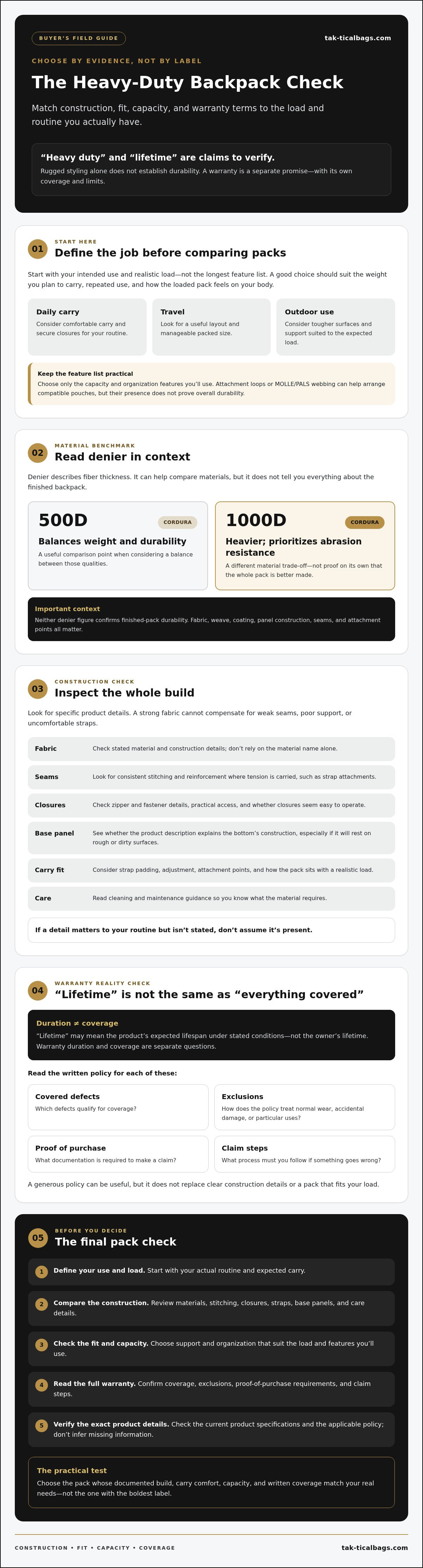
Start with your intended use, not the longest feature list. Compare materials, stitching, zippers, capacity, and carry comfort with your everyday or outdoor needs. As a useful benchmark, 500D Cordura balances weight and durability, while 1000D Cordura prioritizes abrasion resistance. Neither figure tells you everything about the finished pack. You’ll also learn how to check warranty exclusions and claim requirements without assuming “lifetime” covers every kind of damage.
Use these checks to focus on a practical pack with clear specifications and policy details. Once you know what your load requires, explore backpack options from Tak-tical and verify each product’s current details.
Key Takeaways
- Judge a heavy duty tactical backpack by how its construction, fit, and capacity match your routine, not by rugged styling alone.
- Compare material and denier details alongside stitching, closures, straps, and base panels for a more complete view of durability.
- Read warranty terms for coverage, exclusions, proof-of-purchase requirements, and claim steps before relying on a “lifetime” label.
- Start with your actual load and use case, then choose only the capacity and organization features you’ll use.
- Verify specifications and warranty details on the exact product and policy pages before making your choice.
What Makes a Heavy Duty Tactical Backpack Worth Considering?
Buyers need dependable carry, not rugged styling alone. A heavy duty tactical backpack should suit the weight you plan to carry, withstand repeated use, and fit comfortably when loaded. Its value depends on how its materials, seams, closures, and support work together, not on camouflage, webbing, or a bold product label.
In brief: A durable backpack has documented construction and a fit that match its intended load and routine. A warranty is a separate promise, with its own terms and limits.
What does heavy duty mean in a tactical backpack?
There’s no universal standard attached to “heavy duty” or “tactical.” Treat those words as descriptions to verify, not proof of a specific level of performance. Look for details about the fabric, seam construction, zipper quality, strap attachment points, and base reinforcement. Then consider how the loaded pack sits on your body. Strong fabric won’t compensate for uncomfortable straps or poor load support.
Material figures need context, too. Denier describes fiber thickness, but it doesn’t tell the whole story about a finished pack’s durability. As a general comparison, 500D Cordura balances weight and durability, while 1000D Cordura is heavier and prioritizes abrasion resistance. Neither figure alone confirms how well the whole bag is made.
Match the evidence to your routine. A commuter may care most about comfortable daily carry and secure closures. A traveler may prioritize a useful layout and manageable packed size. Outdoor use can call for tougher surfaces and support suited to the expected load. Tactical-inspired organization, such as attachment loops, can help arrange gear. MOLLE and PALS webbing is one system for attaching compatible pouches, but its presence doesn’t establish a pack’s overall durability. Don’t assume a particular feature is included unless the product details confirm it.
Is a lifetime warranty proof of a durable backpack?
No. Warranty duration and coverage are different questions. “Lifetime” may refer to the product’s expected lifespan under stated conditions, rather than the owner’s lifetime. Policies can also differ on which defects qualify, what counts as normal wear, and whether accidental damage or particular uses are excluded.
Read the written terms before treating warranty language as evidence of protection. Check the covered defects, exclusions, proof-of-purchase rules, and claim steps. A generous policy can be useful, but it doesn’t replace clear construction details or a pack that fits your actual load.
Tak-tical sells backpacks and describes its carry gear as functional and stylish. Check the current product page and warranty policy before drawing conclusions about any backpack’s construction or coverage.
How to Assess Construction Before Buying a Heavy Duty Tactical Backpack
A product photo can suggest quality, but it can’t confirm how a pack is made. Before choosing a heavy duty tactical backpack, look for specific construction details in the product description. Check whether the listing identifies materials, reinforcement, closures, strap design, and care requirements. If a detail matters to your routine but isn’t stated, don’t assume it’s present.
Which materials and seams should buyers examine?
Nylon, polyester, and Cordura describe materials, but the name alone doesn’t guarantee performance. Fabric weight, weave, coating, and panel construction all contribute. Denier can help with comparisons, but it’s only one part of the picture. Look for clear specifications and consider how the pack will be used, whether for daily commuting, travel, or outdoor wear.
- Seams: Look for consistent stitching and reinforcement where the pack carries tension, such as at strap attachments.
- Closures: Check the listing for details about zippers and other fasteners. Consider whether they’re easy to operate and positioned for practical access.
- Base panels: Check whether the description explains how the bottom is constructed, especially if the pack will often rest on rough or dirty surfaces.
- Care: Read the cleaning and maintenance guidance so you know what the material requires.
A specification is most useful when it describes the finished pack, not just one fabric component. A strong fabric, for example, doesn’t tell you whether seams are reinforced or straps are securely attached.
How do straps, zippers, and load support affect durability?
Check where shoulder straps meet the bag and whether those points appear reinforced in the product details. Consider the padding, adjustment range, and how the straps may feel with a realistic load. If you can’t handle the pack before buying, use stated dimensions and fit information to assess whether it’s likely to sit comfortably on your frame.
Consider how many access points the bag has and whether its compartments suit your routine. A laptop commuter may need a different layout from someone carrying outdoor essentials. Extra pockets or attachment points add value only if you’ll use them. An overloaded or awkwardly organized pack can put more strain on its components.
Durability comes from the combination of fabric, seams, closures, strap attachments, and load support, not one impressive specification. Compare those details together, and distinguish confirmed product information from features merely suggested by a photo.
If you’re also reviewing a warranty, check what “lifetime” refers to. Federal regulations on “lifetime” warranties address the need to disclose whose or what lifetime the claim means.
Once you know which specifications matter, you can explore Tak-tical backpacks and check each product’s current details before deciding if it fits your needs.
How to Compare Backpack Warranties Without Trusting the Headline
A “lifetime warranty” can sound comprehensive, but the headline doesn’t tell you what qualifies for coverage or how to make a claim. Before choosing a heavy duty tactical backpack, compare the written policy with the way you expect to use the pack. Focus on definitions, exclusions, and claim requirements, not just the length of the promise.
Warranty coverage depends on the published terms, not the headline alone. Use this checklist to compare policies side by side:
| Policy detail | What to check |
|---|---|
| Duration | How long coverage lasts, when it begins, and what “lifetime” refers to. |
| Covered defects | Which manufacturing or material defects qualify, and what remedy is offered. |
| Exclusions | How the policy treats normal wear, misuse, overloading, accidental damage, and unauthorized alterations. |
| Proof of purchase | Whether you need a receipt, order record, original purchaser status, or other documentation. |
| Claim steps | How to submit a claim, where to send the pack if required, who pays shipping, and whether deadlines apply. |
What should a backpack warranty cover?
Read the policy’s definitions carefully. A manufacturing defect is not the same as a seam gradually wearing from regular use, damage from an accident, or a failure linked to improper use. Policies may treat each differently, so don’t assume a warranty covers every problem that appears during ownership.
Confirm who can claim and what happens if the claim is accepted. The policy may define the remedy, and requirements can include proof of purchase or specific claim instructions. Check whether shipping costs, eligible purchasers, or other conditions affect the process. Coverage varies by seller and policy; no single set of terms applies to every backpack.
What does lifetime mean in a backpack warranty?
Look for a precise definition. “Lifetime” might refer to the product’s useful life, a stated period, or another limit explained in the policy. Also check whether coverage transfers to a new owner, applies in your location, or must be claimed within a particular timeframe. Read exclusions closely. Lifetime language isn’t a promise against every kind of damage.
Check Tak-tical’s current policy before making assumptions about its warranty terms. A clear policy lets you judge the promise based on its actual conditions and compare it fairly with the pack’s documented construction.
Choose a Heavy Duty Tactical Backpack for Your Actual Load and Routine
The most useful pack isn’t automatically the biggest or most feature-rich. Choose based on what you carry and where you go. This five-step process can help narrow your shortlist without adding bulk you don’t need.
- Define your routine. Decide whether the pack is mainly for commuting, travel, outdoor use, or a mix. Let your most frequent use guide the choice.
- List your usual load. Write down daily essentials, devices, and occasional items. Include anything awkwardly shaped or accessed often, not just the basics.
- Check fit with a realistic load. Review the product’s measurements and fit details. If possible, assess how the pack sits when loaded and whether the straps adjust comfortably.
- Compare organization. Review the stated compartment layout, access points, and attachment options. Choose features that help you reach or separate items you actually carry.
- Confirm the policy. Read the exact product specifications and written warranty terms. Don’t infer capacity, features, or coverage from styling or a headline.
How much capacity and organization do you need?
Start with the contents, not a capacity number. List your regular essentials, work or personal devices, and items you carry only on certain days. Then compare that list with the advertised capacity and the dimensions of individual compartments, if provided.
A flexible interior can adapt to changing needs, but unused space can make a bag feel larger than your routine requires. Too many pockets can also complicate a simple load. For more ways to plan a practical everyday setup, see this guide to everyday carry backpack planning.
Which use-case details should shape your shortlist?
Commuting: Consider comfort during regular wear, likely weather exposure, and access to items you reach for often. If you carry a device, confirm whether the product page lists a suitable compartment.
Travel: Think about what you need at hand and how the bag fits into your wider carry setup. Check dimensions and features on the exact listing, then explore this guide to work and travel backpacks for a more focused comparison.
Outdoor use: Prioritize comfortable support for the load you expect to carry and organization that suits the items you bring. For activity-specific considerations, consult this guide to hiking backpack selection.
Once your needs are clear, explore Tak-tical backpacks and compare the current product details against your checklist.
Your Final Checklist for Buying a Heavy Duty Tactical Backpack
A confident choice comes from matching the pack to your routine and checking the details behind its claims. Before ordering a heavy duty tactical backpack, use this checklist to compare shortlisted options and spot missing information.
- Fit: Check the pack’s measurements and adjustment details. Consider whether it will sit comfortably on your frame with your usual load.
- Load: List the essentials, devices, and occasional items you plan to carry. Make sure the capacity suits them without adding unnecessary bulk.
- Materials and construction: Confirm the stated fabric and review available details about seams, closures, straps, and base panels. Don’t infer specifications from photos.
- Organization: Match the described compartments and access points to the items you carry. Skip features that won’t serve your routine.
- Product details: Verify dimensions, capacity, materials, care guidance, and included features on the current listing for the exact pack.
- Written policy: Read the current warranty terms, including coverage, exclusions, claim steps, and any proof-of-purchase requirements. Save the policy that applies at purchase.
- Store information: Check current shipping, return, and support details before placing your order.
What to confirm before placing an order
Use the current product page and policy page, not a general description or an old listing. If a detail affects your decision but isn’t stated, look for confirmation rather than assuming it’s included. Keep a copy of the warranty terms that apply when you buy, so you can refer to the actual conditions later.
How to make a confident final choice
Compare your shortlist against the same criteria: your routine, realistic load, fit, and required organization. Treat warranty language as one factor alongside verified construction details. A longer-sounding promise can’t make an unsuitable pack practical, and a durable-looking design doesn’t establish what its policy covers.
Tak-tical sells backpacks, but confirm specific product specifications and warranty terms on the current pages. Once you’ve defined what you need, explore Tak-tical backpacks and assess the available details against your checklist.
Choose Your Next Pack with Confidence
The right heavy duty tactical backpack fits your routine, carries your essentials comfortably, and has construction details you can verify. Compare materials, seams, closures, straps, and organization as a complete picture rather than relying on rugged styling or a single specification.
Then read the written warranty policy. “Lifetime” describes a duration, not automatic protection from wear, accidents, or every kind of damage. Check what’s covered, what’s excluded, and how claims work before you buy. Clear product information and realistic expectations make for a more confident choice.
Tak-tical sells backpacks through its online store, with designs positioned around function and style. Review the current product details and policy information to see whether an option aligns with your needs. Explore Tak-tical backpacks and take the next step toward more purposeful carry.
Frequently Asked Questions
What should I look for in a heavy duty tactical backpack?
Look for construction details that match your load and routine, not just a rugged appearance. Review the stated materials, stitching, closures, strap attachments, base construction, and fit. Check capacity and organization against the items you actually carry. Product descriptions should confirm features such as compartments or attachment points. Don’t assume they’re included based on photos or tactical styling alone.
Is a lifetime warranty on a backpack really for life?
Not necessarily. The written terms define what “lifetime” means, such as the product’s useful life or another stated period. Coverage may apply only to specific defects and can exclude normal wear, accidents, or misuse. Check when coverage begins, who can make a claim, what proof is required, and what remedy is offered. The headline alone doesn’t establish the full protection.
Can a tactical backpack be used as an everyday backpack?
Yes, if its size, fit, and layout work for your daily routine. A tactical-style bag may offer organization or attachment options, but those features can add bulk if you don’t use them. Consider what you carry to work or school, how often you access it, and whether the pack feels comfortable when loaded. Choose for practicality, not appearance alone.
How do I know if a backpack is durable?
Assess the whole construction rather than relying on one material name or denier figure. Check product details for fabric, seam reinforcement, zipper information, strap attachment points, and base construction. Consistent stitching and secure stress points are useful details to evaluate, but photos can’t confirm every specification. Look for clear product information and compare it with the conditions and loads you expect the bag to handle.
What does a backpack warranty usually exclude?
Exclusions vary by policy, so read the exact terms rather than assuming what warranties cover. Policies may distinguish manufacturing defects from normal wear, accidental damage, misuse, overloading, or unauthorized alterations. They may also set requirements for proof of purchase, eligible claimants, shipping, or claim deadlines. Confirm each point in writing before buying, especially if your intended use is demanding.
How do I choose the right tactical backpack capacity?
Start by listing your daily essentials, devices, and occasional items, then compare that load with the pack’s stated capacity and dimensions. The buying guidance here uses 25-35L as a reference for everyday carry, but your needs may differ. Avoid choosing extra space by default: a larger pack can add bulk without improving your setup. Check that frequently used items have practical access and that the loaded bag fits comfortably.
Does Tak-tical offer a heavy duty backpack with a lifetime warranty?
Tak-tical sells backpacks through its online store, but the information here doesn’t confirm a specific heavy duty backpack or a lifetime warranty. Don’t assume a product includes either without checking. Review the current listing for confirmed materials, construction, and features, then read the applicable warranty policy for coverage and exclusions. Verify the exact product and policy details before making a decision.