
A $100 gate fee isn't just a penalty. It's a tax on poor planning that turns a streamlined trip into a financial burden. We've all felt that familiar tension at the boarding gate while watching agents scrutinize every backpack and laptop bag in the queue. You want to move with purpose, not struggle with wrinkled clothes or a disorganized mess at the TSA checkpoint. Learning how to pack a personal item bag is no longer just a travel hack; it's a necessary skill for the modern professional who values efficiency.
You deserve a travel experience defined by organized calm and elevated readiness. We'll show you how to master the art of under-seat packing to eliminate baggage fees and accelerate your airport transitions. This guide provides a strategic blueprint for modular organization, tech protection, and navigating the strict 2026 airline dimensions. You'll learn to bypass the luggage carousel and maintain a crisp wardrobe with a high-performance minimalist system that fits perfectly under the seat in front of you.
Key Takeaways
- Identify the specific 2026 sizing constraints for major carriers to ensure your bag clears every gate sizer without penalties.
- Master how to pack a personal item bag using the 3-2-1 rule and modular packing cubes to achieve maximum internal volume.
- Utilize density-focused packing methods like the Ranger Roll to fit multiple days of essentials into a single under-seat compartment.
- Organize your gear for immediate access with a top-down strategy that speeds up security checks and in-flight transitions.
- Choose high-performance backpacks with multi-compartment layouts to maintain a professional aesthetic while maximizing functional space.
Understanding Personal Item Constraints and Rules
Efficiency starts with boundaries. A personal item isn't just a small bag; it's a specific category of luggage that must fit entirely under the seat in front of you. While a carry-on claims the overhead bin, your personal item remains within reach throughout the flight. This proximity requires a different approach to how to pack a personal item bag. You aren't just packing for a destination. You're packing for the journey itself.
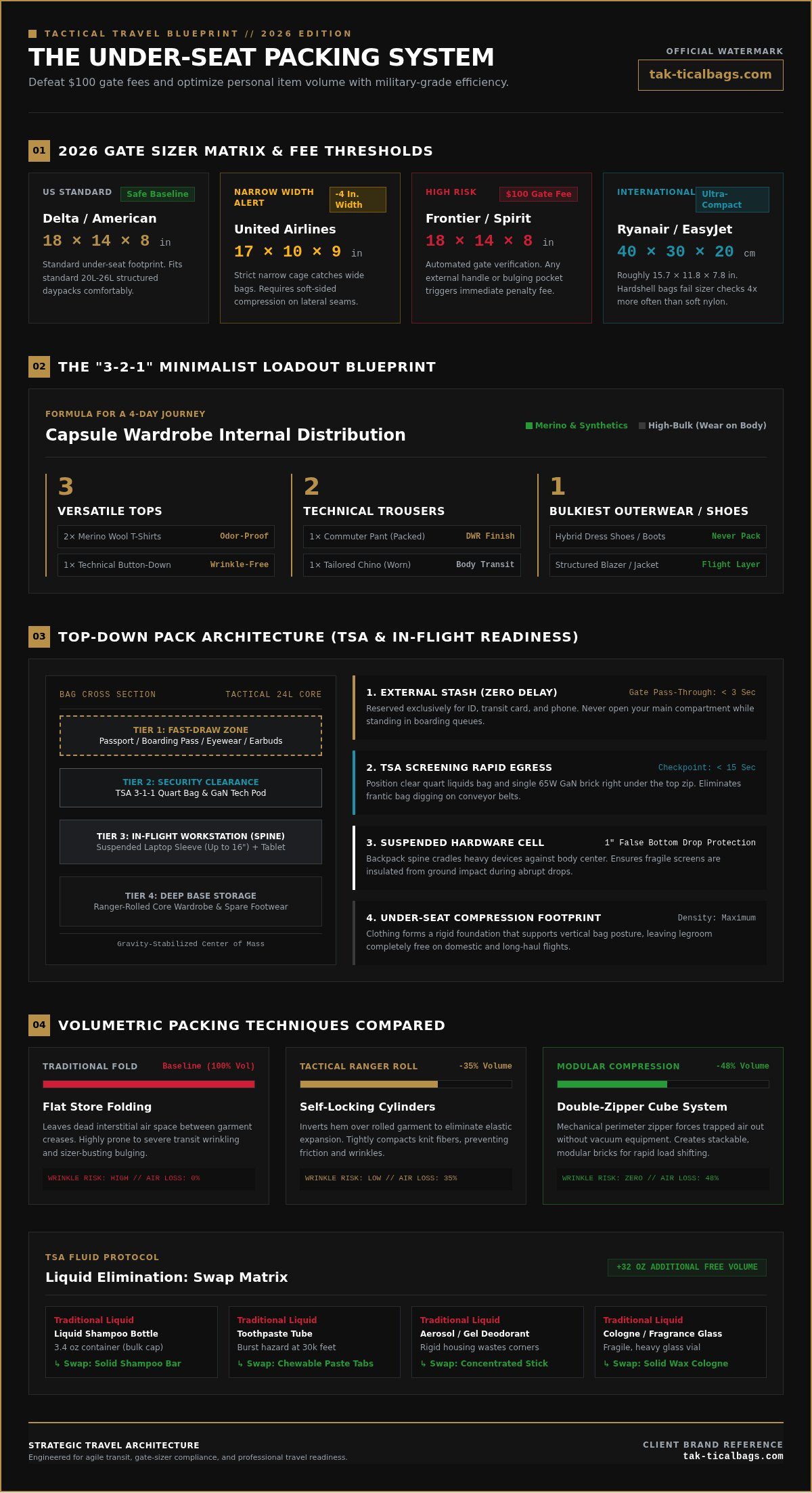
Standard dimensions generally hover around 18 x 14 x 8 inches for major US carriers like American and Delta. However, precision is mandatory. United Airlines enforces a narrower 10-inch width, specifically 17 x 10 x 9 inches, which often catches travelers off guard. Understanding airline hand luggage allowances is the first step toward seamless travel. If your bag fails the "sizer" test, budget carriers like Frontier may charge up to $100 at the gate. Unlike rigid hardshell cases, soft-sided backpacks can be manipulated to fit these unforgiving metal bins.
Airline-Specific Nuances for 2026
Carrier policies are increasingly automated. Budget airlines use strict enforcement to drive revenue, often requiring every passenger in basic economy to prove their bag fits the sizer before boarding. International travel adds another layer of complexity. European carriers like Ryanair limit free bags to 40 x 30 x 20 cm, which is significantly smaller than domestic US standards. Always remember the "one bag" rule. Your laptop sleeve or small purse must fit inside your primary bag during boarding. Disorganization here leads to delays and unexpected costs.
Why Soft-Sided Backpacks Win
Flexibility is the ultimate advantage. Soft-sided bags compress into irregular spaces, accommodating seat struts or entertainment boxes that often obstruct under-seat storage. They also offer a significant weight advantage. Every pound saved on the bag itself is a pound you can use for essentials. Mastering how to pack a personal item bag involves selecting gear that yields to the environment. Beyond the airport, a well-designed backpack provides superior comfort during city transitions, keeping your hands free and your movement fluid. Tactical-style durability ensures these bags survive the rigors of urban travel while maintaining a professional aesthetic.
Curating Your Minimalist Packing List
Minimalist travel isn't about deprivation. It's about intentionality. When mastering how to pack a personal item bag, every gram must earn its place. Start with the 3-2-1 rule. Pack three versatile tops and two pairs of trousers. Wear your bulkiest shoes on the plane. This foundation provides enough variety for a four-day trip while maintaining a slim profile. Focus on high-performance fabrics. Merino wool and synthetic blends resist odors and wrinkles, allowing you to cycle through outfits without a laundry stop. These materials compress easily, ensuring your bag remains within under-seat limits.
Prioritize tech integration over volume. A universal charging kit with a single high-wattage GaN charger replaces a tangled mess of cables. For hygiene, adhere strictly to the TSA 3-1-1 liquids rule. Limit containers to 3.4 ounces (100 ml) and consolidate them into a clear quart-sized bag. Many travelers now bypass these limits by switching to solid formulations for shampoo, toothpaste, and deodorant. This move saves space and accelerates your movement through TSA checkpoints. Every fluid ounce removed from your kit is more room for essential hardware.
The Professional Carry Essentials
Hardware protection is non-negotiable for the modern professional. Use backpacks with dedicated, padded compartments to shield your laptop from impact and compression. Keep essential travel documents like passports and boarding passes in secure, external-access pockets. This ensures you aren't digging through your main compartment at the gate. Choose transition gear that works double duty. A tailored blazer or clean-cut tech jacket provides warmth during the flight and a polished look for your first meeting upon arrival. Refined aesthetics allow your gear to blend into professional settings effortlessly.
Eliminating the 'Just in Case' Items
Redundant gear is the enemy of the minimalist traveler. Audit your bag for "just in case" items that rarely leave the pocket. If you haven't used it on your last three trips, leave it behind. Replace physical books, maps, and printed documents with digital versions stored on your tablet or smartphone. If an item is particularly heavy or bulky, wear it during boarding. The "Wear Your Bulk" strategy utilizes your jacket pockets for power banks or heavy tech accessories. This keeps your bag weight within the strict limits enforced by airlines in 2026 while maximizing your internal storage capacity.
Strategic Packing Techniques for Maximum Volume
Space is a finite resource. Mastering how to pack a personal item bag requires more than just folding. It demands a tactical approach to density. You aren't just filling a bag; you're engineering a load-out. Effective packing transforms a standard 20-liter backpack into a high-capacity travel system that rivals a small carry-on. The goal is to eliminate wasted air and create a modular environment where every item has a dedicated purpose and location.
The Art of the Roll
The 'Ranger Roll' is the gold standard for maximizing density. Lay your garment flat. Fold the bottom two inches inside out to create a small cuff. Fold the sides inward to meet the center. Roll tightly from the top down and tuck the entire roll into the bottom cuff. This method eliminates air pockets and prevents deep creases during transit. Tech-fabrics and performance blends roll better than heavy cotton because they are thinner and more resilient. Bundle packing offers an alternative strategy. Wrap larger items around a core of smaller essentials to maintain a consistent, rounded shape that slides easily into your bag without creating bulk.
Modular Compression
Packing cubes are non-negotiable for the minimalist traveler. They function as internal drawers, keeping your gear categorized and compressed. High-quality nylon cubes allow you to squeeze out excess air, saving 20 to 30 percent of your total volume. This modularity ensures your bag remains organized even after multiple airport transitions. You can extract one cube without disturbing the rest of your kit. For a deeper look at refining your setup for daily and travel use, explore The Art of the Everyday Carry Backpack. These systems prioritize readiness and efficiency.
Balance is essential for long-term comfort. Place heavy items like laptops and charging kits flush against the back panel. This keeps the center of gravity near your body and reduces strain on your shoulders. It also provides a layer of protection for your hardware against external impacts. Utilize every inch of 'dead space' by filling corners or the inside of spare shoes with rolled socks and charging cables. Accessibility is also a critical safety requirement. Ensure your power banks and lithium batteries are easily reachable, as they must remain in the cabin per FAA PackSafe guidelines for carry-on electronics. These regulations exist to mitigate thermal risks. A strategically organized bag is both efficient and compliant with modern aviation standards.
Organizing for Seamless Transitions and In-Flight Access
Movement through an airport should be a study in composure. A disorganized bag creates friction at the TSA belt and frustration in the cabin. Mastering how to pack a personal item bag requires a top-down strategy. Place your liquids bag and electronics at the very top of the main compartment. This allows you to clear the security belt in under 60 seconds without digging through your belongings. Use external side pockets for items requiring immediate reach, such as a water bottle or a compact umbrella. Efficiency is the ultimate travel luxury.
The cabin environment is often cramped and restrictive. Don't fight your bag under the seat mid-flight. Create a "small kit" for your seat pocket before you board. Include noise-canceling headphones, a sleep mask, and essential charging cables. This small preparation prevents you from blockading the aisle while searching for a charger. It ensures your flight is as productive or restful as intended.
The Tech Transition
Hardware access must be instantaneous. A well-designed bag features a dedicated, rear-access laptop sleeve. You shouldn't have to unpack your clothing to reach your computer during a layover. For a deeper dive into selecting the right gear for these high-stakes environments, consult A Sophisticated Approach to Laptop Bags. Proper cable management is equally vital. Use internal mesh pockets or a small tech pouch to prevent a tangled mess at the bottom of your bag. Organized tech protection is the cornerstone of professional readiness.
Maintaining Professionalism
Your bag is a visible extension of your professional image. Keep the exterior clean, understated, and free of dangling straps. In a small bag, managing laundry is a significant challenge. Use a lightweight, odor-trapping bag to separate worn items from clean ones. Finally, pack a "Landing Gear" kit. This small pouch should contain a face mist, toothbrush, and a fresh shirt. Refresh your appearance in the airport lounge immediately after deplaning. You'll arrive at your first meeting looking composed rather than travel-worn. Elevate your travel experience with high-performance backpacks designed for the modern professional.
Choosing the Right Tactical Carry for Your Journey
The vessel you choose dictates the success of your strategy. While fashion-forward leather bags or standard retail backpacks might offer aesthetic appeal, they often lack the structural integrity required for high-density packing. The choice of vessel determines how to pack a personal item bag effectively. Tactical-style durability is essential for the modern traveler. High-denier fabrics, such as ballistic nylon or reinforced polyester, provide a rigid frame that resists tearing and abrasion. These materials maintain their shape even when compressed, ensuring your gear remains protected and your bag fits the sizer every time.
Organization is the antidote to the "black hole" effect. A bag with multiple dedicated compartments allows for the modularity discussed in previous sections. You need a layout that separates tech, clothing, and small essentials without requiring a total unpack. This versatility is what allows a single bag to transition from a flight to a professional boardroom or even a weekend hike. By balancing tactical utility with urban sophistication, you project an image of composed readiness regardless of the environment.
Functional Excellence in Design
Comfort is a primary metric of quality. Padded shoulder straps and integrated back ventilation are critical for navigating long airport transits or city walks. These features distribute weight evenly, preventing the fatigue often associated with over-packed bags. Reinforced grab handles are equally vital. They allow for quick retrieval from under-seat storage or overhead bins during tight connections. For those who require a bag that bridges the gap between professional life and outdoor adventure, consider the principles of Tactical Design for the Modern Citizen. These designs prioritize functional excellence without sacrificing a sleek, minimalist profile.
The Tak-tical Philosophy
Our philosophy is rooted in intentional design. We believe that everyday carry should empower the user through organized calm and modern reliability. Every pocket, zipper, and strap serves a specific purpose in your journey. We build gear for the professional who understands that efficiency is an asset. Mastering how to pack a personal item bag is only half the battle; the other half is carrying a bag that works with you, not against you. We invite you to explore our full range of carry-on bags and backpacks to find the perfect partner for your next transition. Elevate your travel standards with gear built for utility, durability, and refined style.
Master Your Travel Transition
Mastering the under-seat space is about reclaiming control over your journey. You've learned how to navigate the strict 2026 airline dimensions and how to pack a personal item bag using modular techniques like the Ranger Roll. These strategies ensure you bypass the luggage carousel and move through security with professional composure. By prioritizing density and accessibility, you eliminate the friction of modern air travel. Every item in your bag now serves a specific purpose, allowing you to focus on the destination rather than the logistics.
Success depends on gear that matches your intent. You need a solution that balances refined minimalist design with durable tactical-style construction. Optimized for modern tech protection, our backpacks and laptop bags provide the reliability required for a high-paced, mobile lifestyle. Explore Tak-tical's range of functional carry-on bags to find a partner that understands the demands of professional travel. Elevate your daily carry and arrive at your next meeting with a sense of organized calm. Your journey is waiting; travel with purpose.
Frequently Asked Questions
What counts as a personal item bag on most airlines?
A personal item is any bag that fits entirely under the seat in front of you during flight. Common examples include small backpacks, laptop bags, and purses. While standard dimensions for US carriers like American Airlines are 18 x 14 x 8 inches, United Airlines requires a narrower 17 x 10 x 9 inches. Soft-sided bags are preferred because they compress to fit into rigid gate sizers and accommodate under-seat obstructions.
Can I fit three days of clothes in a personal item backpack?
You can easily fit three days of clothing in a high-capacity personal item backpack by utilizing the 3-2-1 rule. Pack three tops and two bottoms while wearing your bulkiest shoes. Mastering how to pack a personal item bag involves using compression cubes to eliminate excess air and rolling garments tightly. This modular approach maximizes internal volume, leaving enough room for your tech essentials and a small toiletry kit.
What is the 3-1-1 rule for packing liquids in a personal item?
The TSA 3-1-1 rule mandates that all liquids, gels, and aerosols must be in containers of 3.4 ounces (100 ml) or less. These containers must fit inside a single, clear, quart-sized plastic bag. Only one bag is permitted per passenger. To save space in your under-seat bag, consider switching to solid toiletries like shampoo bars or toothpaste tablets. This avoids the liquid restriction entirely and speeds up security transitions.
How do I keep my clothes from wrinkling when rolling them?
Prevent wrinkles by using the Ranger Roll method to create tight, uniform cylinders that resist shifting. Smooth each garment flat before rolling to ensure no internal creases are trapped. Selecting performance fabrics like merino wool or synthetic blends also helps, as these materials naturally resist wrinkling better than heavy cotton. Avoid overstuffing your packing cubes, as excessive pressure can set deep lines into the fabric during long flights.
Is a backpack better than a small rolling suitcase for a personal item?
Backpacks are generally superior to small rolling suitcases for under-seat travel. They offer greater flexibility to compress into tight spaces and lack the heavy internal frames and wheels that consume valuable packing volume. A well-designed backpack keeps your hands free and moves seamlessly through crowded terminals. Tactical-style backpacks provide the durability needed for urban environments while maintaining a professional aesthetic that fits into office settings better than bulky luggage.
Will my 16-inch laptop fit in a standard personal item bag?
Most modern 16-inch laptops will fit in a standard personal item bag, provided the bag features a dedicated, padded laptop compartment. Since 16-inch devices often measure approximately 14 inches in width, they slide easily into the 18-inch height of a standard pack. Always verify that the bag's laptop sleeve is suspended from the bottom to protect your hardware from impact when you set the bag down on hard surfaces.
How do I avoid overpacking my under-seat bag?
Avoid overpacking by auditing your "just in case" items and removing anything you haven't used on previous trips. Use a strict packing list and stick to a neutral color palette to maximize outfit combinations. If your bag feels tight, wear your heaviest layers and bulkiest shoes during boarding. Learning how to pack a personal item bag effectively means prioritizing modular essentials that serve multiple purposes throughout your journey.