
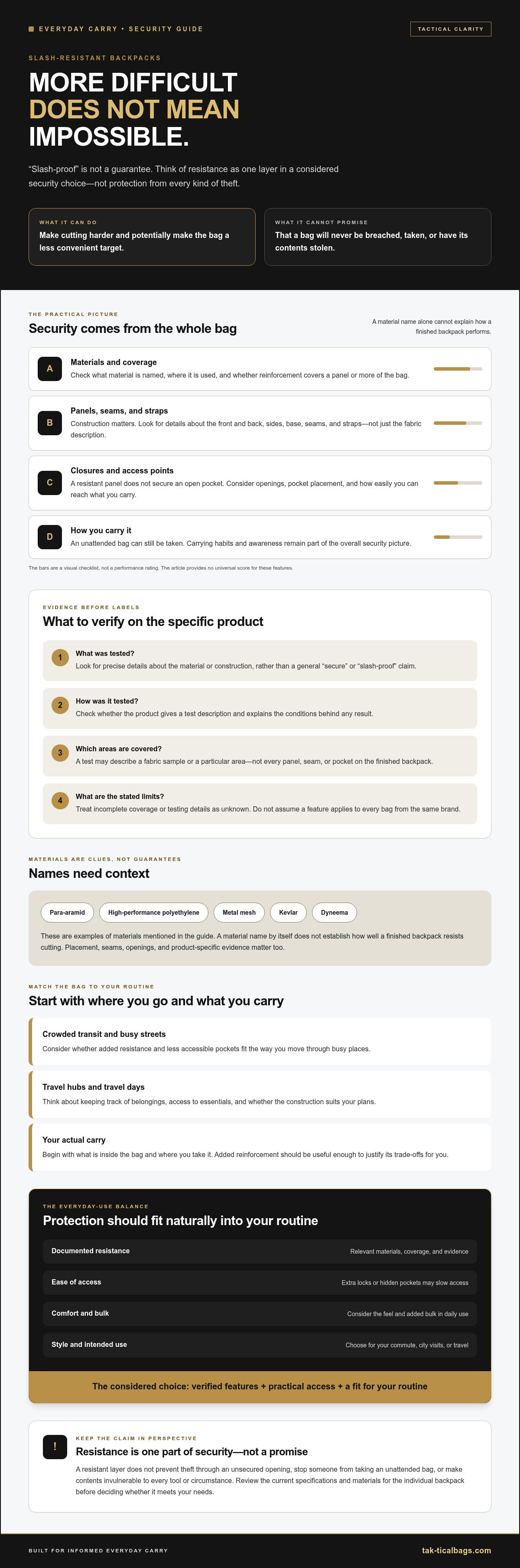
A “slash-proof” label sounds definitive. It isn’t. A slash proof backpack is better understood as a layered deterrent: slash-resistant fabrics or reinforced straps may make cutting harder, but no bag can promise it will never be breached or stolen. That distinction matters in crowded stations, busy streets, and travel days when you need security without sacrificing ease of movement.
It’s reasonable to expect clear answers from a security claim. Yet materials and construction can be difficult to compare, and extra locks or hidden pockets may slow access or add bulk. The right choice depends on what you carry, where you go, and how much protection fits naturally into your routine.
This guide explains what slash-resistant construction can and can’t do, then gives you a practical checklist for evaluating fabrics, seams, straps, closures, comfort, and access. You’ll learn which features address different risks, what to verify in individual backpack specifications, and how to balance security with everyday style. The goal isn’t to find an impossible-to-cut bag. It’s to choose a considered backpack that suits your commute or travel plans, and use it with sensible awareness.
Key Takeaways
- A slash proof backpack is designed to make cutting more difficult, not impossible. Treat the label as a prompt to check the evidence behind the claim.
- Look beyond fabric descriptions. Reinforcement coverage, seams, straps, and access points all contribute to the overall construction.
- Compare documented protection with access, comfort, and intended use to find a bag that fits your routine.
- Start with what you carry and where you go, then compare features relevant to commuting, city visits, or travel days.
- Review current product specifications and materials before deciding whether a backpack meets your needs. Don’t assume a feature applies across an entire brand.
What Does a Slash Proof Backpack Really Mean?
Slash-resistant construction is intended to make cutting a backpack more difficult, not impossible. The phrase “slash-proof” is often marketing shorthand, so look past the label. Check which parts of the bag are reinforced, what the maker says those materials can do, and whether the claim is supported by specific test evidence.
Cut resistance describes only one part of a bag’s security. A resistant panel won’t secure an open pocket or prevent someone from taking an unattended bag. Closures, pocket placement, how the bag is carried, and the wearer’s awareness all affect the overall picture. Verify each feature on the individual product page rather than assuming the claim applies to every bag from a brand.
Slash-resistant versus theft-proof: the practical difference
No backpack can guarantee its contents will never be stolen. A slash-resistant layer may add time or effort to a cutting attempt, potentially making the bag a less convenient target. But it doesn’t stop theft through an unsecured opening, prevent someone from taking the bag, or make its contents invulnerable to every tool or circumstance.
Resistance is not the same as guaranteed protection. Treat absolute-sounding language with care. Look for precise descriptions of the tested material or construction, the area it covers, and the conditions behind any test results. General statements such as “secure” or “slash-proof,” without supporting detail, don’t tell you how a specific bag performs.
Materials used for cut resistance vary. For background on examples such as para-aramid, high-performance polyethylene, and metal mesh, see this overview of cut-resistant materials. A material name alone doesn’t establish how well a finished backpack resists cutting. Placement, seams, openings, and construction matter too.
Who may benefit from a slash-resistant backpack?
Added resistance may be worth considering if your routine regularly takes you through crowded transit, busy streets, or travel hubs, where keeping track of your belongings can take extra attention. It may also appeal if you carry items you’d rather make less accessible. These settings don’t mean theft is inevitable, and travelers don’t all face the same level of risk.
Start with your own routine. Consider where you carry the bag, what’s inside, and whether added reinforcement would be useful enough to justify trade-offs in weight, comfort, access, or style. A slash proof backpack should match your needs, not just a security label. Review current product specifications and materials before deciding whether a particular backpack offers documented features relevant to you.
Which Materials and Construction Details Affect Slash Resistance?
A fabric name can start the conversation, but it can’t tell you how a finished backpack will perform. Slash resistance depends on how materials are selected, positioned, joined, and integrated with the bag’s openings. A reinforced panel may offer different coverage from a bag built with protective material throughout. Either description needs product-specific detail to be useful.
Material choice matters, but construction determines where that protection actually reaches. Research such as the University of Bolton’s slash-resistant fabric research can help explain how protective textiles are developed and tested. It doesn’t establish how a particular backpack performs. For that, look for evidence tied to the finished product, including what was tested, how it was tested, and any stated limits.
How fabric claims and reinforcement should be evaluated
Names such as Kevlar or Dyneema may sound reassuring, but they aren’t proof of a finished bag’s protection. Check whether the product identifies its fabric composition, where that material is used, and what supporting test evidence applies to the specific construction. If a page names a material without explaining coverage or testing, treat the claim as incomplete rather than assuming a level of cut resistance.
Pay attention to the test description and its limitations. A result may relate to a fabric sample or a specific area, not every panel, seam, or pocket on the backpack. Don’t compare material names as if they establish a universal ranking. Rely on documented product-level evidence where it’s available.
Why seams, panels, and access points matter
Map the bag’s likely weak points before deciding whether its construction suits your needs. Look for details on the front and back panels, sides, base, seams, straps, and pockets. If reinforcement covers only selected panels, find out which ones. Product photos may help you locate those areas, but photos alone can’t confirm the material or its performance.
Access matters too. A reinforced body won’t secure contents if a pocket is easy to reach or a closure is left open. Consider how compartments open, where they sit, and whether you can keep important items positioned thoughtfully. Protection is a system, not a fabric label.
Use this checklist as you compare a slash proof backpack:
- Material: Is the composition identified?
- Coverage: Which panels or components are reinforced?
- Evidence: Is testing described for the finished product, with limitations?
- Construction: Are seams, sides, pockets, and closures addressed?
Use the same questions when reviewing backpack specifications and materials. Check each product individually. Slash-resistant materials or features are not confirmed across Tak-tical’s backpack range.
How to Compare Slash-Resistant Backpacks Without Overlooking Everyday Use
Compare the whole carry experience, not just the security label. A slash proof backpack may offer documented reinforcement yet still be awkward to access or uncomfortable on a long commute. Use the same criteria for each bag, and treat vague claims as unverified until the product details explain them.
A practical checklist for evaluating product claims
Look for named protective panels or reinforced areas, the parts of the bag they cover, and a description of any test method. Check what was tested and what remains unprotected. If the product page says only “slash-resistant” without explaining the construction or evidence, don’t assume a level of performance. Seek clarification or compare it with a bag that provides more specific details.
| Evidence | Coverage | Access | Comfort | Intended use |
|---|---|---|---|---|
| Are materials and test details described? | Which panels, seams, or straps are reinforced? | Can you reach essentials easily, and are openings manageable in a crowd? | How does the loaded bag feel on your shoulders and back? | Does its capacity and layout suit your commute or trip? |
| Is the claim specific to this bag? | Are sides, pockets, and other exposed areas addressed? | Can you keep valuables positioned within view or close to you? | Consider weight, fit, and organization with your usual carry. | Will it handle your expected weather exposure and daily routine? |
Security features beyond slash resistance
Protection is only one part of the comparison. Consider pocket placement, closure design, and how easily you can notice unexpected access. A pocket positioned close to your body may suit crowded travel better than an exposed outer pocket, depending on how you carry the bag. Locks or concealed compartments can deter some access, but they don’t guarantee security.
Balance those details against everyday demands. Extra features may add weight, complicate access, or reduce the space available for work essentials. Think about weather exposure too. Check the product’s own information rather than assuming protective construction also offers weather protection.
For a broader view of daily carry, use an everyday carry backpack guide to clarify what you need to bring, how you prefer to organize it, and what feels comfortable over a full day. Then compare individual backpack specifications. Tak-tical’s backpack category is confirmed, but slash-resistant materials or features are not confirmed across its products, so verify each product page before drawing conclusions.
Choose a Slash-Resistant Backpack for Your Commute or Trip
Choose for the day you actually have, not an imagined worst-case scenario. This decision sequence keeps the choice grounded:
- Define your routine: Note where you go and how long you carry the bag.
- List essentials: Include work items, devices, documents, and travel necessities.
- Assess exposure: Consider crowded transit, busy streets, or times the bag may be out of sight.
- Compare verified features: Check product-specific evidence, coverage, access, fit, and construction.
Local conditions and personal habits vary. A feature that matters on a packed commute may be less useful on a short drive or an open-air excursion. Broader trip-planning criteria can also help. Use a work and travel backpack guide to think through capacity, organization, and how your bag will move between settings.
For daily commuting and work
Start with comfort and routine. If you carry a laptop, charger, lunch, and a few personal essentials, look for a size and layout suited to that load. Check how the bag sits when full and whether frequently used items are easy to reach. Think about when it’s exposed to crowded transit and whether you leave it out of sight during the workday. A best backpacks for work guide can help you weigh workplace needs alongside carry comfort.
For city travel and busy transit
Notice how the backpack rests against your body and where its compartments open. In crowded places, convenient access to documents, a device, or travel essentials can matter as much as added security features. Plan where you’ll keep important items, and consider whether you can check the bag easily as you move. For a flexible daily setup, an everyday carry backpack guide can help clarify what you need close at hand.
For travel days, account for transitions: carrying the bag through a station, setting it down while checking information, and keeping essentials accessible in transit. Compare the bag’s verified protective details with its comfort and organization. A slash proof backpack label alone won’t show whether those trade-offs suit your journey. Check the specifications for the particular backpack you’re considering. Slash-resistant materials or features are not confirmed across Tak-tical’s range.
Explore Tak-tical’s backpacks and review each product’s current specifications and materials before deciding whether it fits your routine.
How to Make a Confident Slash-Resistant Backpack Purchase
A confident choice starts with clear expectations. A slash proof backpack label isn’t enough on its own. Before purchasing, compare the specific bag’s documented features with what you carry, where you use it, and how you prefer to access your essentials.
Questions to resolve before choosing a bag
Use this checklist to keep the decision practical:
- What needs protection? List your daily essentials and identify which items you want to keep close or less accessible.
- Where will you use the backpack most? Consider your commute, travel routine, and whether the bag may be left out of sight.
- Are the protection claims specific? Look for exact material descriptions, reinforced areas, coverage details, and evidence tied to the product. If anything is unclear, ask the seller rather than guessing.
- Does it fit your carry? Review dimensions, capacity, compartment layout, and how the bag is designed to sit when loaded.
- Can you use and care for it comfortably? Check closure access and the care guidance provided for the materials.
- Have you reviewed the return terms? Read the current policy before buying so you understand the applicable conditions.
Read the current product page closely. A feature described for one backpack doesn’t automatically apply to every bag from the same retailer or brand. If testing is mentioned, check what was tested and what the result does not establish.
Browse backpacks with clear expectations
Tak-tical sells backpacks and other functional bags, but slash-resistant materials, tests, or security features are not confirmed across its backpack range. That distinction matters: a product should only be described as slash-resistant when its own specifications provide support. If details aren’t available, treat the protection claim as unverified.
Use the criteria in this guide to compare current product information, then decide which features suit your needs for fit, organization, access, and construction. A well-chosen bag should work with your routine, not rely on a security promise it can’t substantiate. Browse Tak-tical backpacks and review each product’s specifications and materials before deciding whether it’s the right fit.
Choose With Clarity, Then Carry With Confidence
The best choice is the backpack that fits your routine and makes its protective claims clear. A slash proof backpack label alone can’t establish how a bag performs. Look for product-specific evidence, check where any protective construction is used, and weigh those details against fit, access, and the items you carry.
Tak-tical sells backpacks through its online store, but slash-resistant materials or security features are not confirmed across its products. Review each product’s current specifications before drawing conclusions. That careful comparison helps you choose based on what’s documented, not on a broad promise.
Explore Tak-tical backpacks and verify the materials and features listed for each bag. A considered choice can support a more organized, comfortable day, wherever your routine takes you.
Frequently Asked Questions
Is a slash-proof backpack really impossible to cut?
No. A slash-proof label doesn’t mean a backpack is impossible to cut. Resistance can make cutting more difficult, but it doesn’t establish protection against every blade, angle, amount of force, or method. Review the specific product’s construction, which areas were tested, and the evidence provided. Even with documented resistance, stay aware of your surroundings and keep the backpack securely positioned and handled.
Can a slash-resistant backpack prevent pickpocketing?
No. Cut-resistant construction addresses one possible way someone might try to access a bag, not every form of theft. Pocket placement, closures, how you wear the backpack, and how closely you monitor it all matter. In crowded settings, consider whether important items sit near your body and whether compartments are easy to check. Choose features that make access more visible or difficult, but don’t treat them as a guarantee.
What materials are used in slash-resistant backpacks?
Products may use different fabrics, reinforcements, or layered construction. The material name alone doesn’t establish how a finished backpack performs. Check the product’s specifications for composition, where protective layers are placed, which areas they cover, and whether testing is described. A material used in cut-resistant gear isn’t proof that a particular bag resists slashing. Look for evidence specific to the backpack’s construction before relying on a claim.
How can I tell whether a backpack is genuinely slash-resistant?
Look for product documentation that identifies protective areas, materials, construction, and testing. Stronger descriptions explain what was tested and what the results cover. Broad labels without those details are difficult to compare and shouldn’t be treated as proof. Ask the retailer specific questions if information is missing, such as whether testing applies to the finished bag or only a material sample. Separate documented product facts from general marketing language.
Are slash-resistant backpacks comfortable enough for everyday use?
They can be, but comfort depends on the individual bag and how you carry it. Consider fit, weight, strap design, ventilation, capacity, and how the backpack feels once packed with your usual items. Protective construction may affect these qualities, though the impact varies by product. Check dimensions and specifications, then compare them with your commute length, daily load, and need to reach essentials easily. A security feature is only useful if the bag works for your routine.
Should I choose a slash-resistant backpack for commuting or travel?
That depends on your routine, exposure to crowds, what you carry, and your personal priorities. Someone who often moves through busy transit may weigh protective features differently from someone who rarely carries a bag in crowded spaces. Compare any documented security details with comfort, organization, and access. You don’t need to choose a feature just because it’s marketed. First identify where you’ll use the backpack, then review evidence for the specific product.
What should I check before buying a slash-resistant backpack?
Check documented claims, protective coverage, material details, seams, closures, fit, capacity, and the seller’s current return terms. Clear evidence matters more than a dramatic label. Confirm which parts of the bag are covered and what any test actually demonstrates. Review the current product page, or ask the seller about details that aren’t explained. Compare each backpack individually rather than assuming a feature applies across a retailer’s full range, including Tak-tical’s online selection.