
Why should your high-performance gear feel like a compromise once you leave the trailhead? You've likely experienced the physical fatigue of a heavy, unbalanced load or the frustration of flimsy materials failing under pressure. It's an old dilemma. Most outdoor gear looks out of place in professional settings, while urban bags lack the grit for a steep ascent.
You deserve a seamless transition. Finding the right functional hiking daypacks means prioritizing both technical precision and a sophisticated silhouette. This is about quiet empowerment and readiness. We'll show you how to select a pack that balances elite performance with a minimalist aesthetic, ensuring you move with effortless efficiency from the city to the summit.
The landscape of gear is shifting toward smarter, more sustainable choices. We'll preview the best models for 2026, focusing on ergonomic load dispersal and advanced, PFC-free materials. Discover how to simplify your packing and elevate your daily journey with a bag built for every environment.
Key Takeaways
- Modern daypacks have evolved from clunky gear into streamlined tools for purposeful readiness.
- Identify high-tenacity fabrics and reinforced stress points that define the most durable functional hiking daypacks for 2026.
- Match your pack's liter capacity to your mission profile. You'll carry exactly what's needed without added bulk.
- Apply the "Center of Gravity" rule to optimize weight distribution for a stable and quiet carry.
- Select a pack that transitions seamlessly between rugged trails and professional environments through minimalist design.
The Evolution of the Functional Hiking Daypack
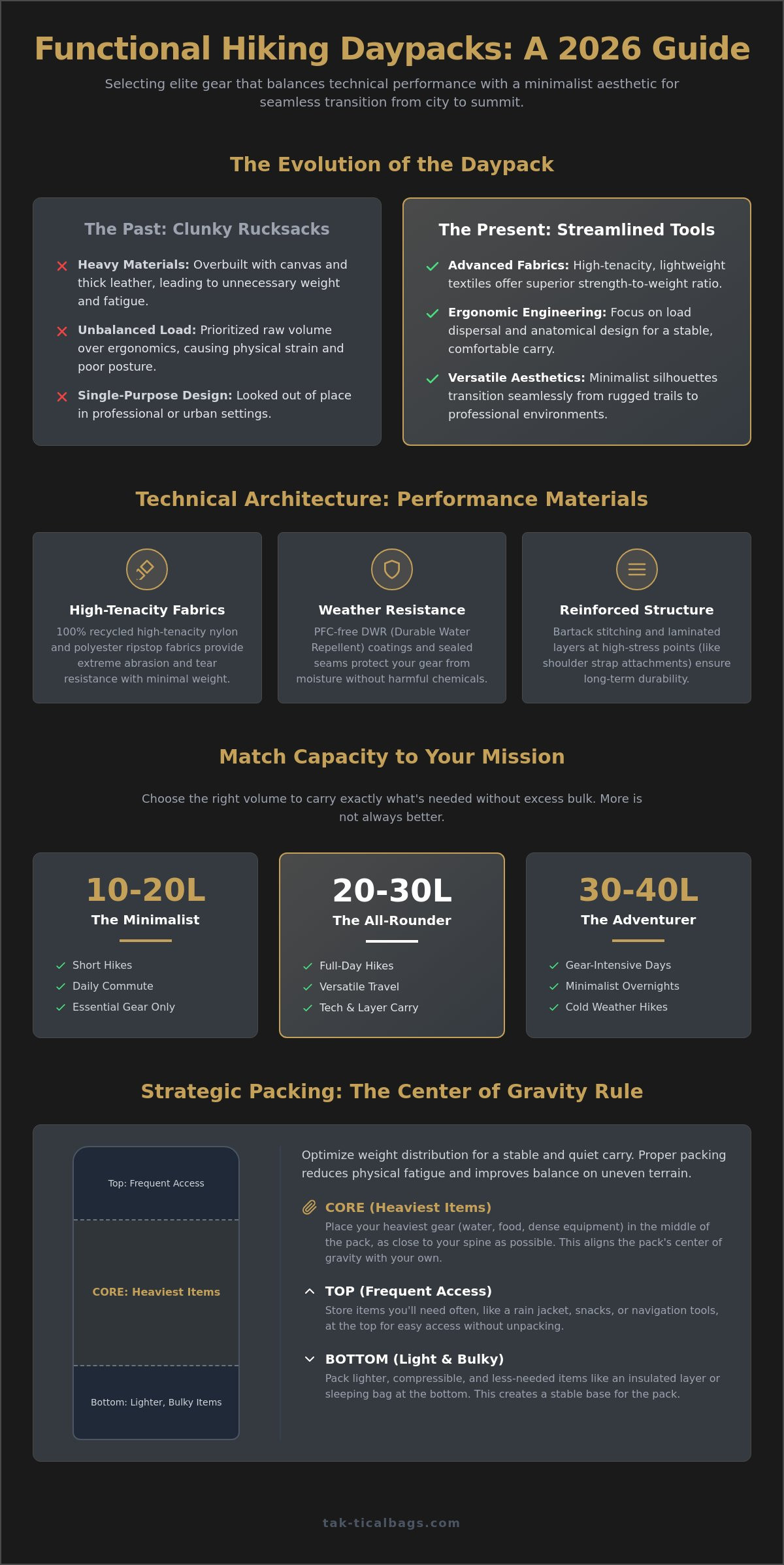
The modern daypack is a tool for purposeful readiness. It's no longer just a container for gear; it's an extension of the body designed for movement. Historically, outdoor equipment relied on heavy, clunky rucksacks that prioritized raw volume over user experience. These bags were often overbuilt, sagging under their own weight and creating unnecessary physical strain. Today, the design philosophy has shifted. We've entered an era of streamlined silhouettes and movement-focused engineering.
This evolution reflects a change in our daily lives. Technical excellence is now a lifestyle standard. You expect your gear to match your pace, providing reliability without the bulk. Choosing functional hiking daypacks is a strategic decision to prioritize efficiency. It's about moving through the world with organized calm, knowing your equipment is as prepared as you are.
From Trail to Town: The Versatility Shift
Modern citizens demand gear that performs in every environment. A pack that works on a ridgeline should also feel at home in a professional setting. This versatility is driven by a need for integration. You shouldn't have to swap your entire kit because your surroundings changed. Minimalist, high-performance silhouettes offer an aesthetic benefit that traditional gear lacks. They project a sense of quiet confidence and urban innovation.
Because of this, technical day hiking rucksacks have become the new standard for commuters and travelers alike. They offer the durability of mountain gear with the sleekness required for city life. This shift isn't just about fashion; it's about the practical reality of a mobile, fast-paced existence. You need one bag that does it all, maintaining its integrity from the morning transit to the weekend summit.
Why Weight and Ergonomics Matter
Clutter creates mental noise. A lightweight, clutter-free carry provides a psychological edge, allowing you to focus on the journey rather than the burden. When you use functional hiking daypacks, you benefit from advanced materials that resist abrasion without adding unnecessary ounces. Every gram saved is energy preserved for the miles ahead.
Ergonomics are equally critical. Well-designed shoulder straps and back panels reduce physical fatigue by working with your anatomy. Proper load distribution ensures that weight sits close to your center of gravity, maintaining your natural physical posture. This prevents the slouching and back strain common with inferior bags. By prioritizing these technical details, you ensure that your gear supports your physical health and mental clarity throughout the day.
Technical Architecture: Materials that Define Performance
Technical excellence isn't accidental. It's the result of rigorous material selection and intentional engineering. In the past, durability meant heavy canvas and thick leather. Today, the standard has shifted toward high-tenacity fabrics that provide extreme abrasion resistance without the bulk. These materials offer a superior strength-to-weight ratio, ensuring your gear remains resilient through years of use. Choosing functional hiking daypacks built with these advanced textiles is the first step toward a reliable carry.
Longevity is also found in the details. Reinforced stress points are critical for long-term reliability. Bartack stitching and laminated layers at load-bearing areas prevent the premature failure common in mass-market bags. This architectural focus ensures that your pack remains a stable partner, whether you're navigating a rocky ridge or a crowded terminal.
High-Tenacity Fabrics and Weather Resistance
Modern performance relies on ripstop and composite materials. For 2026, the industry has moved toward bluesign® approved, 100% recycled high-tenacity nylon and recycled polyester ripstop. These fabrics are engineered to stop punctures from becoming catastrophic tears. For the strategic traveler, a water-resistant shell is a baseline requirement. Your digital assets and layers depend on a shell treated with PFC-free DWR coatings that repel moisture effectively.
The back panel requires a delicate balance. It must provide enough structure to protect the bag's contents while offering the breathability needed for high-output movement. Advanced 3D-mesh and ventilated foam systems ensure airflow, preventing the heat buildup that leads to discomfort during long days on the move.
Minimalist Hardware and Component Design
Hardware should be invisible until it's needed. Bulky buckles and oversized zippers are relics of an older era. Premium functional hiking daypacks now utilize low-profile, purposeful zippers that slide smoothly and resist snagging. This minimalist approach reduces overall weight and maintains the bag's clean aesthetic.
Compression straps are another vital component of a refined design. They allow you to cinch the load, maintaining a slim profile even when the bag isn't full. This prevents gear from shifting, which is essential for maintaining your center of gravity. Component efficiency is the hallmark of a premium daypack; every buckle and strap must serve a specific purpose. If you value this level of detail, consider browsing our latest purpose-built backpacks. This commitment to technical architecture ensures your gear performs at the highest level without sacrificing style.
Determining Your Mission Profile: Capacity and Volume
Your mission dictates your gear. Selecting the right volume isn't about maximizing space; it's about optimizing efficiency. Choosing functional hiking daypacks requires an honest assessment of your environment and duration. A bag that is too large invites overpacking, which leads to physical fatigue and unnecessary clutter. Conversely, a bag that is too small leaves you vulnerable to changing conditions. The goal is to find the exact point where capacity meets necessity.
Adopt a "less is more" approach to your carry. Every liter of capacity should serve a specific purpose. In technical settings, load stability is paramount. Even a smaller pack must sit perfectly against the back to prevent shifting during rapid movement. Load stability in these smaller technical packs is non-negotiable. Without a full internal frame, the bag relies on its own geometry and compression systems to keep the weight centered. This prevents the pendulum effect, where a loose bag sways with every step, wasting energy and causing physical strain. This stability ensures that your focus remains on the path, not the burden on your shoulders.
The Minimalist Carry (10L - 20L)
This range is ideal for fast-paced summits or short urban excursions. It forces a disciplined approach to packing, requiring you to prioritize only the most critical items. You focus on the essentials: hydration, a lightweight shell, and small tech. It's the streamlined choice for those who value maximum mobility and speed. These packs are designed to disappear on your back, providing just enough structural protection for your core kit while maintaining an ultra-low profile that never feels cumbersome in a crowd.
The All-Day Explorer (20L - 30L)
This is the sweet spot for a versatile day hiking backpack. It provides ample room for extra equipment, food, and comprehensive emergency kits. This volume accommodates the standard essentials comfortably, making it the choice for variable climates where you might start in a fleece and end in a shell. It also provides the depth needed for specialized equipment like a mirrorless camera or a robust medical kit.
For many, this volume is the ultimate bridge between environments. It transitions perfectly into a reliable carry-on for global travel, fitting easily into overhead bins while offering enough space for a full day of exploration. This range offers the highest level of integration for the modern professional who travels strategically. It allows for organized calm, giving you the capacity to be prepared for any scenario without sacrificing a sophisticated, urban-ready silhouette. When you invest in functional hiking daypacks of this size, you're choosing a partner that adapts to your lifestyle, from the morning commute to the most demanding trail.
Strategic Organization: Packing for Efficiency
Organization is a strategic discipline. It transforms a simple container into a precision tool. When you use functional hiking daypacks, the goal is a "quiet carry", a state where gear remains silent and stable regardless of your pace. This level of order provides a distinct psychological benefit. Knowing exactly where your essentials are stored eliminates the friction of searching, fostering a sense of organized calm and mental clarity. By mastering the interior of your pack, you ensure that technical performance is matched by personal efficiency.
The Center of Gravity Rule
Optimal weight distribution is the foundation of comfort. To achieve this, you must place your heaviest items close to the spine and centered between the shoulder blades. This keeps the pack's mass aligned with your own, preventing the bag from pulling you backward or throwing you off balance. Learning how to pack a backpack correctly ensures that even a fully loaded bag feels significantly lighter than its actual weight.
Utilize internal compression systems to lock these heavy items in place. This prevents the load from shifting during sudden movements or steep descents. By securing the internal volume, you maintain a consistent center of gravity, which reduces muscle strain and long-term fatigue. A stable load is a safe load.
Internal vs. External Access
Efficiency is defined by how quickly you can react to your environment. Keep frequently used gear, such as a hydration bladder, a lightweight shell, or high-energy snacks, in top or side pockets. These external or quick-access points allow you to retrieve gear without disrupting the entire bag's organization. You shouldn't have to unpack your life to find a single item.
For valuables and digital assets, secure internal compartments are essential. These pockets should be positioned away from high-impact areas to provide maximum protection. The challenge is maintaining a sleek silhouette while maximizing this storage utility. Premium functional hiking daypacks allow you to hide complex organization behind a minimalist exterior. Avoid the temptation to hang excessive gear on the outside of the pack. External attachment points should be used sparingly for items that are too bulky for the interior or need to dry, such as a damp rain fly.
A well-organized bag is the hallmark of a strategic traveler. It allows for a seamless transition between the trail and the city without looking like you're carrying a cluttered rucksack. If you're ready to upgrade your loadout, explore our collection of meticulously organized hiking bags. This level of purposeful design ensures you remain ready for whatever the journey demands.
Elevating the Journey: The Tak-tical Design Philosophy
Design is a statement of intent. At Tak-tical, we believe that your equipment should reflect your commitment to excellence and organization. We've moved beyond the era of choosing between rugged utility and refined aesthetics. Our philosophy centers on the belief that functional hiking daypacks can be both technically superior and visually sophisticated. We position our gear as the bridge between high-altitude performance and the demands of a fast-paced, mobile lifestyle. This is gear for the modern innovator who values craftsmanship as much as capability.
Every stitch and silhouette is intentional. We strip away the unnecessary, leaving only what serves your mission. This minimalist approach doesn't sacrifice strength; it highlights it. By focusing on the fusion of tactical durability and streamlined style, we provide tools that empower you to move through the world with quiet confidence. Elevate your everyday carry by choosing design that respects your time and your journey.
Purposeful Design for the Modern Citizen
Modern life requires seamless integration. Our hiking bags are engineered to transition from a morning trailhead to a mid-afternoon boardroom without hesitation. We achieve this through sophisticated color palettes and clean, architectural lines that define our aesthetic. These aren't just bags; they're versatile companions for those who demand performance in every environment.
- Clean Silhouettes: Minimalist exteriors that hide complex internal organization.
- Refined Palettes: Muted, professional tones that complement an urban wardrobe.
- Integrated Tech: Dedicated spaces for digital assets alongside outdoor essentials.
We craft for the citizen who refuses to be pigeonholed. Whether you're navigating a transit hub or a mountain pass, your bag should feel like a natural extension of your identity. Purposeful design ensures that your gear is never the limiting factor in your day.
Direct-to-Consumer Excellence
Quality shouldn't be a luxury dictated by retail markups. Our direct-to-consumer model allows us to prioritize premium materials and rigorous testing over middleman fees. Every bag undergoes intense evaluation to ensure it meets the demands of a strategic traveler. We focus on high-tenacity fabrics and precision hardware that stand the test of time, ensuring your investment remains reliable for years to come.
This model allows for a closer connection to our community. We listen to the needs of modern professionals and outdoor enthusiasts to refine our functional hiking daypacks continually. Joining the Tak-tical community means choosing a partner in your daily journey. We remain committed to functional excellence and a "less is more" mentality that honors the reader's time and intelligence. It's time to expect more from your gear. Choose a bag that is as prepared and composed as you are.
Master Your Movement
Your gear should never be a distraction. By prioritizing technical architecture and strategic organization, you transform your pack into a precision tool. You've discovered how the right capacity and weight distribution are essential for maintaining a quiet carry. This balance ensures you move with effortless efficiency, whether navigating city streets or the highest summits. Every detail matters when your kit is an extension of your body.
Selecting functional hiking daypacks is more than a choice of utility; it's an investment in a lifestyle defined by readiness and refined aesthetics. Tak-tical bridges the gap between rugged durability and minimalist sophistication. Our direct-to-consumer model ensures you receive premium quality without unnecessary retail markups. We provide worldwide shipping to support the strategic traveler in every environment.
It's time to refine your loadout and move with purpose. Elevate your journey with Tak-tical hiking bags and experience equipment engineered for both durability and style. Stay organized, stay composed, and embrace the path ahead with absolute confidence.
Frequently Asked Questions
What weight is considered ultralight for a hiking daypack?
Ultralight is typically defined as a pack weighing less than 1.5 pounds for a 20-liter capacity. Modern materials like 100D high-tenacity nylon allow for this weight reduction without sacrificing structural integrity. Choosing an ultralight model enhances your mobility on steep terrain. It's about stripping away unnecessary weight to focus on the journey and maintain a fast pace.
Do functional hiking daypacks lack padding and comfort?
Modern designs use targeted padding to ensure comfort without adding bulk. Systems like 3D-mesh backpanels and ergonomic harnesses distribute weight across your frame efficiently. These functional hiking daypacks prioritize breathability and an anatomical fit over thick, heavy foam. You get a supportive carry that remains comfortable and stable during high-output movement in any environment.
Are technical hiking bags durable enough for daily urban use?
Technical hiking bags are often more durable than standard urban backpacks. High-tenacity fabrics and recycled polyester ripstop are engineered to withstand both rugged trails and daily commutes. These materials resist the abrasion of concrete and the snags of dense brush with ease. Investing in a technical pack ensures a long-term partner that survives the rigors of a fast-paced life.
What size hiking backpack do I need for a full day hike?
A capacity of 20 to 30 liters is ideal for a full day hike. This volume comfortably holds extra layers, a hydration bladder, and essential emergency kits. It provides enough space for your gear without becoming cumbersome or heavy. Choosing this size allows for organized calm during long excursions where weather conditions might change rapidly.
Can I use a hiking daypack as a carry-on for travel?
Most hiking daypacks under 35 liters qualify as standard carry-on luggage for global airlines. Their slim, streamlined profiles fit easily into overhead bins and under seats. This makes them a premium choice for strategic travelers who value integration and efficiency. You can transition from the airport terminal to the trailhead with a single, reliable bag.
How do I clean and maintain a high-performance backpack?
Maintain your pack by hand washing it with mild, non-detergent soap and cold water. Never use a washing machine or dryer. High heat and mechanical agitation can destroy technical DWR coatings and structural foams. Air dry your bag in the shade to prevent UV damage. Proper care ensures your equipment remains a reliable partner for years.
Is a waterproof cover necessary for modern hiking bags?
A waterproof cover is a strategic backup for sustained rain. While many functional hiking daypacks feature water-resistant DWR treatments, these can eventually saturate in heavy, prolonged downpours. A dedicated rain cover ensures your digital assets and dry layers remain protected. It's a small, lightweight addition that provides total peace of mind during unpredictable weather.
What is the difference between a tactical backpack and a hiking daypack?
Tactical backpacks emphasize modularity and heavy-duty load bearing through external webbing and reinforced compartments. Hiking daypacks focus on lightweight ergonomics and breathability for sustained, fluid movement. While tactical bags are built for high-impact durability, hiking packs prioritize your natural physical posture. The hiking pack offers a more refined, minimalist aesthetic suitable for both summits and city streets.