
The overhead bin is a gamble you don't need to take. Waiting for space to clear or watching your bag get gate-checked because of a few extra inches is a relic of inefficient travel. You want to move through the terminal with speed. You want to exit the airport while others are still huddled around the luggage carousel. Securing a backpack that fits under airplane seat requirements is more than a way to avoid hidden baggage fees. It's a strategic move for the modern professional who values autonomy and refined utility.
You deserve a bag that balances tactical durability with a sleek, urban aesthetic. This guide will help you master the art of the personal item. We'll examine how to choose a pack that maximizes every square inch of under-seat space without looking like you're heading into a combat zone. We'll cover essential dimensions for major carriers, organization strategies for your tech, and how to maintain a professional look while traveling light. Prepare to streamline your journey and reclaim your time at the gate.
Key Takeaways
- Master the 2026 airline regulations to avoid overhead bin fees and gate delays.
- Select a 20L to 28L capacity for the ideal backpack that fits under airplane seat requirements.
- Prioritize a tactical-style aesthetic that blends professional refinement with high-performance durability.
- Distribute weight strategically to prevent bag bulging and ensure a seamless fit in the sizer.
- Invest in direct-to-consumer quality that integrates tech protection into a sleek, urban design.
The Personal Item Mandate: Why Under-Seat Carry Wins in 2026
The airline landscape has shifted. By 2026, the overhead bin has become a high-priced commodity rather than a standard convenience. Understanding the distinction between hand luggage stored above and a personal item kept at your feet is essential for the modern traveler. While a carry-on might incur fees and gate-checks, a personal item remains your reliable, free-of-charge companion. It is the tactical advantage that ensures your gear stays with you, not in the hold.
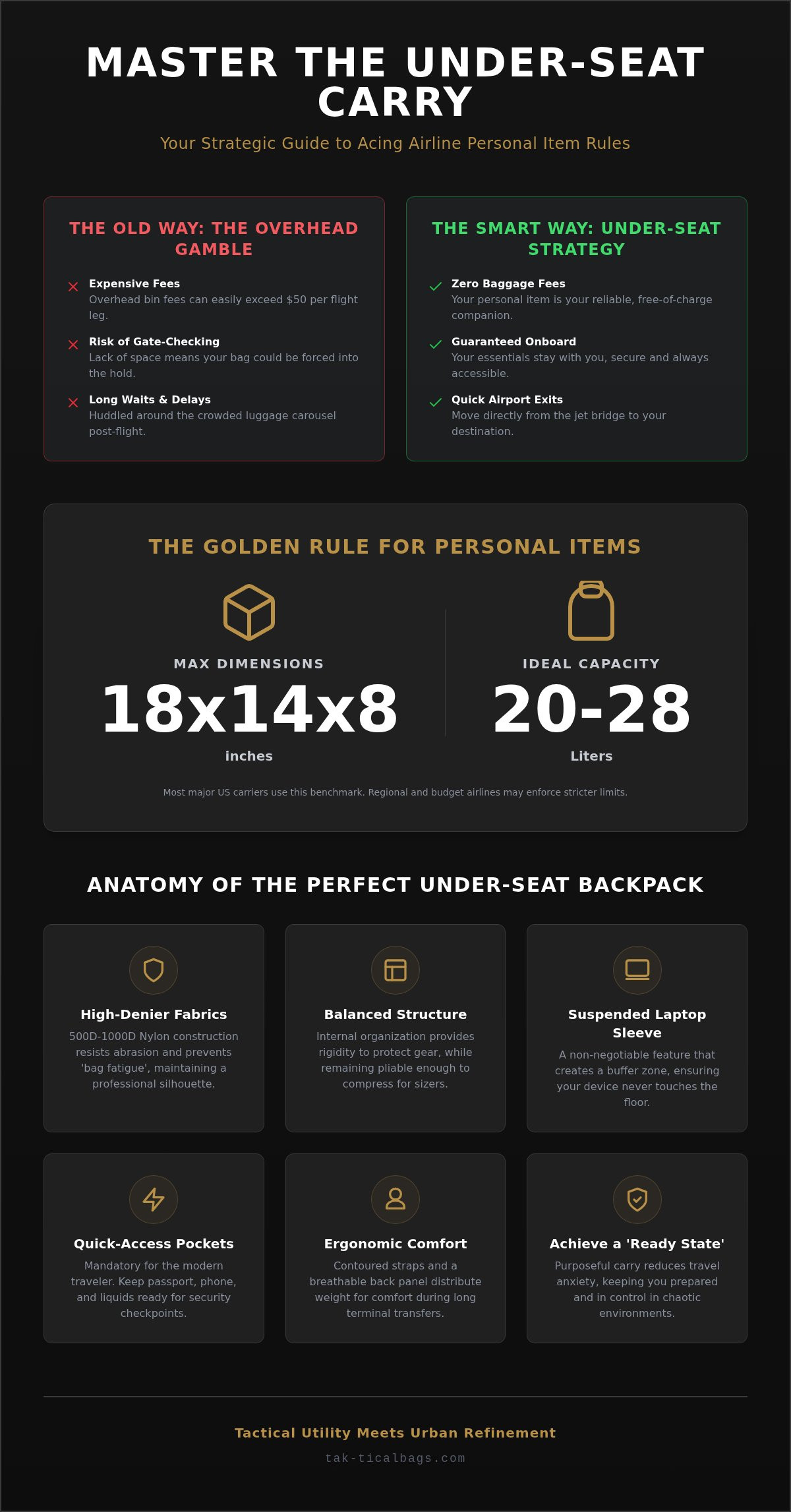
Choosing a backpack that fits under airplane seat dimensions is a financial victory. Overhead bin fees can easily exceed $50 per flight leg, turning a budget ticket into a premium expense. Beyond the cost, you gain the luxury of speed. You bypass the crowded luggage carousel and move directly from the jet bridge to your destination. This 'One Bag' philosophy isn't just about packing less; it's about traveling with purpose and removing the friction of excess gear. Efficiency is the ultimate travel hack.
Standard Airline Dimensions You Must Know
The 18 x 14 x 8 inch benchmark is your golden rule. Most major US carriers use these dimensions to define what constitutes a personal item. However, regional variations exist. Budget carriers in Europe and Asia often enforce stricter limits, sometimes reducing depth or width by several inches. The sizer at the gate is the ultimate judge. If your bag looks bulky, you'll be asked to test it. A backpack that fits under airplane seat requirements should have a soft structure but a defined footprint, allowing you to maximize space while still sliding into the metal sizer during a spot check.
The Psychological Benefit of Purposeful Carry
Travel anxiety often stems from a lack of control. When your essentials are locked in an overhead bin, you're at the mercy of the seatbelt sign and the movement of other passengers. Under-seat carry ensures your tech, documents, and comfort items are always within reach. This creates a 'Ready State' of travel, where you're prepared for quick transitions or unexpected delays. It's about organized calm in a chaotic environment.
Under-seat carry is a deliberate strategy of mobile efficiency that prioritizes immediate access and financial autonomy.
Anatomy of the Perfect Under-Seat Backpack
A superior backpack that fits under airplane seat limits must navigate the tension between structure and flexibility. Soft, shapeless bags "squish" into gate sizers with ease, but they offer zero protection for fragile electronics and professional gear. Conversely, a purely rigid frame provides security but may fail a strict gate agent's depth test. The ideal design uses internal organization to provide enough structure to protect a laptop while remaining pliable enough to compress when the seat support is low.
Aim for the 20L to 28L range. This volume provides enough space for a 48-hour trip or a heavy tech load while maintaining a profile that glides under most seats. Anything smaller limits your utility; anything larger risks a forced gate-check. High-denier fabrics like 500D or 1000D nylon are essential. These materials resist abrasion and prevent the "bag fatigue" that causes cheaper packs to sag and lose their professional silhouette over time. External quick-access pockets are mandatory for the modern traveler. You shouldn't have to excavate your entire pack to find your passport or liquid bag at a security checkpoint. Efficiency begins with accessibility.
Tech Protection and Laptop Integration
Your laptop is your most valuable tool. A suspended sleeve is a non-negotiable feature. It creates a buffer zone that ensures your device never touches the floor when you set your bag down. Choosing a high-quality laptop bag provides the necessary rigidity to protect the screen from pressure while keeping the overall pack slim. Use internal mesh pockets to manage power bricks and peripherals. This prevents gear from shifting to the bottom and creating unsightly bulges that attract unwanted attention from airline staff. Finding a backpack that fits under airplane seat requirements doesn't mean sacrificing your hardware's safety.
Ergonomics for the Long Haul
Comfort matters during long terminal transfers and city walks. Contoured shoulder straps distribute weight across your frame rather than digging into your collarbone. Breathable back panels are essential to prevent moisture buildup during high-activity movement. While sternum straps and load lifters are often associated with larger hiking bags, they are highly functional for a 25L pack. They stabilize the load and keep the bag tight against your back. This makes the carry feel lighter and more controlled. Experience the refined utility of Tak-tical packs, where tactical-grade durability meets minimalist professional design.
Tactical Utility Meets Urban Refinement: The Aesthetic Choice
A travel bag serves as your mobile headquarters. It needs to perform in high-stress transit environments while maintaining a silhouette that fits a corporate boardroom. The 'Tactical-Style Everyday' aesthetic bridges this gap. It prioritizes the structural integrity found in military gear but strips away the aggressive, over-engineered visuals. Choosing a backpack that fits under airplane seat dimensions shouldn't mean compromising your professional image. You want a bag that suggests readiness and organization, not one that looks out of place in a modern city.
Refinement comes from the details. Modern tactical designs utilize subtle PALS or MOLLE integration, often using laser-cut attachment points that lay flat against the bag's surface. This provides the durability of reinforced webbing without the 'combat' look. Color palettes play a critical role in this transition. Matte blacks, deep olives, and slate grays dominate the landscape of refined travel gear. These tones hide the scuffs of travel and pair seamlessly with business attire. The versatility of everyday carry backpacks lies in their ability to look intentional in any environment, from a terminal lounge to a client meeting.
The Modular Advantage
Efficiency is built on organization. A well-designed backpack that fits under airplane seat limits uses internal modularity to maximize space. Instead of carrying a separate tech pouch that adds bulk, look for integrated mesh pockets and elastic loops that secure your peripherals directly to the bag's interior wall. This approach mirrors the functionality of a tactical hiking backpack but adapts it for urban tools. You can customize your carry for specific trips, moving from a tech-heavy setup for a conference to a minimalist loadout for a weekend exploration. Modularity allows your bag to evolve with your itinerary.
Transitioning from Plane to Boardroom
Professional credibility is often judged by your gear. A travel bag shouldn't look like a gym bag or a shapeless sack. Clean lines and hidden zippers are the hallmarks of sophisticated design. They prevent the bag from snagging on seat hardware and present a streamlined profile. Tactical materials like 1000D Cordura offer a premium tactile feel that suggests high-end craftsmanship and longevity. By choosing a pack with a structured frame, you ensure it stands upright when placed next to your desk, maintaining an organized presence throughout your workday. Reliability and elegance are no longer mutually exclusive.
Strategic Packing: Maximizing the 28-Liter Limit
Packing for a 28-liter limit requires a shift in mindset. You aren't just filling a container; you're managing a footprint. The 'Dimensional Bulge' is the silent killer of travel efficiency. A backpack that fits under airplane seat dimensions when empty can quickly expand to 10 or 11 inches deep when overstuffed. This expansion turns a compliant personal item into a gate-agent red flag. To avoid this, prioritize internal compression over external volume. Compression straps pull the load toward the back panel, keeping the bag's profile slim and its depth within the standard 8-inch limit.
Structure your pack using the 'Essential Tier' system. Place heavy, low-frequency items like spare footwear or dense clothing at the bottom. This stabilizes the bag and prevents it from tipping over under the seat. Your middle tier should hold your main wardrobe, while the top tier is reserved for in-flight necessities. Noise-canceling headphones, chargers, and snacks must be accessible without excavating the entire bag. While packing cubes offer organization, they can create rigid lumps that prevent the bag from 'squishing' into a tight sizer. For a 25L pack, consider using flexible folding techniques or integrated mesh dividers instead.
The 3-Day Trip Template
A 72-hour journey is the sweet spot for a 28L carry. Your list should be lean: two shirts, one pair of trousers, and a dedicated tech kit. Footwear is the primary space-taker. Wear your heaviest boots or dress shoes during transit and pack a pair of flat loafers or gym shoes against the back panel. For toiletries, ditch the bulky dopp kit. A flat-pack transparent pouch maximizes the 3-1-1 rule while sliding easily into external pockets for rapid TSA screening. Minimalist carry is about selecting multi-functional gear that reduces the need for 'just in case' items.
Maintaining Compliance Under Pressure
If a gate agent asks you to test your bag, remain composed. A structured bag can often be compressed into a sizer with a firm, even push. If the fit is too tight, use the 'Jacket Pocket' hack. Move your heaviest items, such as a power bank or a large camera, from the bag to your coat pockets. This immediate reduction in weight and depth can be the difference between a free carry and a $50 fee. Ensuring your best work and travel backpack stays within the 8-inch depth limit is a matter of strategic distribution. Upgrade your travel strategy and shop our tactical-grade backpacks to experience the power of purposeful carry.
Purposeful Carry: Why Tak-tical Defines the Modern Traveler
Tak-tical exists at the intersection of rugged capability and minimalist aesthetics. We design for the Modern Citizen, the individual who demands high-performance gear that doesn't look like tactical surplus. A backpack that fits under airplane seat constraints must be more than just small; it must be efficient. Our approach focuses on intentional geometry. We use structured panels to protect your tech while maintaining a pliable footprint that respects airline regulations. This is purposeful carry. It's about having exactly what you need, organized with military precision, and housed in a silhouette that belongs in a first-class lounge.
Our commitment to craftsmanship starts with direct-to-consumer quality control. By removing the traditional retail markup, we deliver premium materials like 1000D Cordura and weather-resistant YKK zippers at a value that makes sense for the frequent traveler. You aren't paying for a logo or a middleman's overhead. You're investing in a tool designed to survive the daily commute and the international terminal alike. We bridge the gap between heavy-duty durability and professional refinement. Reliability is our baseline; efficiency is our goal.
Designed for the Urban Innovator
Travel is often chaotic. We believe your gear should be the antidote to that stress. Our designs foster a sense of organized calm by providing a dedicated home for every piece of equipment. We listen to our community and use their experiences to refine our gear. User feedback directly shapes the evolution of our best backpacks for work, ensuring that every pocket, strap, and compartment serves a specific, modern purpose. A Tak-tical bag isn't a seasonal purchase. It's a long-term investment in your personal mobility and your professional readiness.
Join the Strategic Travel Movement
The days of struggling with bulky luggage and hidden gate fees are over. Elevate your journey with gear that respects your time, your style, and your autonomy. Whether you're navigating a weekend trail or a high-stakes meeting, your carry should empower your movement, not hinder it. We invite you to explore our full collection of travel-ready backpacks. Each piece is engineered to solve the under-seat dilemma while providing the durability required for a life in motion. Find a backpack that fits under airplane seat requirements while exceeding your highest expectations for craftsmanship.
It's time to streamline your experience and travel with confidence. Upgrade your carry at Tak-tical and reclaim the freedom of the strategic under-seat carry.
Reclaim Your Travel Autonomy
Mastering the under-seat carry is a commitment to efficiency. By prioritizing strategic dimensions and a 20L to 28L capacity, you bypass the friction of the overhead bin. A backpack that fits under airplane seat limits ensures your essentials remain within reach while you avoid the rising costs of traditional carry-on luggage. It's about moving through the terminal with speed and arriving at your destination ready for the boardroom or the trail. You've learned how to distribute weight, manage the 'dimensional bulge,' and select materials that stand up to the rigors of frequent travel.
True mobility requires gear that balances tactical-grade durability with a sophisticated minimalist design. You don't have to choose between rugged performance and professional aesthetics. Tak-tical gear is optimized for the modern professional, providing the structure needed for tech protection and the flexibility required for strict gate sizers. Ready to streamline your journey? Elevate your travel with a Tak-tical under-seat backpack. Travel light, move fast, and maintain your composure from takeoff to touchdown. Your next flight is an opportunity to travel with purpose.
Frequently Asked Questions
What is the standard size for a personal item backpack in 2026?
The standard benchmark for 2026 remains 18 x 14 x 8 inches for major US carriers like Delta and United. This specific size ensures your backpack that fits under airplane seat dimensions will pass most gate checks without friction. International budget airlines often enforce tighter constraints, sometimes as small as 16 x 10 x 8 inches. Always verify your carrier's precise requirements before packing to ensure your gear meets their dimensional limits.
Can a 30L backpack fit under an airplane seat?
A 30L backpack is generally too large to guarantee a fit under every airplane seat. Most under-seat spaces are optimized for 20L to 28L volumes. While a soft-sided 30L pack might fit if it's partially empty and pliable, a fully loaded one will likely exceed the depth or height limits of the sizer. Sticking to a slightly smaller capacity ensures your bag remains compliant even when packed for a multi-day trip.
Will tactical backpacks be flagged by airport security?
Tactical backpacks are not flagged by airport security due to their aesthetic or construction. TSA and international agencies focus on the contents of the bag, such as liquids and electronics, rather than the external style. While PALS webbing or high-denier fabrics look rugged, they are perfectly legal for air travel. Ensure your tech is easily accessible in a dedicated laptop compartment to keep the screening process efficient and professional for every journey.
How do I measure my backpack to ensure it fits the under-seat sizer?
Measure your backpack when it's fully loaded to account for the dimensional bulge that occurs with overpacking. Use a standard tape measure to check the height from the base to the top handle, the width across the back panel, and the depth from the back to the outermost pocket. Your backpack that fits under airplane seat requirements must meet these dimensions at its widest points to ensure it slides into the sizer.
Is it better to use a backpack or a duffel bag for under-seat carry?
Backpacks are typically superior for under-seat carry because they offer better weight distribution and internal organization. A structured backpack maintains its shape, protecting your laptop and gear from being crushed under the seat. Duffel bags often lack the necessary compartments for tech and can become awkwardly shaped when full, making them harder to slide into tight spaces. For the modern professional, a refined backpack provides a more organized and ergonomic experience.
What happens if my backpack doesn't fit under the seat?
If your bag doesn't fit the under-seat sizer, the airline will likely require you to gate-check it for a fee. To avoid this, try removing heavy or bulky items like power banks or jackets and wearing them through the gate. This reduces the bag's footprint instantly. If the bag is only slightly over, a structured yet pliable pack can often be compressed with firm pressure to meet the airline's requirements and secure your spot.
Are tactical bags too heavy for strict airline weight limits?
Tactical-style bags using high-quality materials like 500D or 1000D Cordura are designed for durability without excessive weight. While they are sturdier than cheap polyester bags, they rarely exceed the weight limits for personal items, which are seldom weighed by gate agents. The focus is usually on dimensions rather than mass. A well-engineered pack provides the strength needed for professional use while remaining light enough for comfortable terminal transit and quick boarding.