
Your gear shouldn't dictate your destination. The idea that you need separate bags for technical trails and professional travel is a myth. In 2026, a high-performance convertible backpack for travel and hiking is a strategic advantage. It bridges the gap between rugged utility and refined aesthetics. With AI-powered airport scanners now enforcing strict carry-on dimensions, precision and versatility are no longer optional.
You've likely felt the weight of overpacking specialized bags. Perhaps you've carried a laptop in a pack that lacked proper protection or felt out of place in a city setting. We agree that versatility shouldn't mean compromise. This guide teaches you to master the multi-environment carry with a single, purposeful bag. We will explore how to reduce bulk, maintain a sophisticated aesthetic, and ensure ergonomic comfort across every terrain. Prepare to streamline your journey without sacrificing the technical performance you require.
Key Takeaways
- Eliminate the inefficiency of multiple bags by integrating trail ergonomics with professional luggage capacity.
- Identify the essential engineering features of a convertible backpack for travel and hiking, from tuck-away straps to modular transit systems.
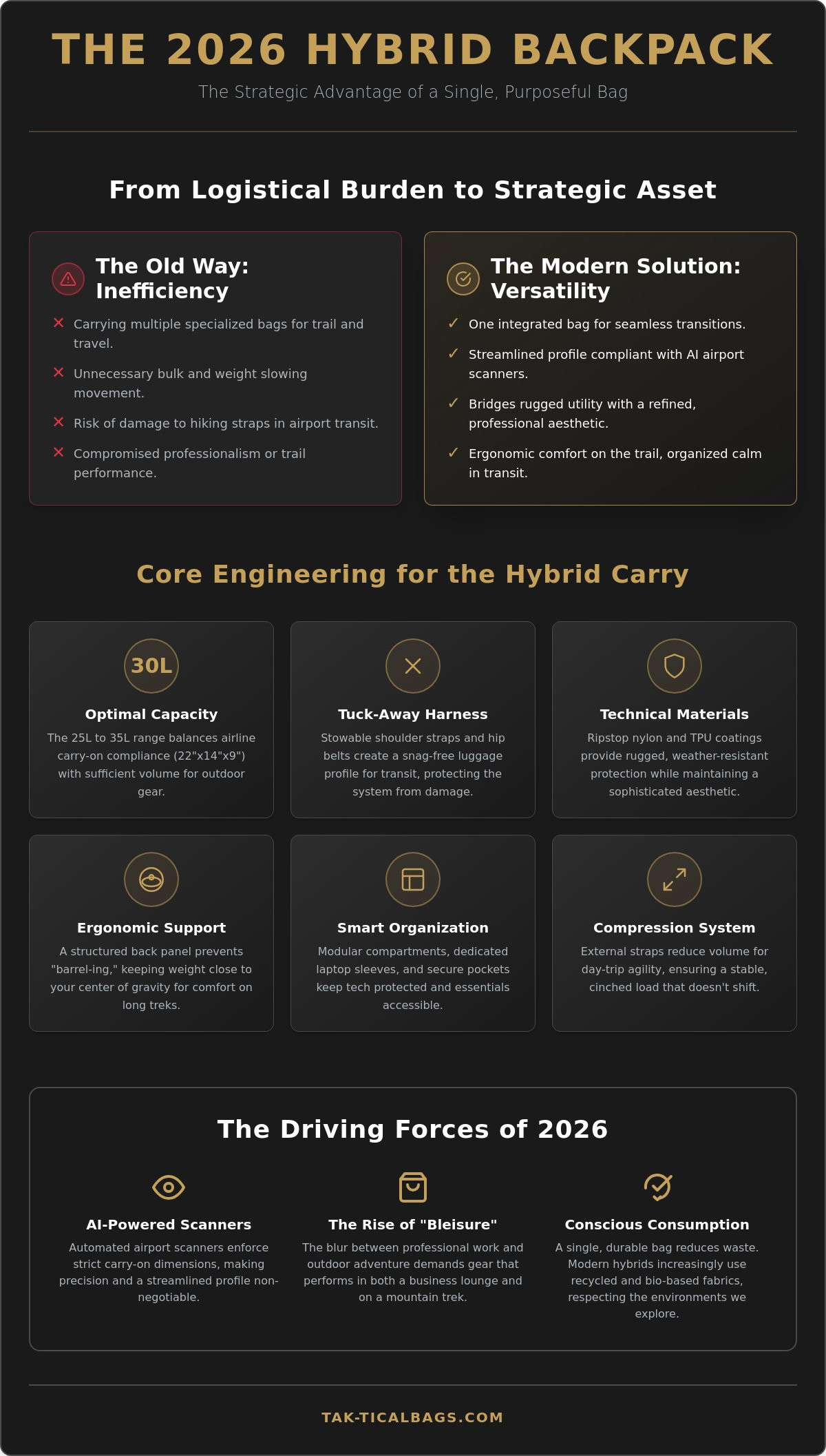
- Target the 25L to 35L capacity range to balance airline carry-on compliance with sufficient volume for outdoor gear.
- Select technical materials like Ripstop nylon and TPU coatings to maintain a professional aesthetic while ensuring rugged protection.
- Execute a strategic audit of your tech dimensions and suspension requirements to find a pack that matches your specific intensity levels.
The Rise of the Convertible Backpack for Travel and Hiking
Specialization is a logistical burden. Carrying a technical hiking pack alongside a separate suitcase is a strategic failure. It creates unnecessary bulk, increases weight, and slows your movement through transit hubs. The modern solution is the convertible backpack for travel and hiking. This hybrid carry fuses the high-volume capacity of traditional luggage with the precise ergonomics of a trail bag. It's designed for those who value efficiency and refuse to choose between a summit and a city center.
The one-bag travel movement has shifted from a niche hobby to a professional standard. It's rooted in purposeful refinement. You don't need more gear; you need better gear. A single, integrated solution allows you to transition from a boardroom to a trailhead without a return trip to your hotel. The core user is the Strategic Traveler. This includes digital nomads who work from anywhere and weekend seekers who demand high-quality craftsmanship. They require organized calm in a fast-paced, mobile lifestyle.
The Evolution of the Multi-Purpose Carry
Early rucksacks were heavy and lacked internal organization. They were built for a single, rugged environment. As global mobility increased, our requirements evolved. Strict airline regulations, such as the standard 22 x 14 x 9 inch carry-on limit, forced a design revolution. Designers began creating the Travel pack as a way to combine mobility with structured storage. In 2026, the rise of automated, AI-powered gate scanners has made this precision even more critical. There's no longer room for error. The aesthetic has also shifted. We've moved away from aggressive military looks toward a sophisticated, non-military tactical style. It's quiet utility for the modern citizen.
Why 2026 is the Year of the Hybrid Bag
The lines between professional work and outdoor adventure have blurred. Remote work is now the foundation of "bleisure" travel. Professionals demand gear that survives a mountain trek while looking appropriate in a business lounge. This shift has turned the convertible backpack for travel and hiking into an essential tool. Technology integration is the new standard. Interior compartments must protect sensitive hardware with dedicated sleeves, while the exterior resists the elements with advanced materials. Sustainability is also a primary driver. Modern hybrids often utilize recycled or bio-based fabrics, ensuring that your gear choice respects the environments you explore. It’s about movement, integration, and readiness for whatever the journey presents.
Engineering Versatility: How Hybrid Day Bags for Hiking Work
Versatility isn't a happy accident. It's the result of precise engineering. A convertible backpack for travel and hiking must solve two conflicting problems. It needs to be sleek enough for an overhead bin and rugged enough for a steep ascent. This requires a modular approach to design. Understanding The Origin and Development of Backpacks reveals that we've moved from simple sacks to complex load-bearing systems. Modern hybrids use high-tensile zippers and reinforced seams to handle the stress of varying environments. It's about purposeful integration.
The "tuck-away" mechanism is the centerpiece of this transition. When you move through airport terminals, loose straps are a liability. They snag on conveyor belts and AI-powered gate scanners. By stowing the shoulder straps into a dedicated back panel, the bag becomes a streamlined piece of luggage. This isn't just about aesthetics. It's about protecting the bag's integrity. Once you reach your destination, the straps deploy in seconds. This allows you to transition from a business traveler to an explorer without missing a beat. It's efficiency in motion.
Load distribution is where many travel bags fail. A true day hike backpack requires a structured back panel. This prevents "barrel-ing" when the bag is full and ensures that weight stays close to your center of gravity. Internal organization must be equally strategic. Large compartments hold your bulkier gear, while small-item security pockets keep your passport and keys accessible. It's a balance of volume and accessibility. You don't have to dig for essentials when every pocket has a clear purpose.
The Conversion Mechanism Explained
- Stowable shoulder straps: These allow for a clean profile during transit. It protects the harness system from damage.
- Compression straps: Use these to reduce volume for day-trip agility. A cinched bag is a stable bag.
- Removable hip belts: Deploy these for weight distribution on long trails. Remove them for a cleaner look in professional settings.
Optimizing for the Day Hike
Technical performance shouldn't be an afterthought. High-output activity requires specific features. Look for hydration bladder compatibility. This allows you to stay fueled without stopping. External attachment points are also vital. They secure trekking poles or damp layers outside the main compartment. Breathable mesh panels on the back and straps are essential. They facilitate airflow and prevent heat buildup during strenuous climbs. If you're ready to upgrade your loadout, explore our collection of high-performance backpacks designed for the strategic traveler.
Travel Efficiency vs. Trail Performance: The Hybrid Balance
The Strategic Traveler understands that gear is often a series of compromises. Most products fail because they lean too far into one world. A convertible backpack for travel and hiking must strike a precarious balance between two opposing design philosophies. You require the internal structure of a trail pack without the bulky, external-frame silhouette that feels out of place in an urban setting. Soft luggage is convenient for cramming into overhead bins, but it lacks the suspension required for a 10-mile trek. The solution lies in semi-rigid back panels. These provide enough support for weight transfer while remaining flexible enough for transit.
Capacity is your next tactical decision. The "Goldilocks" zone for a hybrid carry is between 25L and 35L. Verified airline regulations for 2026 show that most US carriers permit carry-ons up to 22 x 14 x 9 inches. A 30L bag typically fits these dimensions perfectly. It offers enough volume for a multi-day excursion without triggering mandatory gate-checking. If you exceed 35L, you lose the agility needed for day hikes. If you drop below 25L, you sacrifice the ability to carry essential travel gear and tech. Weight is also a factor. With many international carriers enforcing a strict 15.4 lb limit for cabin bags, every gram of the bag's empty weight must be justified by its utility.
Travel-Specific Requirements
Digital security and organization are paramount in professional environments. A dedicated, padded laptop sleeve is a requirement. It keeps your hardware isolated from heavy trail gear and protected from impact. Luggage pass-through handles are another essential for airport navigation. They allow the pack to sit securely on a rolling suitcase during long layovers. We recommend a clamshell opening over a traditional top-loader. This design allows you to see all your gear at once. It mirrors the efficiency of a suitcase while maintaining the mobility of a backpack.
Hiking-Specific Requirements
On the trail, the weight-to-strength ratio determines your comfort. A bag must use high-denier fabrics in high-wear areas while keeping the overall frame lightweight. Weatherproofing is equally critical. Modern hybrids move beyond simple water-resistance. They utilize sealed zippers and integrated rain covers for true elemental protection. Finally, quick-access side pockets are vital. You need to reach water bottles or navigation tools without breaking your stride. This dual-purpose focus ensures you remain organized and ready, regardless of whether you are navigating a city commute or a mountain ridge.
Technical Materials for the Modern Multi-Environment Carry
Material choice is the foundation of readiness. A convertible backpack for travel and hiking must withstand varied stressors that a standard commuter bag simply can't handle. Ripstop nylon is a primary choice for its reinforced crosshatch pattern. This weave prevents small punctures from becoming catastrophic failures on the trail. Ballistic polyester offers a denser weave for superior abrasion resistance in high-friction environments like airport baggage carousels. These aren't just fabric choices; they're strategic decisions for gear longevity.
Protection extends beyond the exterior shell. Many durable laptop bags for travel now utilize TPU coatings. This thin layer of thermoplastic polyurethane creates a permanent barrier against moisture and grit. It ensures your tech remains dry during a sudden mountain downpour or an accidental spill in a transit lounge. Hardware is equally critical. You shouldn't compromise on YKK zippers or Duraflex buckles. These components are the primary points of mechanical failure. High-quality hardware ensures your bag remains functional under the tension of a maximum load.
The 2026 landscape prioritizes environmental responsibility without sacrificing performance. High-performance recycled textiles are now the industry standard for premium gear. Many packs utilize fabrics derived from recycled plastics or bio-based sources like mushroom fibers. These materials match virgin nylon in tensile strength while respecting the environments you explore. It's a commitment to purposeful utility and sustainable innovation.
The Science of Durability
Abrasion resistance is vital for the base of your pack. The bottom of the bag needs extra reinforcement because it's frequently placed on rough granite or concrete transit floors. Tensile strength ensures the bag handles max-capacity loads without seams pulling apart. Denier is a unit of measurement representing the weight in grams of 9,000 meters of a specific fiber. Using high-denier fabrics in high-wear areas extends the life of your carry system significantly.
Aesthetic Refinement
Your bag's finish dictates its versatility. Matte fabrics are preferred for their ability to blend into professional settings. Shiny technical fabrics often appear too "outdoorsy" for urban environments. Minimalist branding is the hallmark of a sophisticated, premium carry. It suggests confidence rather than a need for attention. Stick to a color palette of charcoal, olive, or navy. These tones transition seamlessly from a boardroom to a trailhead. If you're looking for a bag that balances these elements perfectly, explore our collection of professional hiking bags.
Selecting Your Tactical Hybrid: A Strategic Framework
Choosing a convertible backpack for travel and hiking requires a disciplined approach. You aren't just buying a bag; you're selecting a partner for your most demanding days. Start by auditing your primary hardware. If a laptop sleeve doesn't offer suspended protection, your tech is at risk during transit. Next, evaluate your expected hiking intensity. A bag meant for casual gravel paths won't support you on a 2,000-foot ascent. You need a suspension system that transfers weight to your hips, not your shoulders. It's about ensuring your gear works as hard as you do.
Dimensions are non-negotiable. In 2026, AI gate scanners at airports are unforgiving. Verify if your pack meets the 22 x 14 x 9 inch carry-on standard or the 18 x 14 x 8 inch personal item limit used by budget carriers like Frontier or Spirit. Finally, assess the visual profile. Your gear should signal professional readiness. Tactical minimalism offers the utility of modular webbing without the aggressive, military-surplus aesthetic that can alienate clients or colleagues. It's a balance of quiet utility and professional confidence.
Body Fit and Ergonomics
Body fit is a science, and one-size-fits-all is a myth that leads to chronic fatigue. Look for adjustable torso lengths to ensure the hip belt sits correctly on your iliac crest. S-curve straps typically provide better clearance for various chest shapes, while J-curve straps offer a traditional feel for broader frames. Always test the bag with a full load before your trip. Walk for twenty minutes to check for hot spots or pinching. If the weight doesn't disappear into your hips, the geometry isn't right for your anatomy.
The Tak-tical Advantage
Tak-tical designs bridge the gap between rugged performance and urban elegance. We don't believe you should have to compromise between a mountain trail and a boardroom. Our commitment to high-quality craftsmanship ensures that every zipper and seam meets the demands of the modern citizen. You've done the research and understood the technical requirements of a convertible backpack for travel and hiking. Now, it's time to move from informational research to a purposeful purchase. Explore our range of high-performance backpacks and upgrade your carry system for the journey ahead.
Elevate Your Journey with Purposeful Versatility
Mastering the multi-environment carry is a strategic evolution. It's about moving beyond the clutter of specialized bags to embrace a single, refined solution. By prioritizing technical materials like Ripstop nylon and ensuring precise airline compliance, you achieve a state of organized calm. A convertible backpack for travel and hiking isn't just gear; it's a commitment to efficiency and readiness. You've learned to audit your tech needs and assess ergonomic fits to find a pack that transitions seamlessly from city terminals to mountain peaks.
Tak-tical provides the tools for this transition. Our functional and stylish designs are crafted for premium durability, ensuring reliability for both urban and trail use. Trusted by modern citizens worldwide, our bags represent the pinnacle of tactical minimalism. It's time to streamline your loadout and focus on the destination. Explore the Tak-tical Collection of Hybrid Backpacks today. Your next adventure demands gear that's as versatile as your ambition. Step forward with confidence.
Frequently Asked Questions
What is a convertible backpack for travel and hiking?
A convertible backpack for travel and hiking is a hybrid gear solution designed to transition between urban transit and outdoor environments. These packs combine the internal organization and laptop protection of a travel bag with the ergonomic suspension systems found in trail gear. By utilizing stowable straps and technical materials, this bag eliminates the need for multiple specialized packs. It prioritizes efficiency and a minimalist aesthetic for the modern traveler.
Can I use a hiking backpack as a carry-on for most airlines?
You can use a hiking pack as a carry-on if its dimensions remain within standard airline restrictions. Most US carriers in 2026 permit carry-on bags up to 22 x 14 x 9 inches. Traditional hiking packs with rigid external frames often fail these size checks or snag in automated scanners. A hybrid bag is a better choice because its streamlined profile and tuck-away harness are engineered specifically for cabin compliance.
Are convertible backpacks comfortable for long-distance hiking?
Comfort depends on the quality of the internal frame and the suspension system. High-performance hybrids include padded hip belts and S-curve shoulder straps to distribute weight effectively across your torso. While they don't replace 60L expedition packs for multi-week treks, they provide sufficient support for strenuous day hikes or light overnight trips. Proper adjustment of the torso length is critical for maintaining ergonomic health on the trail.
Do hybrid backpacks provide enough protection for my laptop?
Premium hybrid designs feature dedicated, suspended laptop compartments that prevent your device from hitting the ground when the bag is dropped. These sleeves are often lined with impact-resistant foam and positioned against the back panel for maximum stability. This configuration ensures your tech remains secure while you navigate rocky terrain or crowded airport terminals. It is a non-negotiable feature for the modern digital nomad.
What size backpack is best for a 3-day trip that includes hiking?
A capacity of 30L to 35L is the ideal range for a three-day journey. This "Goldilocks" zone provides enough volume for a laptop, clothing, and essential trail gear without becoming cumbersome. It remains light enough for agile movement on the trail while still fitting within the overhead bins of most major airlines. Staying within this range helps you avoid checked bag fees and logistical delays at the gate.
What is the difference between a tactical backpack and a regular hiking bag?
Tactical backpacks prioritize modularity and durability, often featuring reinforced webbing and high-denier fabrics like ballistic polyester. Regular hiking bags focus primarily on weight reduction and ventilation. A tactical hybrid bridges this gap by offering "quiet utility." This means it provides the rugged performance of tactical gear without the aggressive military aesthetic. This makes it appropriate for professional environments and remote trails alike.
How do I clean a convertible backpack after a muddy hike?
Spot clean the exterior using a damp cloth and mild soap to preserve the technical coatings. Avoid machine washing, as the agitation can damage the internal frame and the TPU waterproof layers. For deep cleans, submerge the bag in a tub of cool water and use a soft brush on high-wear areas. Always air dry the pack in a shaded area to prevent UV damage to the technical nylon fibers.
Is a 40L backpack too big for a day hike?
A 40L pack is generally excessive for a standard day hike and can lead to unnecessary fatigue. Large volumes often encourage overpacking, which disrupts your balance on technical terrain. Most day hikers find that 20L to 30L is sufficient for water, snacks, and extra layers. If you use a convertible backpack for travel and hiking, utilize the compression straps to reduce the bag's profile when it is not at full capacity.