
The most secure-sounding backpack may not be the most useful one. A travel backpack with RFID blocking can add a layer of protection for compatible contactless cards, but that feature alone doesn’t make a bag travel-ready. The risk of RFID skimming is considered low by many experts, so weigh the feature calmly rather than choosing based on fear.
It’s reasonable to want your cards protected, especially in busy travel settings. RFID-blocking materials are designed to limit radio signals reaching cards stored in a shielded pocket or area. Their usefulness depends on how the protection is built into the bag. It doesn’t address other concerns, such as pickpocketing, phishing, or keeping essentials organized.
This guide explains how RFID blocking works, when it may matter, and what to look for beyond the label. You’ll learn how to compare security claims with access, capacity, comfort, and organization, then choose a backpack that suits travel and everyday carry. The goal is practical protection without sacrificing a streamlined routine.
Key Takeaways
- RFID protection only applies to compatible cards or documents placed inside the backpack’s protected area.
- When comparing a travel backpack with RFID blocking, look for clear details about pocket placement and construction, not just a label.
- Match pocket access and capacity to your trip length, transit style, and the items you carry most often.
- Use the five-step checklist to identify what needs protected storage and how easily you need to reach it.
- Balance added protection with comfortable carry and useful organization, especially if the bag will also serve everyday routines.
What an RFID-Blocking Travel Backpack Does, and What It Does Not
RFID blocking reduces radio-frequency communication through a protective layer designed to shield a particular area. A travel backpack with RFID blocking can help limit communication with compatible cards or documents stored in that protected pocket. It doesn’t shield every item in the bag. Performance depends on how the pocket is constructed and used.
How RFID signals relate to travel documents and payment cards
Radio-frequency identification (RFID) uses radio waves to communicate information between a reader and a compatible tag or chip. Some passports contain contactless chips, and contactless payment cards use radio communication too, but technologies and implementations vary by item. Check the specifications of the cards and documents you carry rather than assuming they all work the same way.
RFID is not GPS tracking, phone hacking, or magnetic-stripe theft. These involve different technologies and risks. Claims that travelers face constant, widespread RFID theft can overstate the concern. A measured approach is more useful: consider whether shielding offers peace of mind for the items you carry, without treating it as a substitute for broader travel security habits.
What RFID-blocking construction can and cannot do
Shielding only helps when an item is inside the protected area. Pocket placement, closure, construction, and the item itself can all affect how well the setup reduces radio communication. A label alone doesn’t explain what is shielded or how the pocket is intended to be used. Look for details about the protected pocket and check whether your cards or documents fit inside it as designed.
Even a well-designed shielded pocket has limits. It doesn’t secure an unattended backpack, stop someone from opening it, or prevent physical theft. It also can’t protect cards or documents left outside the protected area. Without product-specific test evidence, don’t assume a bag blocks every signal in every condition.
Keep the protection in perspective
Think of RFID blocking as a focused privacy feature, not an all-purpose security system. If protected storage matters to you, make sure the pocket suits the items you carry and is easy to use in your travel routine. Then weigh it alongside practical details such as organization, access, capacity, and comfortable carry. A balanced choice supports both peace of mind and everyday function.
How to Evaluate RFID Protection in a Travel Backpack
Start with the pocket, not the promise. Find out where the protected area sits, what it’s designed to hold, and whether your cards or documents fit without bending or crowding. A pocket that’s difficult to reach may be inconvenient at checkpoints. One mixed in with frequently used items can also make essentials harder to manage.
An “RFID-blocking” label alone doesn’t establish which signals or items the pocket covers, how the shielding is constructed, or how its performance was measured. Look for specific, product-level details. Then weigh them against everyday usability: a clear closure, practical access, and enough separation to keep protected items organized.
Which items belong in an RFID-protected pocket?
Prioritize cards or travel documents whose specifications indicate contactless technology relevant to your concern. You don’t need to shield every passport, card, or electronic device by default. Keep the items you choose together in the intended pocket, and use a separate, accessible place for tickets or other essentials you need to retrieve often. Avoid displaying personal details in public while sorting through your belongings.
How to interpret protection claims and testing
Specific evidence is more useful than broad phrases such as “total security.” Look for measurable, product-specific information explaining the test method, conditions, and part of the bag assessed. A named standard or performance claim should be supported by evidence before you rely on it. Don’t assume a technical-sounding label guarantees a particular level of protection.
- Pocket placement: Check that the protected area suits the items you plan to carry.
- Access and closure: Consider whether you can reach the pocket smoothly and keep its contents contained.
- Separation: Look for a layout that keeps protected cards apart from frequently handled travel essentials.
- Claim detail: Prefer clear construction and test information over unsupported, absolute wording.
For a travel backpack with RFID blocking, the practical question is whether the protected pocket fits your routine, not just whether the feature appears in the description. If you’re comparing protection with daily organization and carry needs, you can also explore everyday carry backpacks as part of your search.
RFID Protection vs. Everyday Travel Backpack Features
A useful travel bag does more than hold protected cards. Compare its security pocket with the features that shape your day: organization, quick access, capacity, and comfortable carry. The right balance depends on how long you’ll be away, what you bring, and how often you move between transit, work, and your destination.
| Feature | What to consider | How priorities can shift |
|---|---|---|
| RFID pocket | Check that its placement and size suit the cards or documents you intend to store there. | More relevant if protected storage is a personal priority; it complements, but doesn’t replace, sensible travel habits. |
| Organization | Look for a layout that separates travel documents, wallet, phone, and other essentials. | More useful on longer trips or when you carry several kinds of gear. |
| Access | Consider how easily you can reach tickets, documents, or a phone while moving through transit spaces. | Quick access may matter most during busy travel days and frequent transfers. |
| Capacity | Allow room for what your itinerary actually requires, without carrying unnecessary bulk. | A day trip may call for less space than an overnight stay or a longer journey. |
| Carry comfort | Assess strap comfort and how the packed load sits against your back. | More important when you’ll wear the bag for extended periods or walk between connections. |
Balance security with organization and access
A protected pocket should work with the bag’s overall layout. Consider whether it keeps selected cards or documents apart from items you reach for repeatedly. Tickets, a phone, and a wallet should remain easy to access without disrupting the rest of your packing. If you travel with a laptop, consider whether a separate compartment fits your work and transit routine. For a broader look at those trade-offs, explore this work and travel backpack guide.
Match capacity and comfort to the journey
Pack for the trip you’re taking. A day out may need only daily essentials, while an overnight stay or longer itinerary calls for room for additional clothing and gear. As the load grows, strap comfort and balanced weight distribution matter more. Consider how easily the bag opens while you’re standing in a queue or changing transit, too. If carrying a work device is a priority, choose a bag with a layout that suits your device and routine. A travel backpack with RFID blocking is most useful when its protective feature works alongside the space, access, and comfort your routine needs.
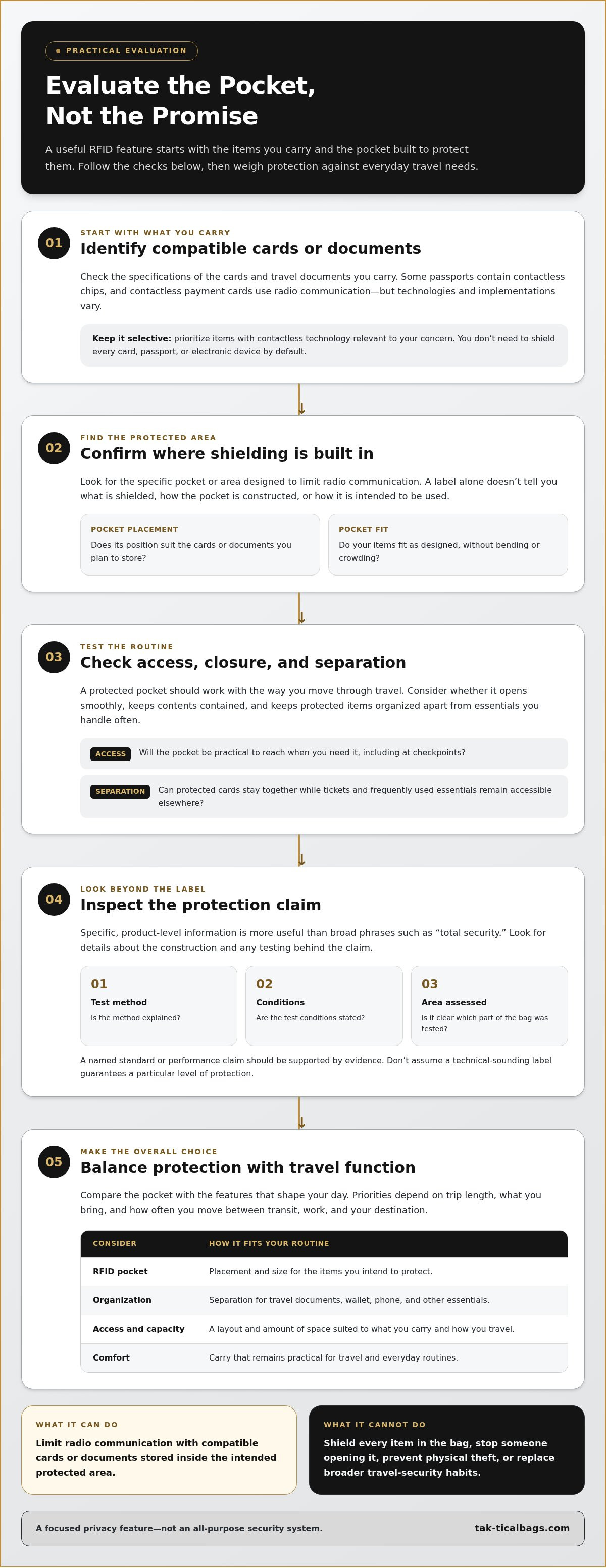
A Five-Step Checklist for Choosing Your RFID Travel Backpack
Choose around the trip you actually take, not a list of security features in isolation. A travel backpack with RFID blocking should fit your itinerary and carry routine first, with protected storage serving as one practical consideration among several.
Match the bag to your itinerary and packing habits
A commute, airport transfer, and overnight stay place different demands on a bag. Think about how long you’ll be away, how you’ll move between destinations, and whether you’ll carry work or leisure essentials. More capacity isn’t automatically better. Excess space can make it easier to pack items you don’t need.
- Step 1: Map your trip. Note the length of your journey and whether you’ll mainly walk, drive, or use trains and planes. Consider how often you’ll need to open the bag while moving.
- Step 2: List your regular carry. Identify the essentials you bring most often, such as a wallet, phone, travel documents, clothing, or work device. Separate daily commuting needs from items required only for an overnight or longer trip.
- Step 3: Decide what needs protected storage. Focus on the specific cards or documents you want to place in a protected pocket. Check that the pocket’s position and dimensions suit them, rather than assuming the feature covers everything inside the backpack.
- Step 4: Compare layout and access. Review pocket organization, closures, device storage, and how quickly you can reach tickets or other essentials. If you move between professional settings and leisure travel, consider whether the same layout works comfortably for both.
- Step 5: Assess fit and the full feature set. Imagine the bag loaded with your usual items. Check how it sits on your shoulders, whether the weight feels balanced, and whether its size and layout suit your travel plans. Finish by weighing the RFID feature alongside organization, comfort, access, and carry-on suitability.
Make a practical final review
Check the functional details before letting appearance decide. A streamlined bag should support your everyday routine as well as travel, without forcing you to trade useful organization for a security label. For broader daily-use priorities, see this everyday carry backpack guide.
Keep the decision measured. RFID blocking can be a helpful extra if protected storage matters to you, but it doesn’t replace attentive travel habits or a comfortable, well-organized bag. Ready to put the checklist into practice? Explore Tak-tical backpacks for functional everyday carry options.
Choose a Travel Backpack That Fits Your Carry Routine
The right choice balances your itinerary, the items you carry, and the way you want them organized. RFID-blocking storage can be a useful extra if you regularly carry compatible contactless cards or travel documents and prefer to keep them in a dedicated pocket. It’s a personal preference, not a reason to choose a bag that feels awkward or lacks the space your trip requires.
Who may value RFID-blocking storage most?
Travelers who carry contactless payment cards or documents with relevant contactless technology may appreciate having a designated protected area. Consider your usual routes and habits: a bag used in crowded transit may make easy-to-reach, well-organized storage especially convenient, while a short trip with few essentials may place less emphasis on the feature. Let your itinerary guide the decision, not fear of constant theft.
Whatever you choose, stay aware of your belongings and keep your bag close in busy spaces. A protected pocket addresses a specific type of radio communication; it doesn’t prevent someone from opening or taking an unattended bag. Thoughtful storage and attentive handling still matter.
When to prioritize other backpack features
If comfort, capacity, or organization will shape your day more than protected storage, give those features priority. Check how the loaded bag sits on your shoulders, whether its pockets suit your essentials, and whether its closures and layout are easy to use in transit. A longer trip may call for room for clothing and extra gear; a daily commute may benefit more from a compact, orderly setup. Compare the complete carry system, not a single security feature.
Tak-tical offers backpacks and carry-on bags with functional, stylish designs for everyday carry. When choosing a travel backpack with RFID blocking, consider whether the pocket and its purpose fit your routine, but don’t let one feature outweigh a comfortable, practical fit. Choose a bag that can move naturally between travel and everyday use.
Ready to find a carry option that suits your next trip and daily rhythm? Explore Tak-tical backpacks.
Choose a Bag That Moves With You
A travel backpack with RFID blocking can offer useful protected storage when it fits the cards or documents you carry. But the feature works best as part of a considered carry setup, not as a substitute for practical travel habits. Pocket placement and clear protection details matter, while organization, access, capacity, and comfort shape how well a backpack serves you throughout the trip.
Start with your itinerary and daily routine. Choose a bag that holds what you need, feels comfortable when loaded, and transitions easily between travel and everyday use. Tak-tical offers backpacks and carry-on bags designed around functional, stylish everyday carry, giving you options to consider alongside the features that matter for your trip.
Explore Tak-tical backpacks for purposeful carry and find a practical starting point for your next journey. Travel with confidence, and choose the features that genuinely support your day.
Frequently Asked Questions
What does an RFID-blocking travel backpack do?
An RFID-blocking travel backpack is designed to reduce radio-frequency communication with compatible cards or documents stored in a designated protected pocket. The shielding applies to items inside that area, not everything packed in the bag. Since contactless technologies vary, check whether your cards or travel documents use technology relevant to the feature. A travel backpack with RFID blocking offers focused storage, not all-purpose protection against theft or fraud.
Is an RFID-blocking backpack necessary for travel?
No, it isn’t essential for every traveler. RFID blocking may offer added peace of mind if you carry compatible contactless cards or travel documents and want a dedicated place to store them. Consider your itinerary and preferences rather than choosing from fear. Keep your bag close in busy areas, use its closures, and stay aware of your belongings. Those everyday habits address risks a shielded pocket can’t prevent.
Can RFID-blocking pockets protect every credit card and passport?
No. A protected pocket is intended to reduce radio communication for compatible items placed within its shielded area, but cards and passports can use different technologies. Protection also depends on the pocket’s construction, placement, and fit. Check the specifications for the particular items you carry, and keep them inside the designated pocket as intended. Don’t assume the pocket protects items elsewhere in the backpack or blocks every signal.
How can I tell whether a backpack really blocks RFID signals?
Look for product-specific details about the protected pocket, its construction, and any testing used to assess performance. Useful claims explain what area was tested and under what conditions, rather than relying only on a broad “RFID-blocking” label. A named test standard or performance result should be traceable to evidence for that product. Without clear details, don’t assume a label guarantees complete protection across all cards, frequencies, or conditions.
Does RFID blocking interfere with a phone or other electronics?
An RFID-shielded pocket is designed to reduce radio communication within its protected area, so a compatible device placed there may have difficulty communicating wirelessly while inside. That doesn’t mean the backpack damages the phone or other electronics. Keep your phone in a separate pocket if you need to use wireless functions or reach it quickly. The effect depends on the pocket’s construction and the device’s technology.
What should I look for in a travel backpack besides RFID protection?
Prioritize the features that support your actual trip: comfortable straps, useful organization, easy access to tickets and daily essentials, and enough capacity without unnecessary bulk. If you carry a laptop, consider whether the device storage suits your commute and travel routine. Check pocket layout and closures, then imagine the bag loaded for a typical day. A balanced carry setup is more useful than choosing by one security feature alone.
Is an RFID-blocking travel backpack useful for everyday carry?
It can be useful if the protected pocket suits cards or documents you carry regularly, but its value depends on your routine. For commuting or daily errands, comfort, access, and organization may matter more. Choose a travel backpack with RFID blocking only if the pocket fits your needs without making everyday essentials harder to reach. A versatile backpack should work for both travel and daily carry, not just one occasional feature.