
A backpack that shifts with every step isn't a tool; it's a distraction. You've likely felt the frustration of shoulder straps sliding outward or the rhythmic bounce of a heavy load during a brisk commute. Finding the right backpack with chest strap for walking is the difference between fighting your gear and forgetting it's there. It turns a chaotic carry into a stabilized, intentional journey. This simple integration provides the quiet empowerment of a load that moves with you, not against you.
We agree that physical fatigue shouldn't be the price of a productive day. You deserve a bag that offers organized calm and high-quality craftsmanship, whether you're on a mountain path or a city sidewalk. This guide reveals how a well-positioned chest strap transforms your ergonomic experience. We will explore the mechanics of weight distribution, the benefits of stabilization, and how to select a bag that transitions seamlessly between environments. Discover how to reclaim your focus and move with elevated efficiency.
Key Takeaways
- Eliminate lateral sway and strap flare by understanding the primary stabilizing role of the sternum strap.
- Shift weight from your outer shoulders to your core to reduce fatigue when using a backpack with chest strap for walking.
- Prioritize sliding rail adjustability and integrated elasticity to ensure your bag moves naturally with your body.
- Apply the "two-inch" rule for perfect strap placement, ensuring maximum comfort without restricting your breathing.
- Transition seamlessly between environments with a carry system designed for both tactical readiness and urban sophistication.
The Role of the Chest Strap in Walking Comfort
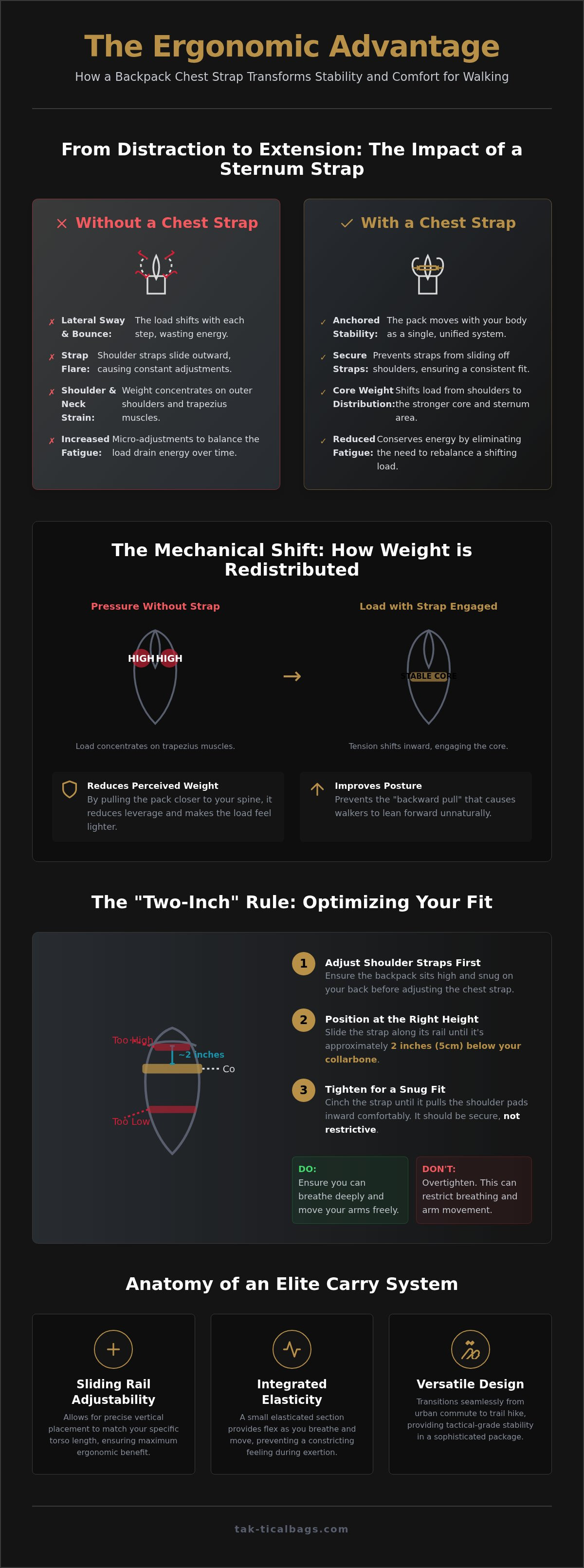
The sternum strap is often perceived as a secondary detail. It's far more than a simple buckle. It's a critical component of Backpack design and components that dictates how a load interacts with your body. While shoulder straps carry the weight, the chest strap manages the movement. For anyone seeking a backpack with chest strap for walking, this small feature provides the necessary tension to keep the system unified. It prevents "strap flare," where the pads slide toward the edge of your shoulders, causing you to shrug or adjust your posture constantly.
Standing still with a pack is easy. Walking introduces gait. Each step creates a subtle lateral shift and a vertical bounce. Without stabilization, your bag sways out of sync with your stride. This creates mechanical drag and wasted energy. A secured chest strap anchors the shoulder straps, pulling them toward your center. It creates a sense of organized calm. You move with purpose because your gear isn't fighting your momentum. It's about quiet empowerment and readiness for the path ahead.
Stability on the Move
Stability is a function of integration. By pulling the shoulder straps inward, the chest strap ensures the weight remains centered over your center of gravity. This alignment reduces the friction that causes shoulder chafing during extended journeys. It also relieves the constant tension in your neck and upper back. Instead of using your muscles to keep the straps from sliding off, you let the hardware do the work. This efficiency is essential for long-duration movement and reduced physical fatigue.
From Commute to Trail: Versatile Stabilization
Modern life demands versatility. Your morning commute might require a professional silhouette, while your weekend involves a brisk pace on a local path. A high-quality backpack with chest strap for walking bridges these worlds. Urban walkers benefit from tactical-grade stabilization hidden within a minimalist shell. It allows for a seamless transition from a relaxed city stroll to a purposeful hike.
For those looking for technical excellence, exploring the best hiking backpacks provides insight into how these features scale for more demanding terrain. The goal is a carry system that feels like an extension of yourself. It should provide elevated efficiency regardless of the environment or the speed of your journey.
Mechanical Benefits: How Sternum Straps Redistribute Weight
The chest strap isn't a secondary safety measure. It's an active ergonomic tool. When you wear a backpack with chest strap for walking, you engage a system that redefines how weight sits on your frame. Standard shoulder straps apply pressure to the outer edges of the shoulders. This often causes the trapezius muscles to tighten as they fight to keep the pack from sliding. By connecting the straps across your sternum, you shift that tension inward toward your core. This redistribution creates a more stable base. It prevents the common "backward pull" that forces many walkers to lean forward excessively.
Experts at the American Chiropractic Association highlight how this stabilization prevents the pack from swaying and keeps straps aligned. This synergy is vital. The chest strap works in tandem with load lifters and hip belts to create a unified carry system. It's about organized calm in motion. You stop fighting the bag. You start moving with it. This integration is essential for those who value both utility and sleekness in their daily gear.
Anatomy of an Ergonomic Carry
The relationship between the chest strap and the back panel is one of constant tension and support. Proper engagement pulls the pack closer to your spine. This reduces the leverage the weight has against your lower back. By distributing the load across the sternum, you lower the perceived weight of your gear. Proper load distribution ensures your center of mass stays aligned with your spine to prevent unnatural curvature during movement. This alignment is the foundation of a sophisticated carry. For a bag that masters this balance, consider exploring our minimalist backpacks designed for urban efficiency.
Reducing Long-Term Fatigue
Fatigue isn't always caused by heavy weight. Often, it's the result of micro-movements. Every time your bag bounces or sways, your body makes tiny adjustments to stay balanced. Over several miles, these adjustments drain your energy. A stabilized load preserves your natural walking gait. It allows your posture to remain upright and relaxed. This level of control is why a tactical hiking backpack is the gold standard for load management. These designs prioritize durability and stability. They ensure that your journey, whether through a city park or a mountain trail, remains a seamless experience of quiet empowerment.
Key Features to Evaluate in a Walking Backpack
Selecting a high-quality backpack with chest strap for walking requires an eye for detail. The hardware is the tactile interface between your body and your gear. While budget options often treat these components as generic add-ons, technical excellence demands purposeful selection. Choose a sliding rail system over fixed attachment loops. Fixed positions limit your ability to find an exact anatomical fit. Rails allow for minute vertical adjustments. This precision ensures the strap sits exactly where your frame requires it, regardless of your height or build. It's about achieving an organized calm through perfect alignment.
Elasticity is a non-negotiable feature for active movement. As your pace quickens, your chest expands to accommodate deeper breathing. A rigid, inelastic strap acts as a cage. It restricts your lung capacity and creates unnecessary pressure. Integrated elastic "give" allows the pack to breathe with you. This subtle flexibility maintains stabilization without sacrificing comfort. It also preserves the longevity of the hardware by absorbing sudden shocks during a brisk gait. Tactile reliability is equally vital. Seek buckles that offer one-handed operation and a distinct, audible click. This ensures you can engage the system without breaking your stride or looking down.
Material durability defines the life of the bag. At Tak-tical, we prioritize high-grade webbing and military-spec hardware. These materials resist the fraying and stretching common in lower-tier products. They maintain their tension over years of daily use, providing the modern reliability you expect from a premium partner.
Adjustability and Fitment
Different torso lengths require different anchor points. A vertical rail system accommodates everyone from the petite urbanite to the tall traveler. We value "set and forget" reliability. Once you find your ideal position, the hardware should stay locked. A minimalist aesthetic does not mean feature-poor design. Sleekness is the result of removing clutter while retaining every essential tool for elevated efficiency.
Breathability and Comfort
Consider how the strap interacts with your wardrobe. A setting that works for a summer t-shirt will need adjustment for a heavy winter parka. High-quality webbing provides comfort without the need for bulky padding. You want a low-profile solution that integrates seamlessly into everyday carry backpacks. This ensures your bag remains a versatile partner. It transitions from professional environments to outdoor adventures without adding unnecessary volume to your silhouette.
Correct Fitment: Optimising Your Backpack for the Trail or Street
Proper fitment is the final step in achieving organized calm. Many users make the mistake of tightening all straps at once. This creates uneven pressure and compromises your posture. Follow the "Bottom-Up" rule to ensure your backpack with chest strap for walking functions as a cohesive unit. Start by securing the hip belt if your bag has one. This anchors the weight to your pelvis. Then, adjust the shoulder straps to pull the load close to your back. Finally, engage the chest strap to lock the system into place. This sequence ensures the weight is distributed before the stabilization is applied.
Positioning is precise. Use the "two-inch" rule: the strap should sit approximately two inches below your collarbone. This placement provides maximum stabilization without compressing your chest or restricting your neck. Tensioning requires a balance between security and freedom. It should feel snug but not restrictive. Once adjusted, test the fit by walking a few paces at your natural speed. Your bag should remain centered over your gravity point without lateral sway or "bouncing" against your spine. If you feel the pack shifting, re-evaluate the shoulder tension before re-clipping the chest buckle.
The Step-by-Step Adjustment Process
Achieving a professional-grade fit takes less than a minute. Follow these steps every time you change your load or your clothing layers. This ritual ensures your gear is always optimized for your current needs.
- Step 1: Loosen all straps before putting the bag on. This allows the bag to settle naturally on your frame rather than forcing your body to adapt to a previous setting.
- Step 2: Tighten the shoulder straps. This brings the bag close to your back and prevents the weight from pulling you backward or causing you to lean forward excessively.
- Step 3: Clip and slide the chest strap into the optimal ergonomic position. Use the vertical rails to find your specific anatomical anchor point for a customized carry.
Fine-Tuning for Your Environment
Your carry should adapt to your surroundings. When tackling uphill climbs, tighten the chest strap slightly. This keeps the bag from pulling away as you lean into the incline. For flat urban strolls, a looser setting offers a more relaxed, breathable feel that suits a casual pace. The strap also serves as a functional anchor; use it to tuck away hydration tubes or secure your sunglasses during a pause in your journey. You can verify the perfect tension by ensuring you can comfortably slide two fingers between the strap and your chest without feeling restricted. This simple check guarantees that your backpack with chest strap for walking provides stability without hindering your natural lung expansion.
Ready to experience a bag that prioritizes your comfort? Explore the full range of Tak-tical backpacks and find your partner for a seamless, stabilized journey.
Elevated Utility: Why Tak-tical Redefines the Walking Backpack
Tak-tical exists at the intersection of tactical readiness and urban sophistication. We believe gear should empower you without shouting for attention. For the Modern Citizen, a backpack with chest strap for walking is a tool of quiet empowerment. It provides the stability needed for a fast-paced life while maintaining a refined, minimalist aesthetic. Our design philosophy centers on organized calm. Every stitch and buckle serves a specific purpose. We don't add features for the sake of complexity. Instead, we refine them for the sake of elevated efficiency. Your gear should be a seamless extension of your intent.
Functional excellence is our baseline. We understand that a daily journey can transition from a subway platform to a wooded trail in a single afternoon. Our bags are designed to be your ultimate partner in these transitions. By focusing on high-quality craftsmanship and modern reliability, we ensure your carry system remains a silent, dependable ally. You stay composed. You stay ready. You stay organized. This commitment to durability ensures that your investment continues to perform long after others have frayed. We build for the individual who demands excellence in every detail.
Tactical Design for the Modern Professional
Integrating technical features into a professional silhouette requires precision. Many office-ready bags sacrifice ergonomics for style. We refuse that compromise. Our work backpacks incorporate the same stabilization systems found in elite outdoor gear. We use premium materials that look at home in a boardroom but perform on the street. The chest strap is low-profile and sleek. It offers the necessary tension for a brisk walk without disrupting your professional image. It's about movement without friction. It's about being prepared for whatever the day presents.
The Tak-tical Difference
We prioritize technical performance within a minimalist frame. Our commitment to durable, purposeful gear means we select hardware that lasts for years, not seasons. We focus on the details that others overlook. From the tactile click of the buckle to the reinforced webbing, every element is curated for the organized individual. This is the Tak-tical difference. We provide the tools for an elevated lifestyle where utility and aesthetics are never at odds. Every bag is walking-ready and built to endure the rigors of constant movement. Experience the difference of a bag designed for your specific rhythm.
Explore our collection of functional walking backpacks and discover a new standard for your daily carry.
Elevate Your Daily Stride
A stabilized carry is the foundation of organized calm. By mastering the sternum strap, you transform your movement from a chore into a seamless journey. You now understand how proper tensioning redistributes weight from your shoulders to your core and why vertical adjustability is essential for a precision fit. Choosing a backpack with chest strap for walking ensures your gear remains a silent, dependable partner regardless of your pace. This simple hardware integration provides the quiet empowerment you need to navigate a fast-paced lifestyle. It’s about the readiness to transition from city streets to mountain trails without friction.
Tak-tical gear is defined by functional excellence. Our bags offer tactical-grade durability combined with minimalist urban aesthetics. Every component is engineered for ergonomic stability to reduce fatigue and enhance your efficiency. Don't settle for gear that sways or bounces. Upgrade your journey with a Tak-tical walking backpack and experience the difference of intentional design. Step out with confidence and reclaim your focus today. Your path deserves a partner that values precision as much as you do.
Frequently Asked Questions
Does a chest strap really help with back pain while walking?
Yes, it reduces strain by shifting weight from the outer shoulders toward your core. This prevents the pack from pulling your center of gravity backward. It stops the compensatory forward lean that often causes lower back fatigue during a commute. By stabilizing the load, it minimizes micro-movements that lead to muscle exhaustion. It's an essential feature for maintaining spinal alignment and quiet empowerment during long journeys.
How tight should the sternum strap be on my backpack?
The strap should be snug enough to pull the shoulder straps inward without restricting your breathing or distorting the strap padding. Aim for a tension that allows you to slide two fingers between the strap and your chest comfortably. If the shoulder straps start to pucker or pull away from your body at the top, the tension is too high. Proper tensioning ensures elevated efficiency and organized calm while moving.
Can I add a chest strap to a backpack that doesn’t have one?
You can purchase aftermarket sternum straps that clip onto existing shoulder strap webbing. These universal kits are useful for retrofitting older bags. However, integrated systems are superior because they are engineered to handle specific load distributions. A purpose-built backpack with chest strap for walking offers better stability. It ensures the hardware doesn't slide or fail under the tension of a heavy load during your daily journey.
Are backpacks with chest straps suitable for professional work environments?
Modern designs integrate these features into sleek, minimalist silhouettes that look professional in a boardroom. You don't have to choose between ergonomic support and urban style. High-quality materials like high-grade webbing and matte hardware allow the chest strap to blend into the bag's design. It provides quiet empowerment for the commuting professional who values both aesthetics and utility. This integration ensures a seamless transition between the office and the outdoors.
What is the difference between a chest strap and a waist belt for walking?
A chest strap stabilizes the shoulder straps to prevent swaying while a waist belt transfers the weight directly to your hips. The chest strap focuses on the upper body's lateral movement and load alignment. The waist belt is designed to take the pressure off your shoulders entirely. Using both creates a complete carry system for maximum comfort. This combination is common in technical hiking bags designed for heavy loads and long distances.
Is a chest strap necessary for a small daypack used for short walks?
It's not strictly necessary for very light loads, but it significantly improves comfort even on short trips. Even a small pack can bounce or shift during a brisk walk. Using a backpack with chest strap for walking ensures the bag remains centered over your gravity point. This stability reduces friction and prevents the straps from sliding off your shoulders. It's a small detail that provides a more organized and composed walking experience.