
Efficiency isn't about what you leave behind. It's about how you integrate what remains. For many professionals, the true challenge of travel isn't the distance. It's the friction of overpacking "just in case" items that only add weight and chaos. You've likely experienced the frustration of unearthing a tangled web of cables or presenting a wrinkled shirt at a high-stakes meeting. This strategic guide reveals how to pack a carry on for 5 days with a modular system designed for professional efficiency and quiet empowerment.
We believe that travel should feel like a seamless transition rather than a logistical burden. You deserve to navigate the terminal with an organized calm that reflects your competence. This article provides a blueprint for minimalist travel that doesn't compromise on style or utility. We'll cover the 2026 TSA 3-1-1 liquid standards, airline size compliance, and the specific folding techniques that maximize your 22 by 14 by 9 inch space. Prepare to transform your packing process into a refined ritual of readiness and arrive at your destination with total confidence.
Key Takeaways
- Adopt a "One-Bag" philosophy to eliminate travel friction and maintain professional momentum through intentionality.
- Utilize a modular Zone System and compression technology to organize essentials for seamless transitions from the terminal to the office.
- Master how to pack a carry on for 5 days by applying the 5-4-3-2-1 rule and a disciplined color palette for maximum versatility.
- Execute a strategic 5-step build process that prioritizes weight distribution and rapid access to tech and security-cleared items.
- Ensure 2026 compliance by selecting carry-on architecture that integrates durability with sophisticated, minimalist design.
The 5-Day Carry Philosophy: Why Intentional Packing Matters
Efficiency isn't accidental. It's the result of a deliberate framework that values utility over volume. Five days represents a unique logistical threshold. It's too long for a single change of clothes, yet brief enough to bypass the baggage carousel. Mastering how to pack a carry on for 5 days is more than a space-saving exercise; it's a commitment to intentionality. By adopting a "One-Bag" mindset, you eliminate the physical and mental drag of excess gear. This approach ensures you move seamlessly from the boarding gate to a high-profile meeting without the distraction of disorganized luggage. You arrive ready, not weary.
Five days is the ideal duration to test your efficiency. It forces you to curate a wardrobe that integrates perfectly, ensuring every item serves a dual purpose. When you pack with purpose, you achieve a state of organized calm. This mental clarity is vital during high-stakes travel where timing is everything. You aren't just carrying a bag. You're carrying a mobile headquarters that supports your professional lifestyle. This readiness allows you to focus on your professional objectives rather than your belongings.
Breaking the Overpacking Cycle
Many travelers fall victim to the "just in case" fallacy. They pack items for scenarios that rarely materialize, leading to heavy, cluttered bags. True efficiency requires a shift from a tourist mindset to a strategic traveler approach. Transitioning means recognizing that most "emergencies" can be solved with local resources. You don't need to pack for every possible weather event or social occasion. Instead, pack for the most likely 90% of your trip and remain adaptable for the rest. This transition relies on three core principles:
- Daily Utility: If you won't use it daily, reconsider its place in your bag.
- Versatility: Every garment must pair with at least two other items.
- Immediate Access: Essentials should be reachable without unpacking the entire core.
Refining your inventory is the first step in learning how to pack a carry on for 5 days with total precision. This discipline prevents the need for checked luggage and keeps you mobile in fast-paced environments.
Spatial Awareness and Bag Selection
Success begins with the right architecture. For a 5-day journey, a bag with a 25-35 liter capacity offers the perfect volume without exceeding airline limits. Look for a design that prioritizes internal organization and includes a dedicated, padded laptop bag compartment. This ensures your primary work tool remains protected and accessible during security screenings. Choose materials like high-denier nylon or reinforced canvas. These fabrics provide the durability needed for urban transitions without adding unnecessary bulk. A well-chosen bag acts as a silent partner in your journey, facilitating movement rather than hindering it. It should feel like an extension of your professional persona: sleek, purposeful, and highly functional.
The Modular Framework: Organizing for Seamless Transitions
Transitioning from a cluttered bag to a modular system is the hallmark of a professional traveler. The Zone System divides your internal space into three distinct tiers based on access frequency. Place high-utility items like your passport and noise-canceling headphones in the top tier for rapid retrieval. Reserve the center for your clothing core. Store heavy, low-frequency items like an extra pair of shoes at the base to maintain a stable center of gravity. This vertical organization ensures you never have to unpack your entire life to find a single cable at the gate.
Mastering how to pack a carry on for 5 days means treating your bag as an integrated ecosystem rather than a hollow container. Use compression technology to maintain a slim profile. These tools don't just save space; they prevent the internal shifting that causes deep wrinkles in your professional attire. For managing the "clean/dirty" divide, integrate a lightweight, odor-resistant laundry bag. It isolates used garments, maintaining the integrity of your fresh clothes until the final day of your journey. If you're looking for a foundation for this system, explore our range of carry-on bags designed for high-density organization.
Tech and Digital Protection
Your digital tools are your livelihood. Secure your 16-inch laptop in a suspended, padded sleeve to mitigate impact during transit. This design prevents the device from hitting the ground when you set your bag down. Adopt the "one-charger rule" by utilizing a multi-port GaN charger that handles your phone, laptop, and tablet simultaneously. It's an efficient way to eliminate cable clutter and reclaim valuable cubic inches. Keep tablets or e-readers in a dedicated quick-access zone for effortless retrieval during long flights or layovers.
The Toiletry Strategy
Compliance doesn't have to mean compromise. Follow the TSA 3-1-1 rule by utilizing a clear, leak-proof kit for liquids under 3.4 ounces (100ml). To bypass volume restrictions entirely, switch to solid alternatives like shampoo bars or toothpaste tabs. These items don't count toward your liquid limit and won't leak on your clothes. A small "Grab-and-Go" pouch for essentials like lip balm and hand sanitizer keeps you refreshed without digging through your main compartments. This level of preparation ensures a seamless transition through security and a professional appearance upon arrival.
The Essential Inventory: Applying the 5-4-3-2-1 Rule for 5 Days
Mastering the inventory is the core of learning how to pack a carry on for 5 days without sacrificing style. The 5-4-3-2-1 rule provides a rigid yet flexible framework for the modern traveler. This system dictates: 5 sets of socks and underwear, 4 tops, 3 bottoms, 2 pairs of shoes, and 1 accessory. This specific ratio balances daily freshness with total mobility, ensuring you have a clean base for every day of your journey. To make this work, you must enforce a strict color palette discipline. Stick to a cohesive range of neutrals like navy, charcoal, and black. This ensures every top integrates with every bottom, creating multiple potential combinations from just seven primary garments.
Fabric selection is your most powerful tool for efficiency. Prioritize technical materials like merino wool and high-performance synthetics. These fabrics offer superior odor resistance and moisture-wicking properties, allowing you to remain fresh through long travel days and rapid transitions between environments. Use the "Wear One, Pack One" strategy for your bulkiest layers. Wear your heaviest jacket or blazer during transit. This simple choice reclaims significant internal volume for your modular cubes and tech pouches, keeping your bag light and your movement unrestricted.
Curating the Capsule Wardrobe
Versatility is your primary filter when selecting clothing. Every piece should transition effortlessly from a professional briefing to a casual dinner. Layering acts as a spatial hack, allowing you to adapt to fluctuating cabin temperatures or varying climates without adding bulk to your bag. A Tactical Capsule is a high-performance wardrobe designed for maximum utility and minimal weight. By focusing on high-quality basics that serve dual purposes, you ensure you're never underdressed or over-encumbered during your five-day stint.
Footwear Management
Footwear often consumes the most space in a carry-on. Follow the "Heavy Feet" rule: wear your most substantial pair, such as boots or formal shoes, on the plane. Pack a second, flatter pair that serves both professional and casual needs, like a minimalist sneaker or a sleek loafer. Maximize every cubic inch by using the interior of your packed shoes. They provide the perfect protected location for rolled socks, belts, or small chargers. This level of detail is essential for anyone refining how to pack a carry on for 5 days with professional precision and organized calm.
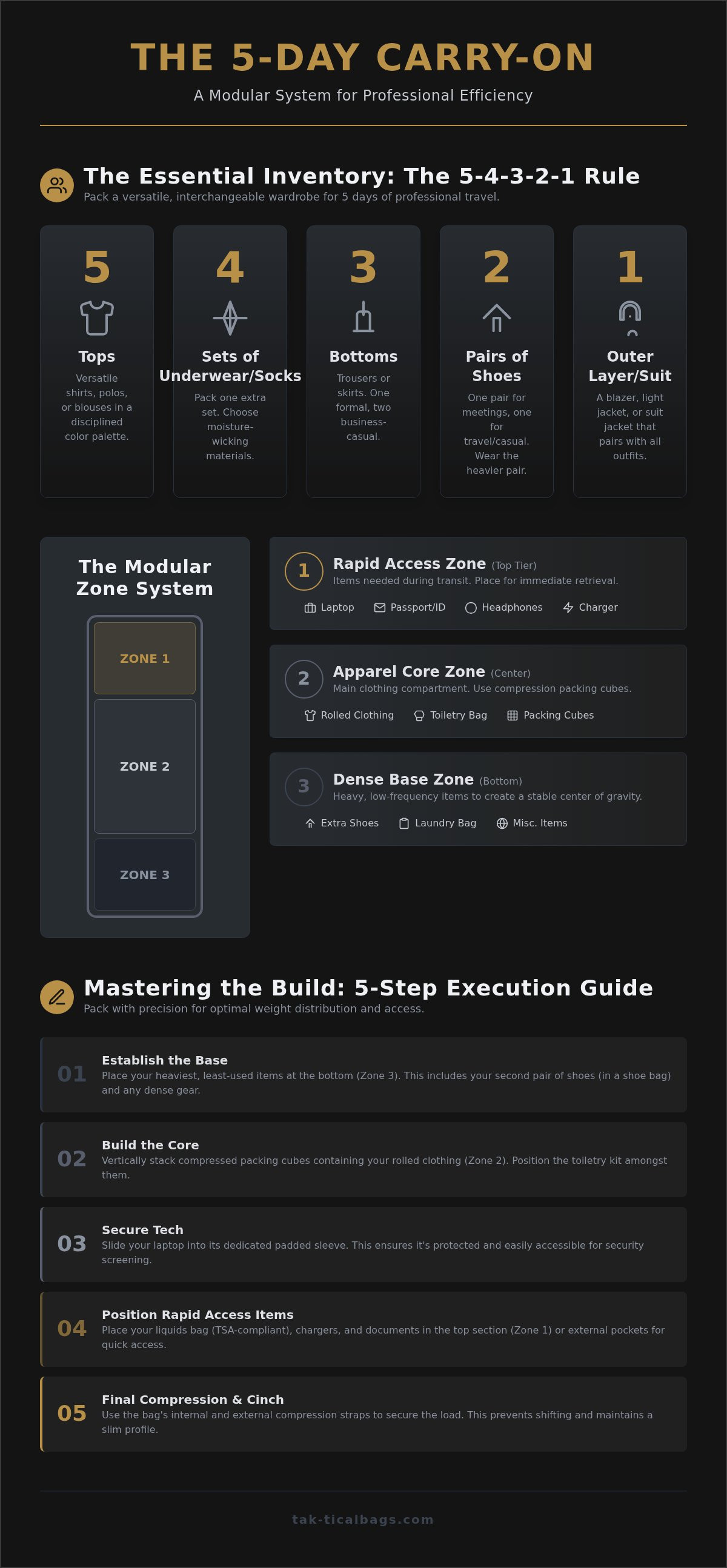
Mastering the Build: Your 5-Step Execution Guide
Execution is where strategy meets reality. To truly master how to pack a carry on for 5 days, you must treat the assembly process as an engineering task. A logical build order ensures your bag remains balanced, your items stay protected, and your transit remains fluid. Follow this five-step sequence to optimize every cubic inch of your bag's architecture.
- Step 1: The Foundation. Place heavy, low-use items at the bottom of the main compartment. Your secondary shoes, stuffed with socks, should sit here to create a stable base.
- Step 2: The Core. Insert your modular packing cubes. These contain your primary 5-4-3-2-1 inventory. Align them vertically if your bag allows, creating a "bookshelf" effect for easier visual identification.
- Step 3: The Tech Layer. Slide your laptop into the dedicated rear sleeve. This placement keeps the most expensive and rigid item protected against the flat back panel, preventing it from shifting or bending.
- Step 4: The Peripherals. Fill the small gaps between your cubes and the bag walls with soft items. This is the ideal space for a light rain shell, a charging brick, or your integrated laundry bag.
- Step 5: The Command Center. Reserve the top-access pockets for your "high-frequency" items. Your passport, phone, and TSA-compliant liquids bag must be reachable in seconds at security checkpoints.
Following this build prevents the frantic "gate-side dig" that characterizes disorganized travel. If you're ready to implement this system, our carry-on bags provide the precise pocket architecture needed for a professional execution.
Weight Distribution for Ergonomic Carry
Comfort during long terminal walks depends on your bag's center of gravity. Keep the heaviest items as close to your back as possible. This reduces the leverage pulling on your shoulders and prevents fatigue. While a hiking backpack often positions weight higher for trail stability, a travel-focused carry-on should keep mass centered. Secure internal compression straps tightly. This prevents the load from sagging or shifting when you transition from a taxi to the check-in counter.
The Art of the Roll vs. Fold
Different garments require different techniques to survive a five-day trip without damage. Roll knits, t-shirts, and denim to eliminate air pockets and maximize space. For maximum tactical compression, use the 'Ranger Roll' method: it creates a tight, self-contained bundle that won't unravel. Conversely, fold professional collared shirts and blazers. Lay them on top of your compressed rolls to minimize pressure. This hybrid approach ensures you arrive with a crisp, professional look without the need for a dedicated garment bag.
Beyond the Journey: How to Choose Your Next Purposeful Carry-On
Mastering how to pack a carry on for 5 days is only half the equation. The architecture of your bag determines whether your modular system succeeds or fails under the pressure of transit. When evaluating bag architecture, look for external carry points that allow for modular expansion and hidden pockets that secure sensitive documents. These features provide a layer of security and utility that standard luggage lacks. A purposeful carry-on must respect the 22 by 14 by 9 inch standard enforced by major carriers in 2026. This compliance ensures you bypass the friction of forced gate-checking and maintain your organized calm from departure to arrival.
Your travel gear shouldn't be retired once you reach the hotel. A truly efficient bag transitions into a refined work backpack upon arrival. This versatility is essential for the modern professional who moves between corporate environments and urban explorations. Invest in refined craftsmanship that reflects your commitment to functional excellence. High-quality materials and sleek, minimalist lines elevate your professional presence, signaling a persona of readiness and sophisticated intent. Choosing the right tool for the journey is the final step in mastering the art of the 5-day carry.
Refining Your Everyday Carry
The discipline required to pack for five days naturally sharpens your daily habits. It informs how you curate your EDC backpack for local transitions, ensuring you carry only what's necessary for the task at hand. Seek gear that offers multi-environment versatility, allowing you to move from a morning commute to an evening event without a change of equipment. This approach defines the 'tactical citizen' aesthetic: a look that is rugged enough for movement but polished enough for the boardroom. It's about integration, not just transportation.
Final Readiness Checklist
Before leaving the house, perform a 30-second audit to ensure your system is primed for the journey. This brief moment of reflection prevents the mental fatigue of second-guessing your inventory. Focus on three critical areas of functionality:
- Gravity Check: Ensure the heaviest items are centered and close to the back panel.
- Access Zones: Confirm your passport and liquids bag are in their designated top-access pockets.
- Seal Integrity: Check that all compression straps and zippers are secure to prevent internal load shifting.
Purposeful, minimalist travel is a skill that improves with every trip. By focusing on high-impact gear and a modular mindset, you transform the logistical challenge of how to pack a carry on for 5 days into a seamless expression of professional efficiency. Arrive ready. Arrive organized. Arrive as a leader.
Arrive Ready for Your Next Transition
Mastering the logistics of travel is a professional skill that pays dividends in organized calm. By applying a modular framework and the 5-4-3-2-1 rule, you transform a potentially chaotic process into a refined ritual of efficiency. You now understand how to pack a carry on for 5 days with total precision; every item serves a purpose and every transition remains seamless. This approach isn't just about saving space; it's about empowerment and readiness for whatever the next five days require. You arrive at your destination focused on your objectives rather than your luggage.
Your gear should be as purposeful as your itinerary. Choosing a bag with tactical-grade durability and integrated tech protection ensures your primary work tools remain secure in any environment. Elevate your professional presence with a sophisticated minimalist design that transitions effortlessly from the terminal to the boardroom. Readiness is the foundation of modern efficiency, and your carry gear is the most important tool in your mobile headquarters. It's time to move with intention and leave the friction of overpacking behind.
Explore the Tak-tical Carry-On Collection for Purposeful Travel and navigate your next journey with intentionality. Move with confidence and arrive prepared for anything.
Frequently Asked Questions
Can I really fit 5 days of clothes in a 25L backpack?
Yes, you can fit a five-day inventory in a 25L bag by prioritizing technical fabrics and a modular build. This capacity requires a minimalist approach where every item coordinates perfectly. It's the ultimate test of your everyday carry efficiency. By utilizing compression and the "Wear One, Pack One" strategy, you maintain a sleek profile while ensuring you have everything necessary for professional and casual environments.
What is the best way to pack a laptop for a 5-day trip?
The most secure method is placing the device in a dedicated, padded rear sleeve. This keeps the weight close to your center of gravity and protects the screen from external impact. Ensure the sleeve is suspended to prevent the laptop from hitting the ground when the bag is set down. Use a single multi-port GaN charger to minimize cable clutter within your tech zone and reclaim space.
How do I keep my clothes from wrinkling in a carry-on?
Combine rolling and folding techniques to maintain a professional appearance. Roll knit items like t-shirts and base layers to save space; fold structured garments like blazers and collared shirts. Placing folded items on top of the compressed rolls prevents deep creases. Tightening internal compression straps is vital to stop clothes from shifting and bunching during transit, which is the primary cause of deep wrinkles.
Should I use packing cubes for a short 5-day trip?
Packing cubes are essential for maintaining organized calm even on short journeys. They act as the "drawers" of your mobile headquarters, separating clean garments from your integrated laundry bag. Cubes also provide the compression needed to maximize internal volume. This modularity allows you to access specific items quickly without disrupting the entire build of your bag, ensuring you stay ready for every transition.
What are the TSA liquid rules for carry-on bags in 2026?
The TSA 3-1-1 rule remains the standard for carry-on luggage in 2026. All liquids, gels, and aerosols must be in containers of 3.4 ounces (100ml) or less. These containers must fit into a single, clear, quart-sized bag. While some airports with advanced CT scanners no longer require you to remove this bag during screening, you must still adhere to these volume restrictions for all flights.
How do I choose between a rolling carry-on and a travel backpack?
Choose a travel backpack if your journey involves frequent transitions between trains, stairs, and uneven urban terrain. Backpacks provide superior mobility and keep your hands free for tech use or navigation. Rolling bags are suitable for long walks on flat terminal floors but lack the versatility of a modern backpack. A backpack better supports the "tactical citizen" aesthetic and a lifestyle defined by purposeful movement.
What is the 5-4-3-2-1 packing method?
This method is a curation framework designed for how to pack a carry on for 5 days with total precision. It includes five pairs of socks and underwear, four tops, three bottoms, two pairs of shoes, and one accessory. By following this ratio, you ensure a fresh rotation of clothing without over-encumbering your bag. It relies on a disciplined color palette to ensure all pieces integrate seamlessly for any occasion.
How do I pack for a 5-day trip with only personal items?
Packing for five days in a personal item requires extreme intentionality and a bag roughly 18 by 14 by 8 inches. You must wear your bulkiest shoes and jacket on the plane to reclaim internal space. Focus on ultra-lightweight merino wool and technical synthetics that roll into tight bundles. This approach eliminates all travel friction, allowing you to move through the airport with maximum speed and professional efficiency.