
Why carry forty liters of dead weight when your essentials only require fifteen? Most outdoor enthusiasts struggle with the over-pack trap, lugging around bulky bags that feel like overkill for a standard day trip. On the other end of the spectrum, cheap packable options often lack the ergonomic support needed for actual performance. Finding the right small hiking backpack shouldn't mean sacrificing utility for size. You deserve a carry solution that feels weightless yet remains indestructible.
This guide explores the intersection of technical minimalism and tactical-grade durability. Discover how to choose a high-performance small hiking backpack that balances a refined design with the utility required for both rugged trails and city streets. We'll demystify liter capacities; we'll also examine the rise of hybrid vest designs and the materials that provide professional-grade comfort. It's time to streamline your journey. Focus on the path ahead, not the weight on your shoulders.
Key Takeaways
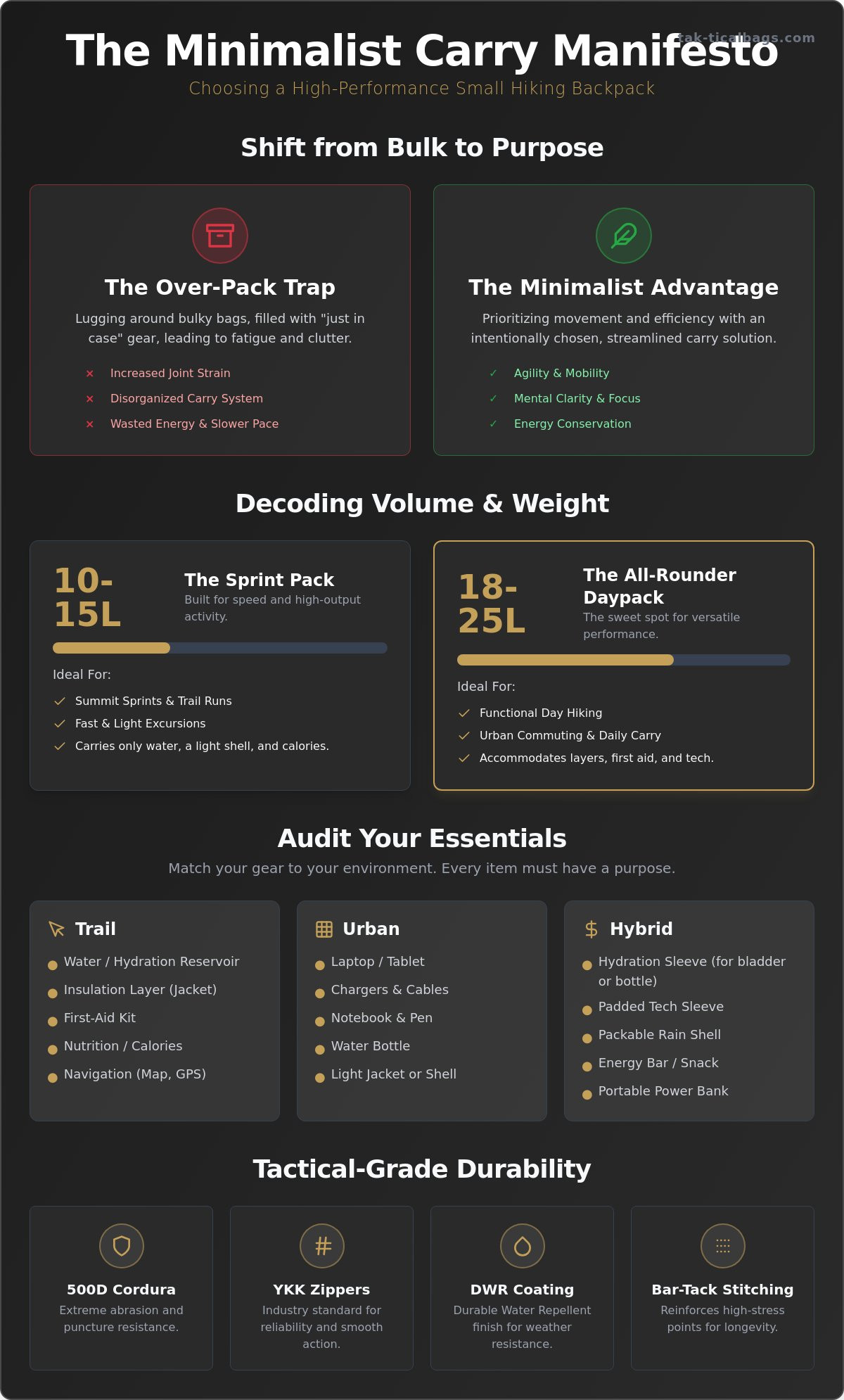
- Shift from bulk to purpose. Prioritize movement through minimalist design and intentional carry.
- Decode volume and weight. Select a small hiking backpack that balances 15L to 25L capacity with ergonomic support.
- Audit your essentials. Use a structured framework to match your gear to trail, urban, or hybrid environments.
- Integrate rugged utility with refined aesthetics. Discover how tactical-grade materials provide quiet empowerment and lasting reliability.
The Shift Toward Minimalist Carry in Modern Hiking
The traditional rucksack is evolving. For decades, the hiking community equated volume with safety. We carried massive packs for simple afternoon loops, burdened by "just in case" gear that rarely saw use. Today, the philosophy has shifted toward intentionality. Modern hikers prioritize movement. They value agility over excess. A small hiking backpack isn't a compromise; it's a strategic choice for the purposeful traveler who values efficiency above all else.
The "Citizen-Adventurer" lifestyle demands this versatility. Modern professionals don't just work; they move. They need a single solution that bridges the gap between a laptop in the city and a hydration reservoir on the trail. Technical fabrics have reached a point where they are both ultralight and exceptionally abrasion-resistant. These materials allow a small hiking backpack to handle the rigors of the backcountry while maintaining a sophisticated, urban-ready aesthetic. Integration is the goal. You carry one bag that performs everywhere.
Defining the Small Hiking Backpack
Efficiency lives in the 10L to 20L range. This capacity provides enough space for the essential five—water, insulation, first aid, nutrition, and navigation—without inviting clutter. A slim silhouette is vital; it keeps the center of gravity close to your spine. This integration improves balance on technical terrain. Modern materials, like those found in tactical-style daypacks, offer incredible weight-to-strength ratios. Many modern packs utilize 500D Cordura or specialized ripstop nylons that resist punctures while remaining flexible. You get the ruggedness of a military rucksack in a footprint that weighs significantly less.
The Problem with "Just in Case" Packing
Oversized bags are magnets for unnecessary weight. If the space exists, we instinctively fill it. This leads to rapid fatigue and a disorganized carry system. Every extra pound slows your pace and increases joint strain. Constraining your volume forces a decision-making process. You learn to audit your gear. You begin to distinguish between actual needs and comfort-based distractions. A smaller pack creates a disciplined environment where every item has a dedicated purpose.
- Clutter reduction: Smaller bags require precise organization and thoughtful placement.
- Energy conservation: Less weight means more miles with less effort and reduced physical recovery time.
- Mental clarity: A streamlined kit fosters a sense of readiness and organized calm.
Minimalism isn't about having nothing. It's about having exactly what you need. By choosing a refined carry system, you reclaim your mobility. You move through the world with quiet confidence and elevated efficiency.
Decoding Technical Specs: Capacity, Weight, and Load
Technical specifications are more than numbers on a tag. They are the blueprint of your performance. When selecting a small hiking backpack, the relationship between volume and weight determines your agility. A pack that is too heavy when empty wastes your energy; one that is too flimsy under load compromises your comfort. Precision is the metric that matters most. You need a system that supports your gear without adding unnecessary mass.
Consider the distinction between dry weight and loaded weight. Dry weight refers to the pack's mass before you add a single item. High-performance minimalist packs often weigh under 15 ounces. However, the loaded weight is where the pack's engineering is truly tested. A high-quality small frame must distribute weight across the shoulders and upper back without sagging. On smaller bags, strap geometry is the primary driver of ergonomics. Look for contoured designs that follow the natural curve of the body to prevent chafing during high-output movement. This ensures the bag moves with you, not against you.
Liter Capacity to Activity Mapping
Choosing the right volume requires an honest assessment of your gear. A 10-15L pack is built for speed. It's the choice for summit sprints or trail runs where you only need water, a light shell, and calories. Moving up to the 18-22L range provides the sweet spot for functional hiking daypacks. This volume accommodates extra layers, a comprehensive first aid kit, and specialized tools while maintaining a sleek profile. Internal organization is key here. Dedicated sleeves for hydration and small tech prevent your gear from shifting into an unbalanced mess. Open-bucket designs offer simplicity, but segmented compartments provide the organized calm needed for a fast-paced lifestyle.
Material Excellence: Beyond Basic Nylon
Durability in 2026 is defined by tactical-style resilience. High-denier fabrics like 500D Cordura offer a sophisticated matte finish and extreme abrasion resistance. Pair these with YKK zippers and reinforced bar-tack stitching at stress points to ensure longevity. Weather resistance is equally critical. While few bags are truly waterproof, modern DWR coatings and PU-backed fabrics protect your contents from sudden squalls. For those pushing their limits, prioritize back panel breathability. Advanced suspended mesh systems create airflow that pulls heat away from your body, preventing the moisture buildup common with traditional foam panels.
True readiness comes from gear that balances these technical demands without looking like an experimental science project. If you value a blend of rugged construction and urban integration, explore the curated collection of tactical-inspired carry solutions designed for the modern explorer.
Small Hiking Backpack vs. Large Rucksack
Choosing between a small hiking backpack and a large rucksack is a decision between two different philosophies of movement. One prioritizes total self-sufficiency; the other emphasizes speed and agility. While a large rucksack is a mobile base camp, a small pack is a precision tool. It's the difference between carrying your world and carrying only what moves you forward. Understanding where your needs fall on this spectrum is the first step toward a more efficient journey.
The "Aero" factor is a primary advantage of the smaller frame. A large rucksack often extends beyond the width of your shoulders and above your head. This creates a high center of gravity and a bulky silhouette that snags on branches or rocks. In contrast, a small hiking backpack stays within your natural torso profile. This streamlined design allows for superior balance on technical terrain. You can navigate tight switchbacks or rocky scrambles without a shifting mass pulling you off-balance. It is about integration. The bag becomes an extension of your body, not an obstacle to your progress.
Load distribution also differs significantly between these two styles. Large rucksacks rely on rigid internal frames and heavy-duty hip belts to transfer weight to the pelvis. This is essential for loads exceeding 30 pounds. Small packs are generally shoulder-dominant. Because the total weight is lower, you don't need the restrictive bulk of a padded waist belt. This frees your hips for a full range of motion. It also makes the bag a more versatile everyday carry backpack. It transitions from a mountain trail to a city commute without looking like an oversized piece of expedition gear.
The Technical Rucksack: When Bigger is Better
The large rucksack remains the standard for multi-day expeditions. If you're carrying a tent, a sleeping system, and several days of nutrition, a minimalist bag isn't feasible. Winter hiking also demands more volume. Extra insulation, safety gear, and specialized tools require the capacity found in The Modern Day Hiking Rucksack. These packs are designed for heavy-load stability and long-distance endurance where storage is the priority.
The Small Daypack: The Minimalist Advantage
For the majority of day trips, the small pack is the superior choice. It offers an unrestricted range of motion that rucksacks cannot match. You can move through the world with less physical strain on your lower back and hips. Storage is also easier. Small bags fit into overhead bins, under vehicle seats, or in gym lockers. They provide a level of mobility that encourages you to get out more often. Efficiency is the ultimate luxury in modern hiking.
Selecting Your Ideal Carry: A Purposeful Framework
Selection is an exercise in discipline. You aren't just buying a bag; you are defining your mobility. To find your ideal small hiking backpack, follow a structured framework based on purposeful readiness. This process ensures your gear supports your pace rather than dictating it. Every choice should bring you closer to a state of organized calm and elevated efficiency.
Start with a rigorous audit. Lay out your "Essential Five" items: hydration, nutrition, insulation, first aid, and navigation. If your current gear won't fit in a 20L footprint, it's time to modernize your kit, not upsize your pack. Next, identify your primary environment. A pure trail bag might look too aggressive for a boardroom. A hybrid solution offers the best of both worlds. It provides the durability of the backcountry with the sleekness of the city. A high-performance small hiking backpack must move with you across all terrains.
Hydration and integration are the next pillars. Decide if you prefer the convenience of an internal hydration bladder or the accessibility of side bottle pockets. For those who value modularity, check for tactical integration. MOLLE webbing allows you to add pouches for specialized missions without committing to a larger silhouette. Finally, prioritize comfort. Seek out ventilated mesh back panels and adjustable sternum straps to manage heat and load stability. These features are critical for maintaining focus during high-output movement.
Organization Strategy for Small Volumes
Efficiency requires placement. Use internal sleeves to secure a laptop or a hydration reservoir. This prevents shifting and protects sensitive tech from impact. External attachment points should be used sparingly for items like trekking poles or a damp rain shell. To master this, learn how do you pack a backpack to maximize every cubic inch of your carry system. Precision packing is the secret to technical minimalism.
The Hybrid Requirement
Modern life is fluid. Your bag should be too. Look for subtle tactical styling that blends into professional environments while maintaining trail-ready durability. Ensure the dimensions are carry-on compliant for seamless travel between terminals and trailheads. A sleek, minimalist exterior isn't just an aesthetic choice; it's a safety feature in urban settings. It keeps your profile low and your belongings secure. You deserve gear that works as hard as you do.
Ready to upgrade your carry? Explore our premium hiking bags designed for the technical minimalist.
Tactical Sophistication: The Tak-tical Approach
Tak-tical exists at the intersection of rugged utility and urban elegance. We believe that a small hiking backpack shouldn't just survive the trail; it should elevate your daily movement. Our design philosophy centers on the concept of purposeful readiness. It's a state of being where your gear is organized, your load is balanced, and your aesthetic is refined. We don't build bags for the occasional hobbyist. We build them for the modern innovator who demands functional excellence in every environment.
Craftsmanship is our foundation. We select materials that suggest modern reliability, such as high-denier fabrics and precision-engineered hardware. Every stitch is a commitment to durability. By stripping away unnecessary fluff, we achieve a rhythmic pace in our design that respects your time and your energy. This isn't just a carry solution. It's a partner in your daily journey. Our bags provide the quiet empowerment you need to navigate a fast-paced, mobile lifestyle with composed confidence.
Designed for Integration
Integration is the ultimate goal of the modern adventurer. Your life isn't siloed, and your bag shouldn't be either. We've designed our packs to facilitate seamless transitions between the office, the gym, and the trail. Thoughtful pocket placement ensures immediate access to essentials like keys, passports, or communication devices without fumbling through a disorganized void.
- Refined Aesthetics: We avoid the "over-tactical" look that feels out of place in professional settings, opting for sleek, clean lines.
- Purposeful Utility: We maintain the rugged construction and reinforced stitching required for high-stakes technical performance.
- Streamlined Access: Strategic compartments allow for organized calm, even when you're moving between different environments.
The result is a silhouette that looks as sophisticated in a terminal as it does on a summit. It's gear that works as hard as you do, without the aggressive visual noise of traditional tactical gear. You get the strength of military-grade equipment with the polish of premium urban carry.
The Future of Functional Carry
As we move through 2026, the demand for specialized, high-performance small packs continues to grow. The "one size fits all" mentality is fading. In its place is a focus on precision and intentionality. Investing in a Tak-tical bag means choosing a piece that outlasts seasonal trends. Our commitment to high-quality craftsmanship ensures that your small hiking backpack remains a reliable asset for years to come.
Refinement is a choice. Efficiency is a lifestyle. If you're ready to experience the bridge between rugged durability and urban sophistication, it's time to choose a system that matches your ambition. Discover the difference of a carry solution built for the modern explorer. Explore the Tak-tical collection to find your next essential tool for adventure.
Master Your Movement Through Intentional Carry
Efficiency is more than a strategy; it's a state of readiness. By prioritizing a streamlined footprint, you reclaim your mobility and sharpen your focus on the terrain. A high-performance small hiking backpack serves as the ultimate tool for this transition. It bridges the gap between rugged backcountry demands and the refined pace of urban life. You don't need excess volume to be prepared. You need tactical-grade utility that integrates seamlessly with your lifestyle.
It's time to invest in gear that mirrors your ambition. Elevate your carry with Tak-tical hiking bags. Our designs offer tactical-grade durability in a minimalist silhouette, specifically engineered for the modern citizen-adventurer. With worldwide shipping ensuring global readiness, your next essential tool is ready for dispatch. Streamline your kit. Master your movement. The path ahead is yours to define with composed confidence.
Frequently Asked Questions
How many liters should a small hiking backpack be?
A small hiking backpack typically ranges from 10 to 25 liters. The 10-15L range is ideal for fast-paced summit pushes where speed is the priority. For standard day hikes that require extra layers and a comprehensive first aid kit, the 18-22L range offers the best balance of capacity and agility. This volume ensures you carry exactly what you need without inviting unnecessary clutter into your system.
Can I use a small hiking backpack as a daily work bag?
You can absolutely use a small hiking backpack for daily professional use. Modern hybrid designs prioritize a sleek, minimalist exterior that fits into an office environment while maintaining trail-ready durability. Look for internal sleeves that provide organized calm for your laptop and tech. This versatility allows for a seamless transition from your morning commute to a sunset trail run without switching your gear.
Is a 10L backpack too small for a 5-mile hike?
A 10L pack is often the perfect size for a 5-mile hike. This capacity easily accommodates two liters of water, a lightweight rain shell, and essential nutrition. It encourages a disciplined approach to packing that reduces physical fatigue. By stripping away the dead weight of a larger rucksack, you reclaim your range of motion and move through technical terrain with elevated efficiency.
What is the most durable material for a small hiking bag?
High-denier fabrics like 500D Cordura or specialized ripstop nylons are the most durable options available. These materials provide exceptional abrasion resistance and puncture protection without the bulk of traditional canvas. When paired with YKK zippers and reinforced bar-tack stitching, these fabrics ensure your carry solution outlasts seasonal trends. It's an investment in modern reliability that withstands the rigors of both the backcountry and the terminal.
Do small hiking backpacks need hip belts?
Hip belts are rarely necessary for packs under 20 liters. Because the total loaded weight is typically low, a well-contoured shoulder harness and an adjustable sternum strap provide enough stability. This shoulder-dominant carry frees your hips for a full range of motion. It's a strategic choice that improves your balance on steep ascents while reducing the overall footprint of your gear.
Can a small hiking backpack fit a hydration bladder?
Most technical small packs are designed to accommodate a hydration bladder. They feature internal sleeves to keep the reservoir secure and ports for the drinking tube to exit the main compartment. This integration allows for hands-free hydration during high-output movement. Always ensure the bag includes an internal hook to prevent the bladder from sagging as the water level decreases.
Are tactical-style backpacks heavier than standard daypacks?
Tactical-style packs may have a slightly higher dry weight than ultralight daypacks. This is a result of reinforced construction, denser materials, and modular attachment points like MOLLE webbing. However, in a small footprint, the weight difference is often negligible. The trade-off is a significant increase in durability and purposeful readiness. You get gear that works as hard as you do in any environment.
How do I know if a small backpack will fit my torso length?
To ensure a proper fit, measure your torso length from the C7 vertebra at the base of your neck to the top of your iliac crest. Compare this measurement to the pack's back panel height. While small packs are more forgiving than large internal-frame rucksacks, the harness should still sit comfortably between your shoulders. A correct fit ensures the bag moves with your body, not against it.