
The most effective piece of tactical gear is the one you don't notice until you need it. For too long, choosing a tactical hiking daypack meant sacrificing aesthetics for utility. You likely have a closet full of bags that either disintegrated after one season or featured so many dangling straps they felt like a liability in a professional setting. It's frustrating to carry gear that screams for attention when you value quiet readiness and refined organization.
You deserve a carry solution that respects your time and your environment. We'll show you how to master the balance of rugged durability and sophisticated design for your next adventure. This guide explores the 2026 standard for purposeful utility. We cover everything from laser-cut attachment systems to materials that transition seamlessly between the trail and the city. You'll learn exactly how to choose a reliable, long-lasting pack that organizes your tech and trail gear without looking like a soldier on deployment. Let's redefine what it means to be prepared.
Key Takeaways
- Learn why the modern tactical hiking daypack has evolved into a modular system that balances high-performance durability with a sleek, professional silhouette.
- Identify the technical "Big Three": premium materials, reinforced stitching, and high-grade zippers. These components ensure your gear survives the most demanding terrain.
- Understand the advantage of "Clamshell" openings over traditional rucksacks. Rapid access to your gear makes every mission more efficient and organized.
- Master the efficiency of "Zone Packing" to optimize weight distribution. Keep your essential tech and trail gear secure and accessible at all times.
- Discover how to achieve functional excellence across different environments. Choose a pack that offers rugged utility while maintaining a sense of practical elegance.
Defining the 2026 Tactical Hiking Daypack: More Than Just Rugged
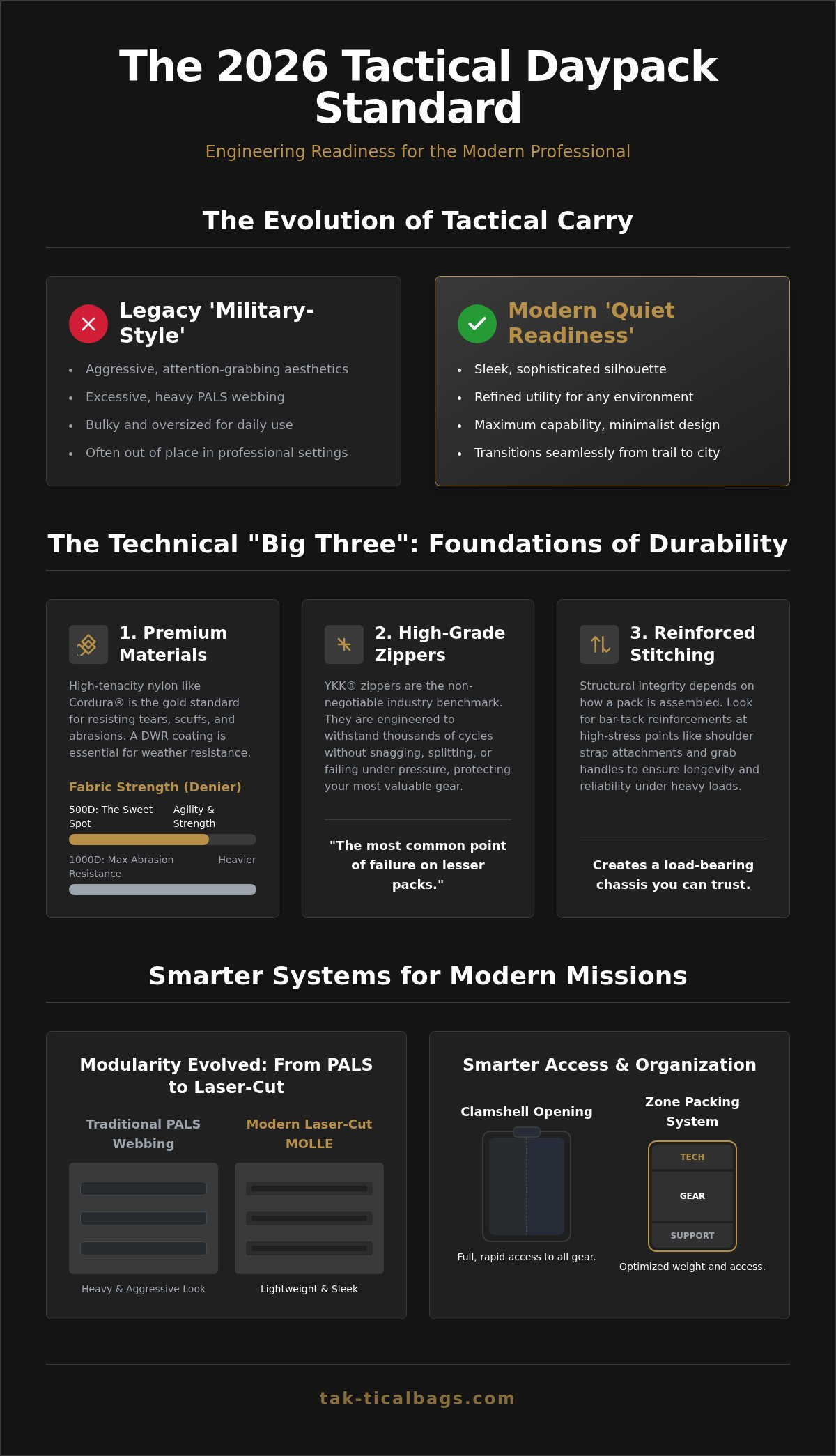
The 2026 tactical hiking daypack is no longer defined by aggressive aesthetics or excessive webbing. It has evolved. Today, it functions as a high-performance modular system designed for the modern professional. Legacy "military-style" bags often prioritized bulk and a battlefield look that felt out of place in urban settings. Modern design has moved toward refined utility. This shift focuses on a sleek, minimalist exterior that conceals a complex internal architecture. Efficiency is the goal. Readiness is the result.
Tactical now signifies readiness for any environment, not just combat. It describes gear that integrates into your life. Whether you're navigating a mountain ridge or a metropolitan transit system, your carry must adapt. You need a pack that offers military-grade protection without the aesthetic baggage of the past. It's about movement, integration, and a sophisticated approach to daily challenges.
The Evolution of Tactical Carry
Movement requires efficiency. We've transitioned from oversized, heavy rucksacks to streamlined daypacks built for speed. This evolution was accelerated by the Everyday Carry (EDC) movement. Users began demanding gear that could protect a laptop as effectively as a hydration bladder. Design requirements changed. Modern packs must be agile. Quiet Readiness is the 2026 design standard, defined as maximum capability hidden within a sophisticated and understated silhouette. It allows you to move through the world with confidence, knowing your gear is prepared for the unexpected without drawing unnecessary attention.
Why Durability is the New Luxury
Quality is the ultimate sustainable choice. There is a practical elegance in buying one high-quality bag instead of three cheap ones that fail within a season. Tactical materials aren't just for rugged terrain; they are a shield for your expensive tech. High-denier fabrics and weather-resistant coatings ensure your digital tools stay dry during a sudden downpour. This protection offers more than just physical security. It provides emotional value. There is a profound sense of organized calm that comes from gear you can trust. When the weather turns or the terrain gets difficult, your pack remains a reliable partner. It's an investment in your own efficiency and peace of mind.
Engineering Readiness: Key Technical Features to Demand
Engineering a superior tactical hiking daypack requires technical precision. It is not enough for a bag to look rugged. It must perform under pressure. True durability relies on the "Big Three": materials, zippers, and stitching. These elements dictate whether your gear survives a decade of use or fails during its first storm. High-quality construction creates a sense of modern reliability that cheaper alternatives cannot match.
Fabric strength is measured in Denier (D). This rating indicates the thickness and weight of the individual fibers used in the weave. While 1000D nylon offers maximum abrasion resistance, 500D is often the preferred choice for a tactical hiking daypack. It provides an ideal balance of strength and agility. This material protects your essentials without adding unnecessary bulk to your frame, allowing for faster movement across varied terrain.
Material Science: Cordura and Beyond
High-tenacity nylon remains the industry gold standard. It is engineered to resist tears and scuffs that would shred standard polyester bags. For the modern professional, a water-resistant DWR coating is essential. This finish ensures a seamless transition from a rainy trail to a dry office, keeping your internal tech secure and dry. Hardware matters just as much as the fabric. YKK zippers are non-negotiable for tactical gear. They are designed to withstand thousands of cycles without snagging or splitting. Cheap zippers are the most common point of failure. Don't settle for anything less than these proven components.
Modularity and the MOLLE System
Modularity allows you to customize your carry for specific missions. The PALS (Pouch Attachment Ladder System) webbing grid is the foundation of this flexibility. While traditional webbing can look overly aggressive, 2026 designs utilize laser-cut MOLLE. These precise slots are cut directly into the face of the fabric. This method reduces weight and maintains a sleek, professional appearance. You can attach hiking poles, water bottle pouches, or specialized tech cases only when you need them. This level of adaptability is key to a purposeful carry system that evolves with your journey.
Ergonomics complete the package. A pack that carries heavy loads must distribute weight across your body effectively. Demand reinforced back panels with integrated airflow channels to prevent heat buildup. Padded, S-curve shoulder straps and adjustable sternum straps are vital for long-term comfort. When your gear fits correctly, it feels like an extension of your body. You can focus on the trail rather than the burden on your back.
Tactical vs. Traditional: Decoding the Best Carry for Your Terrain
Choosing between a tactical hiking daypack and a traditional trekking bag is a decision between modularity and specialized minimalism. Traditional hiking packs prioritize absolute weight reduction. They often utilize internal frames and thin polyester fabrics. While lightweight, these materials lack the structural integrity required for heavy tech or rugged environments. Tactical designs favor reinforced back panels over rigid frames. This creates a lower profile, allowing you to move through dense brush or crowded transit systems without snagging.
Aesthetics also play a critical role in versatility. Traditional gear often features high-visibility neon colors designed for trail safety. These shades feel out of place in a professional setting. Tactical tones like charcoal, olive, and deep obsidian offer a sophisticated alternative. They provide an understated appearance that transitions seamlessly from the summit to the city. Long-term value is another differentiator. A tactical bag built from high-grade nylon will consistently outlast a lightweight polyester pack. It is an investment in longevity rather than a temporary solution.
The Clamshell Advantage
Accessibility defines efficiency. Traditional rucksacks typically use top-loading designs. This creates a "black hole" effect where items at the bottom are impossible to reach without unpacking everything. Tactical packs utilize a clamshell opening. This full-zip design allows the bag to lay flat, enabling you to pack and organize your gear like a suitcase. You can see every item instantly. For those looking to master their internal layout, The Art of the Everyday Carry Backpack provides a deeper look into purposeful organization. It's about finding what you need exactly when you need it.
Load-Bearing Ergonomics
Comfort is non-negotiable. Even a small load becomes a burden if the weight isn't distributed correctly. Tactical weight management relies on sternum straps and low-profile waist belts to stabilize the pack during movement. S-curve shoulder straps are essential. They follow the natural contours of your body, preventing the straps from digging into your chest or neck during long-distance day hikes. A well-fitted 20L to 30L daypack should rest securely against the small of your back without restricting shoulder mobility. This balance ensures you remain agile and focused on the journey ahead.
Strategic Packing: Maximizing Your Daypack for 2026 Adventures
Efficiency is a skill. Packing is the execution. To master your carry, adopt the Zone Packing method. This strategy prioritizes weight distribution to maintain your natural center of gravity. Place your heaviest items, such as hardware or dense gear, directly against the back panel near your spine. This prevents the pack from pulling backward and straining your shoulders. Medium-weight items belong in the center, while light, bulky gear like a mid-layer should occupy the bottom. A tactical hiking daypack should feel like an extension of your body, not a burden pulling you off balance.
Internal mesh pockets are the key to organized calm. Use them to isolate digital essentials from trail gear. Cables, multi-tools, and nutrition bars should have dedicated homes to prevent a cluttered main compartment. For external gear, utilize low-profile attachment points. Secure tripods or trekking poles tightly to the sides to maintain a minimalist profile. This ensures you can move through dense brush or crowded transit systems without snagging on your surroundings.
The Hybrid Packing List
Modern readiness often requires carrying a 16-inch laptop and a 3L hydration bladder simultaneously. Transitioning between these environments requires a hybrid setup. Use reinforced internal sleeves to provide a rigid barrier for your tech, protecting it from both impact and potential moisture from a reservoir. This dual-utility approach allows you to move from a remote workspace to a summit push without switching bags. For a deeper look at maximizing your loadout, explore The Best Hiking Backpacks of 2026. It's about achieving technical excellence through smart organization.
Transitioning from Trail to City
Moving from the wilderness to a professional setting requires a change in silhouette. Compression straps are vital here. Once you've stowed your trail gear, tighten these straps to reduce the bag's volume. This creates a sleeker, more professional appearance for urban travel. Quick-change strategies involve keeping hiking-specific accessories in secondary pockets while maintaining clear access to your tech compartments. You can find the perfect balance of aesthetics and utility in our collection of refined hiking bags. Proper packing ensures you always project an image of composed readiness, regardless of your destination.
Elevating the Mission: Why Tak-tical Redefines the Tactical Daypack
Tak-tical designs for the modern citizen. We believe a tactical hiking daypack should do more than survive the trail. It must enhance your daily life. Our philosophy centers on functional excellence and practical elegance. We strip away the unnecessary. We focus on what matters. This approach creates gear that feels both authoritative and approachable. It is carry gear built for those who value movement and integration.
Our direct-to-consumer model is a strategic advantage. It ensures premium quality without the traditional retail markup or "tactical tax." You receive professional-grade materials and refined construction at a fair value. We invite you to join a community of travelers who value organization and purpose. Efficiency is a choice. Readiness is a standard. We provide the tools to help you meet both.
Design That Respects Your Time
Visual noise is a distraction. Streamlined aesthetics create a sense of organized calm in a chaotic world. When your bag looks clean, your mind follows. Every pocket in our design serves a specific purpose. There is a dedicated spot for every essential item, from your hydration reservoir to your secure tech. This level of integration saves seconds throughout your day. These seconds add up to a more efficient life. We are a partner in your daily journey, ensuring you stay focused on your mission rather than your gear.
Craftsmanship Built for the Future
We prioritize refinement. Our focus on high-quality materials ensures your gear remains relevant for years to come. Sleek integration is not just about looks. It is about how the bag moves with you through different environments. A Tak-tical bag is an investment in long-term readiness. It is built to endure the unpredictable. Choose gear that reflects your commitment to functional excellence. Explore our collection of tactical style everyday backpacks and elevate your carry today.
Mastering the Art of Purposeful Carry
The 2026 standard for utility is defined by quiet readiness. You now understand that a tactical hiking daypack is a high-performance modular system designed for any terrain, from the remote summit to the city center. By prioritizing premium materials and strategic internal organization, you transform your daily carry from a burden into a reliable partner. We've identified the technical requirements for long-term durability and the ergonomic features that ensure your comfort over miles of unpredictable terrain. True readiness is about having everything you need exactly where you expect it.
Tak-tical delivers a sophisticated, minimalist design for the modern traveler. Our direct-to-consumer model ensures you receive premium tactical-grade materials without the unnecessary retail markup. It's time to stop settling for gear that fails after one season. Invest in craftsmanship built for the future and enjoy the organized calm of a perfectly packed bag. Your next adventure deserves a solution that matches your ambition and your personal style.
Elevate your carry with Tak-tical’s refined hiking daypacks. Step forward with the confidence of being fully prepared for whatever the journey brings.
Frequently Asked Questions
Is a tactical daypack suitable for professional office environments?
Yes, if the design prioritizes a minimalist aesthetic. Modern 2026 trends favor "Quiet Readiness," which moves away from excessive external straps and camouflage patterns. A sleek, solid-colored pack in charcoal or obsidian transitions seamlessly from the trail to the boardroom. These designs provide the durability of tactical gear without the aggressive look that often feels out of place in a corporate setting. It's about refined utility.
What is the best size for a tactical hiking daypack?
A capacity of 20 to 30 liters is the industry standard for a tactical hiking daypack. This size provides enough volume for essential trail gear and a laptop while remaining agile for urban commuting. If you're planning a full day on the trail, 25 liters is often the "sweet spot." It balances storage capacity with a low-profile silhouette that doesn't restrict your natural movement.
Are tactical backpacks waterproof or just water-resistant?
Most tactical packs are water-resistant rather than fully waterproof. They utilize high-denier fabrics like 500D or 1000D nylon treated with a Durable Water Repellent (DWR) coating. This protection handles sudden downpours and light snow effectively. For total submersion, you'd need a specialized dry bag. For most hikers and commuters, the standard water-resistant finish offers sufficient protection for electronics and gear in unpredictable weather conditions.
Can I carry a laptop in a tactical hiking bag safely?
Yes, provided the bag includes a dedicated, padded internal sleeve. Many modern tactical designs prioritize tech protection as part of their modular system. Look for sleeves that are "suspended" to prevent the laptop from hitting the ground when you set the bag down. This integration allows you to carry a 16-inch laptop alongside a hydration bladder, making the bag a versatile partner for work and adventure.
How do I clean and maintain a tactical nylon backpack?
Hand wash your pack with mild soap and lukewarm water. Avoid washing machines, as they can damage the DWR coating and the structural integrity of the back panel. Use a soft brush for stubborn stains on the nylon fibers. Rinse the bag thoroughly and air dry it in the shade. Regular maintenance, such as checking zippers for debris, ensures your investment remains a reliable partner for years.
What is MOLLE and do I really need it for hiking?
MOLLE is a modular attachment system that uses a grid of webbing to secure extra pouches or gear. While not strictly required for every hike, it offers unmatched versatility. You can attach water bottle holders or trekking poles only when they're needed. Modern laser-cut systems provide this utility with a much sleeker profile. This allows you to customize your tactical hiking daypack without adding unnecessary visual noise.
Why are tactical backpacks more expensive than standard daypacks?
The cost reflects the use of premium, military-grade materials and reinforced construction techniques. Tactical bags utilize high-tenacity nylon, YKK zippers, and heavy-duty stitching that standard polyester bags simply lack. These components are built to survive extreme conditions and heavy loads. While the initial investment is higher, the long-term value is superior. You're paying for gear that outlasts multiple cheaper alternatives over a decade of use.
How should a tactical daypack fit for maximum comfort?
The pack should sit high on your back with the weight distributed close to your spine. Adjust the shoulder straps so the bag rests securely against your shoulder blades without gaps. Use the sternum strap to prevent the shoulder straps from sliding outward during movement. If the bag has a waist belt, it should sit on your hip bones to transfer weight away from your shoulders. A proper fit ensures organized calm.