
Your backpack shouldn't force a choice between looking like a corporate drone or a tactical operative. Most professionals settle for flimsy bags that fail during a sudden downpour or bulky rucksacks that feel out of place in a boardroom. It's time to stop compromising. You deserve a carry solution that integrates rugged readiness with a polished, minimalist silhouette.
Finding the best commuter backpack means looking for gear that balances tactical-grade durability with professional sophistication. You likely already know the frustration of disorganized tech pockets and poor weight distribution that leads to chronic shoulder strain. This guide helps you navigate these pain points by identifying the features that truly matter for a seamless daily journey.
We'll examine how modern materials and intentional design create a bag that transitions effortlessly from the morning transit to the executive office. Expect a clear look at specialized tech protection, ergonomic support, and the streamlined aesthetics defining urban navigation in 2026.
Key Takeaways
- Transform your daily carry into a mobile headquarters that integrates work, health, and travel requirements into one streamlined system.
- Discover how high-denier fabrics and weather-resistant components define the best commuter backpack for 2026, ensuring your technology remains secure in any weather.
- Prioritize the "Logic of Access" with suspended laptop sleeves and specialized compartments that organize your essentials for rapid, intuitive retrieval.
- Optimize your comfort with advanced ergonomic features like load lifters and contoured straps that distribute weight for a fatigue-free journey.
- Select a carry solution that balances tactical-grade durability with a minimalist professional aesthetic to suit both the boardroom and the street.
Redefining the Commute: Why Your Bag is Your Mobile Headquarters
The daily commute has evolved. It's no longer a simple gap between your front door and your desk. In 2026, the best commuter backpack serves as a mobile headquarters. It houses your workstation, your gym essentials, and your travel documents in one cohesive unit. This shift isn't just about carrying gear; it's about supporting a lifestyle that refuses to stay in one place. You need a system that facilitates movement without friction.
We've moved beyond the era of "just a bag." Today, professionals demand a purposeful carry system. This transition reflects a deeper understanding of backpack designs and history, where utility originally met rugged necessity. Now, that same ruggedness must survive the urban jungle. You require tactical-level durability to protect your hardware from unpredictable weather and heavy use, but you don't want the aggressive military aesthetic. You want the strength of a mountain pack with the elegance of a tailored suit.
There's a significant psychological edge to this approach. When every item has a dedicated, intuitive home, your brain experiences a sense of organized calm. You aren't fumbling for keys at the subway gate or digging for a charging cable during a client presentation. You're composed. You're ready. This mental clarity is the true benefit of high-end engineering.
The Environment Transition: From Boardroom to Transit
Minimalist design is the bridge between these worlds. A clean silhouette ensures you can walk into a high-stakes meeting with professional confidence. It doesn't look cheap, and it doesn't look like you're heading to a campsite. On a crowded train, that same sleek profile prevents you from snagging on fellow passengers or getting caught in closing doors. Versatility is the new standard. Your bag must adapt as quickly as your schedule does, moving from a professional setting to a social one without missing a beat.
Purposeful Readiness: Beyond the Daily Grind
Modern life doesn't stop at 5 PM. The best backpacks for work now transition seamlessly into weekend adventures. They offer enough volume for a change of clothes and a small toiletry kit, effectively doubling as premium carry-on bags for short trips. Readiness means knowing your gear is protected regardless of where the journey takes you. Purposeful carry is the intentional integration of high-level utility and refined aesthetics.
Technical Excellence: Materials and Weatherproofing for the Urban Elements
The best commuter backpack isn't just a container. It's a shield. In 2026, the materials used in premium carry have reached a tipping point. You no longer have to carry a heavy, rubberized rucksack to keep your laptop dry. Modern textile engineering offers high-denier strength with a fraction of the weight found in traditional gear. This balance is critical for reducing ergonomic risks during long transits where every ounce matters.
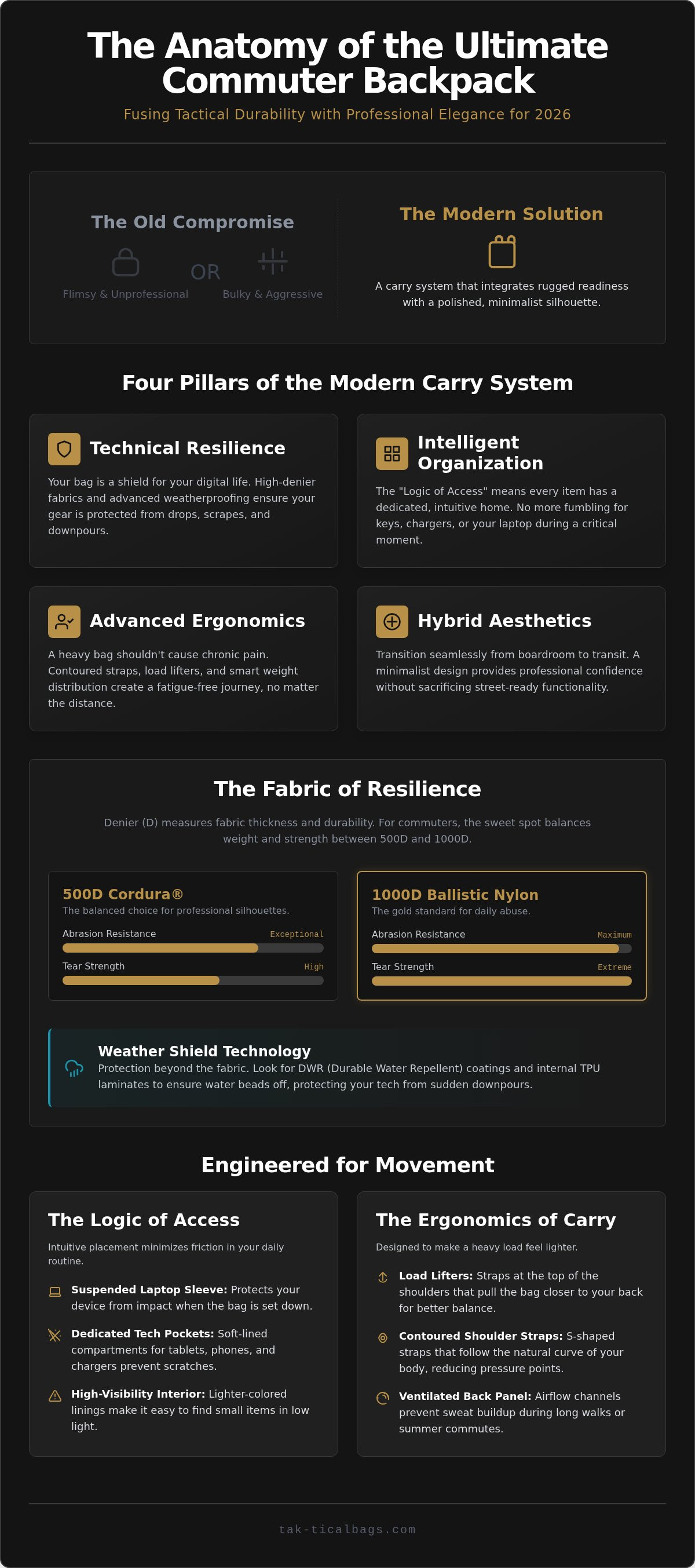
Understanding water resistance is vital for urban navigation. Most commuters don't need a bag rated for deep-sea submersion. You need protection against the persistent drizzle of a London morning or a sudden New York downpour. Look for DWR (Durable Water Repellent) coatings and internal TPU laminates. These layers ensure water beads off the surface instead of soaking into your expensive hardware. It's about maintaining readiness regardless of the forecast.
The Fabric of Resilience: Cordura and Ballistic Nylon
Denier measures the thickness of the fibers in your bag's fabric. For the best commuter backpack, the sweet spot lies between 500D and 1000D. 500D Cordura provides exceptional abrasion resistance while remaining supple enough for a professional silhouette. 1000D Ballistic Nylon offers nearly twice the tear strength. It's the gold standard for those who put their gear through daily abuse on crowded subways. Integrating these materials into an everyday carry backpack ensures your investment lasts for years, not just seasons.
Durability testing provides the proof. High-end manufacturers now subject fabrics to Martindale tests to simulate years of friction against clothing. This ensures your bag won't pill your wool coat or fray at the corners after six months of use. Choosing these materials means prioritizing longevity over fast-fashion alternatives that fail when you need them most.
Hardware That Holds: Zippers and Buckles
The zipper is the most common failure point. If the teeth misalign, the entire bag becomes useless. This is why YKK zippers are non-negotiable for serious professionals. Specifically, look for Aqua-guard or reverse-coil zippers on the laptop compartment. These designs feature a polyurethane coating that creates a physical barrier against moisture. It's a small detail that prevents a catastrophic tech failure during a storm.
Hardware is also evolving toward silent utility. Traditional plastic buckles are loud and feel cheap. In 2026, the move is toward magnetic Fidlock systems and anodized aluminum hardware. These provide secure, one-handed operation that feels premium and stays quiet in a hushed office environment. If you value this level of technical detail, explore our full collection of technical carry designed for the modern professional.
Sophisticated Organization: Protecting Your Digital and Daily Essentials
Effective organization follows a clear hierarchy. You shouldn't hunt for your phone, keys, or transit pass. The best commuter backpack uses a "Logic of Access" strategy. This means placing high-frequency items in external, quick-access pockets. Deep-storage gear stays in the main compartment. This layout creates a sense of organized calm. It's the difference between a cluttered bag and a tool that anticipates your every move.
Managing tech clutter is the hallmark of a premium carry system. Cables, dongles, and power banks shouldn't sit in a tangled heap at the bottom of your pack. Internal mesh pockets provide visibility and security for small peripherals. A dedicated admin panel keeps your pens, notebooks, and everyday tools upright and accessible. It's about maintaining a professional workflow while you're on the move, ensuring you're ready for a meeting at a moment's notice.
Protection extends beyond simple padding. The best commuter backpack integrates structural reinforcement to guard against the bumps of urban transit. Whether you're navigating a crowded elevator or a busy train platform, your essentials remain secure. This level of intentional design ensures your gear stays in pristine condition, regardless of how demanding your daily journey becomes.
The Suspended Laptop Sleeve: A Study in Protection
A standard pocket isn't enough for modern hardware. Sophisticated laptop bags utilize a suspended design, often called a "false bottom." This ensures your device never touches the ground when you set your bag down. It creates a protective air gap that absorbs impact. These sleeves must accommodate the 14-inch and 16-inch devices common in 2026. Soft-touch linings are also essential. They prevent micro-scratches on premium aluminum casings during transit.
Capacity vs. Profile: Finding Your Ideal Volume
Volume dictates your daily rhythm. A 15L pack is perfect for the minimalist who only carries a laptop and a light layer. A 20L bag is the standard for most professionals. If your "gym-to-office" routine requires a change of shoes and clothes, look for 26L or expandable options. Clamshell openings allow for full visibility and easy packing. Top-loaders offer a slimmer, more aerodynamic profile for crowded urban spaces. Choose the volume that supports your specific journey without adding unnecessary bulk.
The Ergonomics of Movement: Comfort for the Long-Distance Commuter
A bag is only as good as it feels after forty minutes of transit. You might find the best commuter backpack based on aesthetics, but if the harness system fails, the experience becomes a burden. Comfort in 2026 is a matter of physics. It's about how a bag manages the center of gravity against your spine. High-end urban carry utilizes load lifters, small straps at the top of the harness, to pull the weight closer to your back. This prevents the pack from pulling backward and straining your neck.
Many "minimalist" brands prioritize a thin strap profile to look sleek. This often results in a painful failure under heavy tech loads. When you carry a laptop, tablet, and power banks, thin straps dig into the trapezius muscles. Professional carry requires substance. You need a harness that distributes pressure across a wider surface area without looking like a bulky camping rucksack. It's the difference between a bag you tolerate and one you forget you're wearing.
Urban versatility also demands a removable sternum strap. While essential for stabilizing a heavy load during a sprint for the train, a dangling chest strap looks out of place in a professional lobby. The ability to snap it off or hide it away maintains your polished silhouette while providing technical support when the journey gets demanding.
Contoured Straps and Load Distribution
The shape of your straps determines how the bag interacts with your body. J-curve straps are traditional and work well for many, but S-curve straps are often superior for broader shoulders or those wearing structured blazers. They follow the natural contours of the chest, preventing the fabric from bunching up your professional attire. High-density EVA foam is the internal hero here. Unlike cheap open-cell foam, it won't compress or "bottom out" over time, ensuring the cushion stays effective for years. Proper weight distribution can make a 10lb load feel like 5lb.
Ventilation and Back Panel Design
Avoiding the "sweaty back" syndrome is a primary concern for the active professional. The science of air-mesh and molded foam channels creates a chimney effect, allowing heat to escape upward as you move. This requires a delicate balance. You want maximum airflow without a back panel that looks like a plastic ribcage. The best hiking backpacks provide the blueprint for this level of comfort, showing how to manage heat and moisture during high-output activity. By adapting these technical insights for the city, you achieve a dry, composed arrival at your destination. If you're ready to upgrade your daily journey, explore our ergonomically engineered backpacks designed for the modern professional.
Choosing Your Commuter Backpack: The Tak-tical Approach to Functional Elegance
At Tak-tical, our design philosophy centers on durability without excess. We believe the best commuter backpack shouldn't force you to choose between the ruggedness of a hiking pack and the elegance of a professional briefcase. Instead, we bridge that gap. We take the high-stakes reliability of tactical gear and refine it into a minimalist silhouette. This approach ensures you remain prepared for the unpredictable nature of urban navigation while maintaining a composed, professional image.
Direct-to-consumer quality is the standard for 2026. By removing traditional retail markups, we focus resources on premium components like Cordura fabrics and magnetic hardware. You aren't just buying a bag; you're investing in a tool designed for purposeful readiness. Every stitch and pocket exists to support your daily journey, providing an organized calm that empowers your movement through the city.
The Refined Tactical Aesthetic
Traditional tactical gear is often loud and aggressive. For the modern professional, we use a more sophisticated language. We integrate subtle MOLLE webbing or hidden attachment points that provide modularity without the "military" look. These features allow you to customize your carry while keeping the exterior clean. We favor matte finishes and a neutral palette of Black, Slate, and Olive. These tones ensure your bag complements a tailored suit as easily as a casual weekend outfit. Tactical style everyday backpacks have become the ultimate choice because they offer superior utility within a refined, urban-ready frame.
The Investment in Longevity
Sustainability in the carry industry starts with quality. Replacing a cheap, flimsy bag every year creates unnecessary waste and recurring costs. A premium commuter backpack is a long-term investment. When you calculate the "cost per wear" over several years of daily use, high-end gear often proves more economical than budget alternatives. It's about buying better, not more. Before you make your final selection, consider this checklist:
- Does the laptop sleeve offer a suspended "false bottom" for drop protection?
- Are the zippers weather-resistant to protect your digital essentials?
- Is the silhouette streamlined enough for crowded transit?
- Does the harness system include load lifters for ergonomic support?
- Can the bag transition from a professional office to a weekend trip?
If the answer to these questions is yes, you've found a carry solution that will serve you for years to come. Elevate your daily journey with the Tak-tical collection.
Master Your Daily Journey
Your daily journey is more than a simple transition between spaces. It's a strategic operation that requires the right equipment. Selecting the best commuter backpack is about finding a tool that balances rugged durability with a refined, minimalist aesthetic. You now understand how technical materials and ergonomic harness systems transform a heavy load into a manageable, organized carry. This is the foundation of purposeful urban navigation.
Don't settle for gear that fails during a downpour or looks out of place in a professional setting. Our designs ensure tactical-grade durability meets minimalist urban design. You'll gain peace of mind with suspended laptop protection engineered specifically for digital professionals. We provide the tools for an organized calm; you provide the momentum. We also offer free global shipping on all purposeful carry gear to support your readiness from day one.
Browse the Tak-tical Commuter Collection and redefine your mobile headquarters. Step into your next commute with the confidence of a well-organized professional. Your journey deserves excellence.
Frequently Asked Questions
What is the ideal size for a commuter backpack?
The ideal size typically ranges between 15 and 26 liters. A 20L volume serves as the standard for most professionals, providing enough space for a laptop, chargers, and a light jacket. If your routine includes a visit to the gym or carrying a change of shoes, look toward 26L. Minimalists who only carry digital essentials will find 15L sufficient for a sleek, low-profile journey.
Are tactical backpacks professional enough for an office environment?
Tactical backpacks are professional enough for the office when they feature a refined, minimalist design. The best commuter backpack blends tactical-grade durability with a clean silhouette that avoids aggressive military aesthetics. Look for subtle attachment points and matte finishes in neutral tones like black or slate. This balance ensures your gear performs in the field while maintaining a composed image in the boardroom.
What is the difference between water-resistant and waterproof backpacks?
Water-resistant backpacks use coatings like DWR to bead moisture off the surface during typical rain. Waterproof bags are often fully submersible and use heavy, rubberized materials. Most urban professionals only require high-level water resistance. This provides ample protection for tech during a commute without the added bulk and weight of a fully waterproof rucksack. It's about readiness for the elements without unnecessary excess.
How do I protect my laptop in a commuter backpack?
Protect your laptop by choosing a bag with a suspended sleeve, also known as a false bottom. This design creates a protective air gap between your device and the floor, absorbing impact if the bag is dropped. Ensure the sleeve is padded and lined with soft-touch fabric to prevent scratches. This structural reinforcement is critical for anyone carrying premium hardware through the unpredictable bumps of public transit.
Do I really need a sternum strap for a city commute?
You need a sternum strap if your commute involves long walks or frequent sprints for the train. It stabilizes the load and prevents the shoulder straps from sliding, which reduces fatigue. For a city commute, a removable or hideaway strap is the best choice. This allows you to utilize the technical support during transit and maintain a polished, professional look once you enter the office.
What materials are the most durable for daily use?
Cordura and Ballistic Nylon are the most durable materials for daily urban use. A denier count between 500D and 1000D offers the perfect balance of abrasion resistance and weight. These tactical-grade fabrics outlast standard polyester and keep your gear looking new for years. Investing in these high-performance textiles ensures your best commuter backpack survives the friction and stress of a daily mobile lifestyle.
How do I clean and maintain my premium commuter backpack?
Clean your premium backpack by spot treating stains with a damp cloth and mild, non-detergent soap. Avoid machine washing or drying, as the heat and agitation can damage technical coatings and structural foam. Regularly check zippers for debris and wipe them down to ensure smooth operation. Proper maintenance preserves the bag's water resistance and aesthetic appeal, extending the life of your investment for the long term.