
Your gear should be an extension of your intent, not a burden on your performance. Most explorers believe they must choose between a lightweight hiking backpack built for speed and a heavy frame built for survival. You've likely felt the physical toll of an overbuilt bag. You've also seen the failure of flimsy fabrics that trade durability for a lower number on the scale. It's a compromise that no longer serves the purposeful traveler.
True readiness requires a more sophisticated approach. We'll show you how to balance technical weight reduction with the tactical resilience required for unpredictable terrain. This guide explores how to reduce physical strain while maintaining the organization your lifestyle demands. Discover a pack that lasts years, not seasons, and integrates seamlessly from the urban environment to the summit. Your journey deserves gear that is light, durable, and prepared for anything.
Key Takeaways
- Master the transition from heavy traditional frames to minimalist designs that prioritize long-term trail endurance.
- Decode the science of high-tenacity fabrics to find a lightweight hiking backpack that offers both speed and tactical durability.
- Discover how modularity and intentional organization outperform the limitations of standard, single-compartment ultralight bags.
- Follow a precise framework for selecting your ideal pack volume by calculating base weight and specific mission requirements.
- Learn to integrate professional-grade gear into a sophisticated lifestyle that transitions seamlessly from the city to the summit.
The Evolution of the Lightweight Hiking Backpack
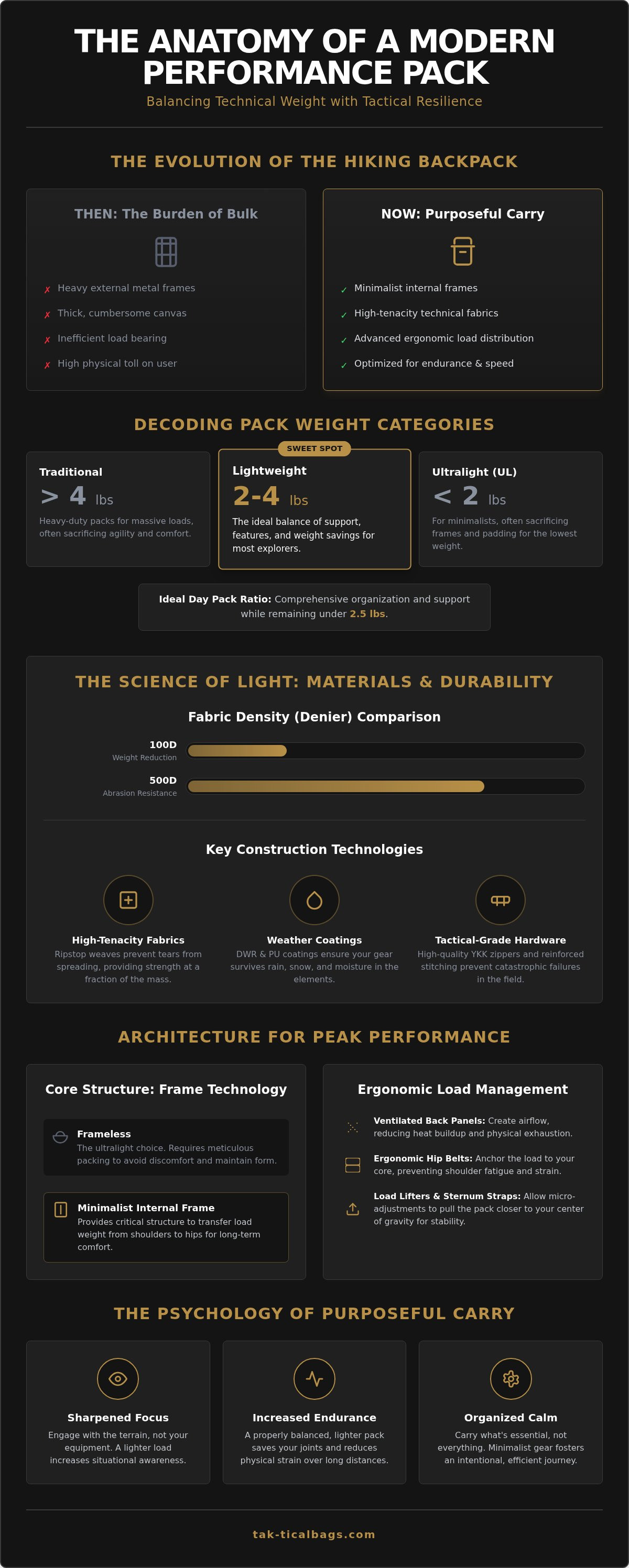
The era of the rigid, heavy external frame has passed. Historically, durability required thick canvas and cumbersome metal supports. Today, the history of ultralight backpacking reveals a trajectory toward material intelligence. We've moved from carrying excess to a philosophy of purposeful carry. A modern lightweight hiking backpack is no longer just a container. It's a technical tool designed to maximize trail endurance. By 2026, the focus has shifted from merely stripping weight to optimizing every gram for speed and comfort.
Distinguishing between lightweight and ultralight (UL) is essential for the modern explorer. A lightweight pack usually weighs between 2 and 4 pounds, offering a refined balance of support and weight savings. Ultralight gear often drops below 2 pounds, frequently sacrificing internal frames or padding. For most, the goal isn't the absolute lowest number. It's about gear that disappears on your back. Modern high-tenacity polyesters and advanced Ripstop nylon have redefined durability. They prove that a lighter pack can withstand seasons of rugged use without failure.
The Psychology of Purposeful Carry
A lighter load does more than save your joints. It sharpens your focus. When you aren't fighting a shifting, heavy mass, your situational awareness increases. You engage with the terrain rather than your equipment. Minimalist gear fosters a sense of organized calm. It prompts you to evaluate what's truly essential for the journey. Being ready for anything doesn't require carrying everything. It requires carrying the right items, curated for efficiency and ease of movement.
Weight vs. Utility: The Modern Trade-off
Stripping weight eventually reaches a point of diminishing returns. Sacrificing a ventilated back panel or intuitive pocket systems for a few saved ounces often results in a less capable pack. These features provide the utility that makes a long trek sustainable. While some thru-hikers prefer a simple sack, the modern day-hiker demands organization and versatility. The ideal weight-to-utility ratio for a day pack is achieved when the bag provides comprehensive organization and structural support while remaining under 2.5 pounds. This balance ensures you stay fast, organized, and ready for the next peak.
Materials and Architecture: The Science of Light
Engineering a superior lightweight hiking backpack requires a deep understanding of textile density. Denier (D) is the standard metric here. It measures the linear mass density of fibers. A higher denier, such as 500D, provides exceptional abrasion resistance for rugged terrain. Conversely, a 100D fabric prioritizes weight reduction for high-speed movement. Modern technical fabrics like Ripstop nylon and high-tenacity polyesters offer a middle ground. They provide the strength of traditional materials at a fraction of the mass. While Dyneema is often cited for its strength-to-weight ratio, tactical construction methods using reinforced polyesters often provide better long-term value and organization.
Durability isn't just about the fabric. It's about how that fabric is held together. Tactical-grade stitching and weather-resistant coatings, such as Polyurethane (PU) or Durable Water Repellent (DWR), ensure your gear survives the elements. High-quality hardware and YKK zippers add negligible weight but prevent catastrophic failures in the field. This level of material intelligence ensures your pack remains a reliable partner. Choosing the right hiking bags means looking beyond the weight tag to the architecture beneath.
Frame Technology and Load Distribution
The debate between internal frames and frameless designs is central to pack selection. Frameless packs are the hallmark of ultralight enthusiasts, yet they require meticulous packing to avoid discomfort. Most explorers benefit from a minimalist internal frame. These structures provide the necessary rigidity to transfer weight to the pelvic structure. A well-designed hip belt is essential for this transition. It prevents shoulder fatigue by anchoring the load to your core. Proper ergonomic backpack design also incorporates ventilated back panels. These systems create airflow, reducing heat buildup and physical exhaustion during high-output adventures.
Ergonomics of the Modern Strapping System
Straps are the primary interface between you and your gear. S-curve shoulder straps generally offer a better fit for diverse body types, contouring around the chest and torso. J-curve straps are more traditional, often preferred by those with broader builds. Load lifters and sternum straps are the hidden heroes of trail comfort. They allow for micro-adjustments that pull the pack closer to your center of gravity. Padding density also matters. Soft padding feels good in the store, but high-density foam maintains its shape over long distances. This prevents the straps from digging into your trapezius muscles after hours of movement. Every adjustment point serves a singular purpose: keeping you agile and ready.
Tactical Efficiency vs. Traditional Hiking Packs
The "one big sack" philosophy dominates much of the ultralight market. This approach prioritizes a single metric: weight. While effective for thru-hikers covering thousands of miles, it often fails the modern adventurer. A lightweight hiking backpack should offer more than just a low number on a scale. It should offer efficiency. Tactical organization provides a structured environment where every piece of gear has a designated position. This isn't just about convenience. It's about readiness. When you can access your rain shell or medical kit in seconds, you're better equipped for the trail's unpredictability.
Tactical-grade materials also redefine the durability conversation. Many traditional hiking bags use thin sil-nylon that tears on the first encounter with granite or dense brush. Tactical-inspired designs utilize high-tenacity weaves that resist punctures and abrasions. These packs handle talus fields and overgrown paths without compromise. They also integrate modularity through MOLLE systems. This allows you to scale your carry up or down based on the mission. You aren't locked into a fixed volume. You're empowered by a system that adapts to your specific needs.
The Problem with "One Big Pocket"
The "ultralight sack" creates a retrieval problem. In fast-access scenarios, digging through a deep main compartment is inefficient. Dedicated hydration sleeves and tech-ready internals solve this issue. They secure your most critical items while keeping them accessible. A tactical layout balances this external accessibility with internal security. Your gear stays organized, even when the terrain becomes vertical. This structure prevents the "load shift" common in unstructured bags, maintaining your balance and focus on the trail.
Versatility: From Commute to Canyon
A refined hiking bag doesn't look out of place in a professional setting. The modern adventurer demands gear that transitions from the morning commute to a weekend canyon trek. A sleek, low-profile design navigates crowded transit as easily as it moves through dense forest. This versatility makes it the ultimate high-performance travel carry-on. If you're looking for a solution that bridges the gap between professional life and outdoor exploration, check out the Best backpacks for work guide for 2026. Choosing a pack with a sophisticated aesthetic ensures you're always prepared, regardless of the environment.
A Framework for Selecting Your Lightweight Pack
Selecting a lightweight hiking backpack is a strategic decision. It requires a systematic approach to ensure your gear supports your movement rather than hindering it. Follow this five-step framework to find a pack that aligns with your specific mission profile.
- Step 1: Calculate your Base Weight. Your pack should be the final acquisition in your gear list. Sum the weight of your essentials, excluding food and water. This total dictates the suspension strength required.
- Step 2: Determine volume needs. Match the capacity to your duration. A pack that is too large encourages "packing for fears," leading to unnecessary weight.
- Step 3: Measure your torso length. Precision fit is non-negotiable. Measure from your C7 vertebra to the top of your iliac crest to ensure the frame aligns with your anatomy.
- Step 4: Audit your organization needs. Consider your reliance on hydration bladders, tech sleeves, or external tool attachments.
- Step 5: Test with a realistic load. A pack feels different under tension. Load it with your expected weight and move through a range of motion.
Volume Guidelines for the Modern Hiker
Capacity is about efficiency, not just space. An 18L to 25L pack is the sweet spot for technical day-hikes and summit pushes. It forces a minimalist discipline while providing enough room for layers and water. For weekend adventures or gear-heavy excursions, look toward the 28L to 35L range. Avoid the temptation to over-size. Excess volume often results in a shifting load that compromises your stability on technical terrain.
The Fit Test: Ensuring Long-Term Comfort
Comfort on the trail is won or lost in the first mile. Identify hot spots early by paying attention to pressure on the collarbone or friction at the lower back. Adjust your harness based on the gradient. On steep ascents, tighten the load lifters to bring the weight forward. On descents, loosen them slightly to allow for more shoulder mobility. Learning how to pack a backpack for a day hike is just as important as the pack itself. Proper weight distribution eliminates fatigue and keeps you focused on the horizon. Ready to upgrade your carry? Explore our collection of premium hiking bags designed for purposeful readiness.
Elevating Your Adventure with Tak-tical
Tak-tical exists at the intersection of high-performance utility and refined aesthetics. We believe your gear should reflect a commitment to excellence. A lightweight hiking backpack shouldn't force a choice between technical capability and professional appearance. Our design philosophy centers on purposeful readiness. We create tools for the individual who moves seamlessly between environments. Whether you're navigating a mountain pass or a metropolitan transit hub, your carry remains consistent. We build gear for those who value both form and function.
We prioritize both organization and weight in every design. Most lightweight bags sacrifice internal structure to save grams. We reject this compromise. Our packs use material intelligence to provide the durability of tactical gear without the traditional bulk. By operating as a direct-to-consumer brand, we deliver premium craftsmanship without the traditional retail markup. You receive professional-grade equipment designed for the modern citizen. This is gear built for years of use, not just a single season. It's an investment in reliable, long-term performance.
Integrated Features for the Modern Trail
Versatility is the core of our architecture. Every pack features dedicated hydration routing for the trail alongside secure, padded laptop integration for the city. We merge tactical-inspired durability with minimalist aesthetics. This ensures your bag looks as sharp in a professional setting as it does on a granite ridge. We use high-tenacity fabrics that resist the elements while maintaining a sleek, low-profile silhouette. Every zipper, strap, and pocket serves a specific function. There's no clutter. Only performance. You're prepared for the commute and the canyon alike.
Join the Ready-for-Anything Community
Investing in high-quality gear is an investment in your lifestyle. It's about supporting a mobile, active existence with tools that won't fail when the terrain gets tough. Our community values efficiency, organization, and craftsmanship. We invite you to experience the difference that intentional design makes in your daily journey. Take the next step toward elevated readiness and explore our curated collection of Hiking Bags to find your perfect partner for the trail. Tak-tical delivers the ultimate fusion of modern reliability and sophisticated style for the intentional explorer.
Equipping Your Next Objective
Mastering the trail requires a shift from carrying everything to carrying what matters. You've learned that a superior lightweight hiking backpack is defined by its material intelligence and ergonomic precision rather than a single weight metric. By prioritizing tactical organization over the "one big sack" philosophy, you gain the efficiency needed for unpredictable environments. Proper fit and volume selection ensure that your gear remains an extension of your body, supporting your endurance instead of hindering it.
Modern readiness is about integration. It's about gear that transitions from the boardroom to the brush without a loss of utility or style. Tak-tical provides this balance through professional-grade craftsmanship and a commitment to functional excellence. With tactical-grade durability and minimalist, sophisticated design, our bags are built for the modern traveler who demands reliability across every border. We offer global shipping to ensure you're prepared for any horizon.
Elevate your carry with Tak-tical Hiking Bags. Your next adventure begins with the right foundation. Stay focused, stay agile, and keep moving forward.
Frequently Asked Questions
What is considered a "lightweight" hiking backpack?
A lightweight pack typically weighs between 2 and 4 pounds. This distinguishes it from ultralight options that often drop below 2 pounds by removing essential structural elements. A quality lightweight hiking backpack maintains a balance between mass reduction and necessary support. It provides enough rigidity to carry loads up to 30 pounds comfortably. This category is ideal for hikers who value speed without sacrificing the durability needed for technical terrain.
Can I use a lightweight hiking backpack for daily commuting?
Yes, modern technical bags are designed for a seamless transition between environments. A refined pack often includes dedicated sleeves for tech and hydration routing. This versatility allows you to move from a professional setting to a trail without changing your gear. The sleek, minimalist aesthetic ensures the bag looks appropriate in an urban landscape. It functions as a high-performance tool for both the daily commute and weekend exploration.
How do I know what size (liter capacity) I need for a day hike?
Capacity depends on your specific mission and the gear required for safety. For most technical day hikes, a volume of 18L to 25L is the standard. This size accommodates water, layers, and emergency tools without encouraging over-packing. If your journey involves heavy photography equipment or winter layers, consider a 28L to 35L pack. Choosing a purposeful volume prevents unnecessary weight and keeps your movement agile on the ridge.
Are lightweight backpacks less durable than heavy-duty rucksacks?
Not necessarily, as material science has redefined what it means to be durable. Modern high-tenacity polyesters and Ripstop nylon provide exceptional abrasion resistance with minimal weight. While traditional heavy rucksacks use thick canvas, a technical lightweight hiking backpack utilizes advanced weaves to handle talus and brush. Durability is now a result of material intelligence and reinforced construction rather than sheer fabric thickness or weight.
Should I choose an internal frame or a frameless backpack?
Most explorers benefit from a minimalist internal frame for better load distribution. Frameless designs are lighter but require expert packing to avoid discomfort and hot spots. An internal frame transfers weight to your pelvic structure, reducing strain on your shoulders and spine. This is essential for maintaining situational awareness and endurance during long treks. Choose a frame if you prioritize a controlled carry and consistent comfort across varying terrain.
How do I clean and maintain a technical lightweight backpack?
Maintain your pack by wiping it with a damp cloth and mild soap after every use. Avoid harsh detergents or machine washing, as these can damage weather-resistant coatings like DWR or PU. Pay close attention to zippers and hardware, removing dirt or grit that can cause failure. Store your bag in a cool, dry place away from direct sunlight. Consistent care ensures your gear remains a reliable partner for years of service.
What is the best way to adjust a hiking backpack for the first time?
Start by loosening all straps and loading the pack with realistic weight. Anchor the hip belt first, ensuring it sits firmly on your iliac crest to support the load. Tighten the shoulder straps so they contour to your body without pulling the weight off your hips. Adjust the sternum strap to stabilize the harness. Finally, use the load lifters to pull the pack closer to your center of gravity for maximum stability.
Is a tactical-style backpack heavier than a standard hiking pack?
While some tactical bags prioritize heavy fabrics, a sophisticated hybrid design maintains a competitive weight profile. These packs integrate tactical-grade durability with minimalist architecture to stay light and agile. The addition of modular systems like MOLLE adds negligible weight while providing significant utility. You gain superior organization and resilience without the burden of a traditional, overbuilt rucksack. It's about achieving high-performance readiness through smarter, not heavier, construction.