
The wrong volume doesn't just weigh down your shoulders; it compromises your entire experience. You've likely felt the friction of a bulky pack that catches on every branch or the anxiety of a minimalist bag that leaves no room for a vital layer. Deciding what size hiking backpack for a day hike is a strategic choice, not a guess. It's about finding that precise equilibrium where you are fully equipped but entirely unburdened.
You want gear that works as hard as you do without looking out of place in a modern environment. We agree that a bag should be an extension of your intent, not a hindrance to your pace. This guide will help you master the art of volume selection to ensure your next adventure is defined by effortless movement and tactical readiness. We'll preview the 2026 standards for short and full-day treks, explain the 20 to 30 liter sweet spot, and show you how to achieve a seamless transition from urban streets to mountain trails without sacrificing safety or aesthetics.
Key Takeaways
- Identify the 10L to 30L gold standard for day hikes, selecting the minimalist tier for speed or higher volumes for technical readiness.
- Learn how to determine what size hiking backpack for a day hike is necessary by factoring in seasonal insulation and specific terrain requirements.
- Map your gear to specific liter capacities using tactical organization techniques that prioritize rapid access and spatial efficiency.
- Optimize comfort through precise ergonomic integration, focusing on torso length and load-dispersing hip belts for a secure fit.
- Adopt a "one bag" philosophy with high-durability materials that bridge the gap between technical trails and urban environments.
Defining the Standard: Capacity Ranges for the Modern Day Hike
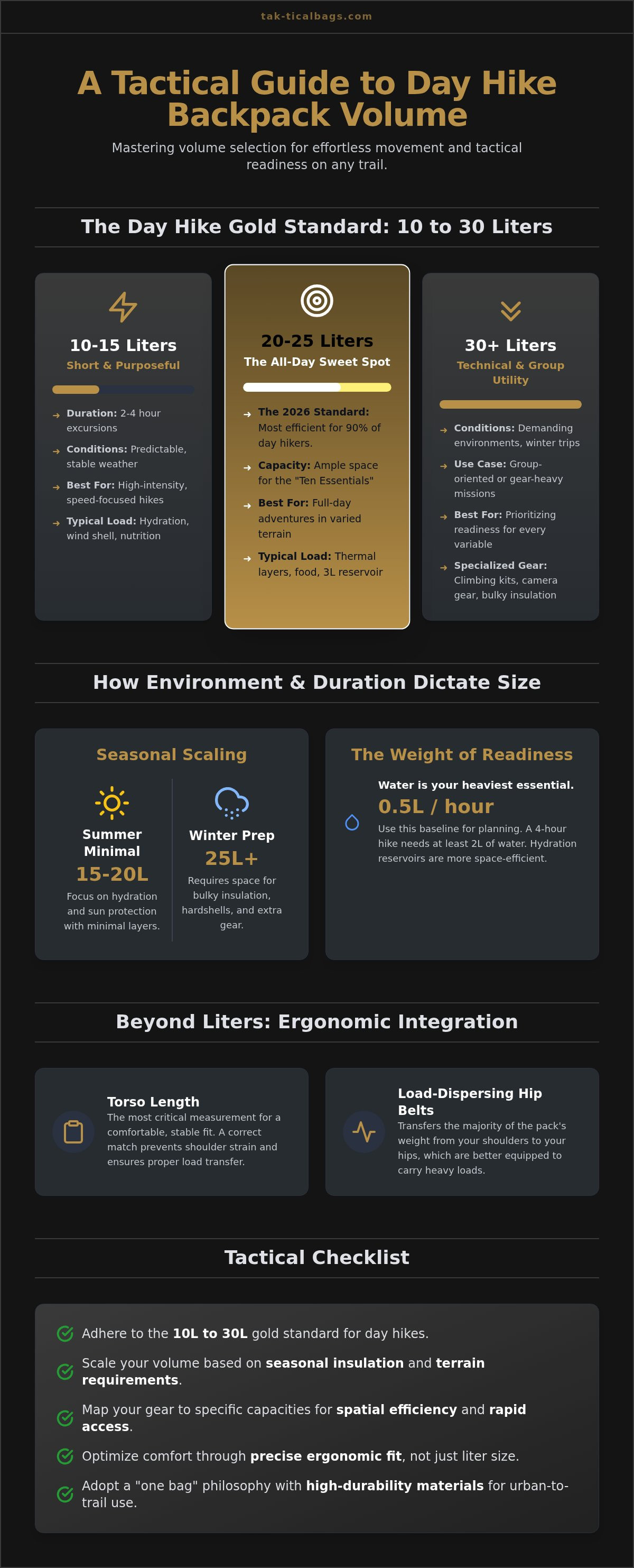
Precision starts with volume. For the modern adventurer, the industry gold standard for a single day on the trail falls strictly between 10 and 30 liters. This range ensures you remain agile without compromising on strategic readiness. Understanding what size hiking backpack for a day hike fits your specific objective, the current climate, and your commitment to minimalist efficiency is vital. A well-chosen bag feels like a natural extension of your body rather than an external burden.
The 10-15 Liter Range: Short and Purposeful
Speed defines the 10 to 15 liter category. These packs are designed for 2 to 4 hour excursions where weather patterns remain predictable and stable. You don't need excessive storage; you need immediate accessibility. Focus on carrying a high-performance hydration bladder, a compressible wind shell, and targeted nutrition. This volume is particularly effective for high-intensity movement or those who require a bag that transitions seamlessly from an urban environment to a local trailhead. It represents the refined choice for the professional who values a minimalist approach to high-quality gear.
The 20-25 Liter Range: The All-Day Sweet Spot
Versatility lives in the 20 to 25 liter mid-range. This pack size provides ample space for the Ten Essentials without the burden of unnecessary bulk. It accommodates a full day's worth of supplies, including thermal layers, a comprehensive lunch, and a 3-liter hydration reservoir. 20L is the most efficient volume for 90% of day hikers in 2026. This size allows for organized calm. Everything has a dedicated place, from your headlamp to your specialized safety gear. Whether you're exploring technical coastal cliffs or dense forest paths, this capacity maintains your center of gravity and supports effortless movement.
The 30 Liter Plus Range: Technical and Group Utility
Capacity requirements increase when the environment becomes more demanding. Packs exceeding 30 liters are the standard for gear-heavy missions or group-oriented trips. They are essential when your journey involves specialized equipment like climbing harnesses, ropes, or professional-grade camera kits. While Backpacking (hiking) often focuses on multi-day treks, a 30L to 35L pack serves as a high-capacity day bag for winter conditions where bulky insulation and heavy shells are non-negotiable. It is the sophisticated choice for those who prioritize readiness for every variable.
Variables of Volume: How Environment and Duration Dictate Size
Volume requirements shift based on your environment. Deciding what size hiking backpack for a day hike requires assessing external factors before you pack a single item. It's a calculation of risk versus duration. You must prioritize tactical readiness while maintaining physical efficiency. A bag that is too small forces compromises on safety. One that is too large invites unnecessary weight. The goal is a streamlined profile that adapts to the day's specific demands.
Seasonal Scaling: Summer Minimal vs. Winter Prep
Climate dictates capacity. In peak summer, your primary concern is hydration and sun protection. You can often operate within a 15L to 20L range. Winter demands more. You need space for bulky down mid-layers, hardshells, and spare gloves. A 25L bag is often safer for variable mountain weather. It provides the necessary buffer to store layers as you generate heat without overstuffing the main compartment. This adaptability ensures you remain prepared for sudden temperature drops common in alpine settings. It prevents the frustration of lashing gear to the outside of your pack, which can throw off your balance on technical terrain.
The Weight of Readiness: Water and Nutrition
Water is your heaviest essential. Use a baseline of 0.5L per hour for planning. A four-hour hike requires 2L, while a full day might demand 4L or more. Rigid bottles offer durability, but soft-sided hydration reservoirs are more spatially efficient as they shrink during use. Pair this with high-calorie, low-volume nutrition to maximize internal space. Organizing these items effectively allows you to carry The Ten Essentials without feeling weighed down. If your current bag feels cramped, exploring specialized hiking bags designed for efficient weight distribution can transform your trail experience. Proper placement of these heavy items near your back is crucial for maintaining an ergonomic carry.
Terrain influences your gear list significantly. Steep, technical trails may require specialized safety equipment or trekking poles that need external attachment points. Don't assume a larger bag is inherently heavier. Modern designs use high-tenacity fabrics that provide volume without the weight penalty. Finally, consider the group dynamic. If you're carrying supplies for children or pets, your individual volume needs will naturally scale upward. A 30L pack becomes the standard when you're the primary gear mule for the team. It allows you to maintain organization while serving as the anchor for the group's safety, ensuring everyone remains comfortable and prepared.
Spatial Efficiency: Mapping Your Gear to Specific Liter Capacities
Efficiency is about more than total volume. It's about how you utilize every cubic inch. When determining what size hiking backpack for a day hike, consider the internal architecture. Tactical organization uses specialized pockets to keep high-frequency items within reach. External attachment points like MOLLE webbing or lash loops offer modular expansion for lightweight gear. This keeps the main compartment streamlined while ensuring you're ready for any contingency. A dedicated laptop sleeve is also vital for those who merge professional duties with trail time.
The 15L Loadout: Speed and Agility
A 15L pack is built for momentum. It's the choice for high-intensity summits or well-marked local trails where speed is the priority. You move faster when you carry less. This volume forces a disciplined approach to packing. It's the refined choice for the minimalist athlete who values a sleek profile.
- 2L hydration bladder
- Ultralight rain shell
- Strategic nutrition like energy bars and gels
- Compact first aid kit
- Communication devices and keys
Choosing the best functional hiking daypacks in this size ensures you maintain a low profile. It's about carrying exactly what you need. Nothing more. It's the ultimate tool for fast-paced excursions.
The 25L Loadout: The Strategic Explorer
25L is the definitive volume for remote trails and unpredictable forecasts. It accommodates a comprehensive list of gear without sacrificing mobility. This size provides the necessary buffer for changing conditions. It's the most versatile capacity for the dedicated explorer who requires all-day autonomy.
- 3L hydration reservoir
- Insulating fleece and hardshell
- Full midday meal
- Portable power bank and headlamp
- Small mirrorless camera or binoculars
This capacity allows you to carry the American Hiking Society's 'Ten Essentials' comfortably. It's the ideal size for a tactical hiking backpack because it balances internal storage with external utility. You have room for safety gear and comfort items without the bulk of a multi-day bag. It empowers you to go further.
Packs at the 35L mark serve the gear-intensive trekker or the family leader. They provide a buffer for group supplies or technical hardware. This capacity is also perfect for winter hikes where layers are thicker and more numerous. It maintains the "one bag" philosophy by offering enough space for a full day of autonomy in harsh environments. You stay organized. You stay ready. You stay mobile regardless of the load.
Precision Fit: Beyond Liters to Ergonomic Integration
Capacity is a hollow metric without the context of fit. You can select the perfect volume, but if the bag doesn't align with your biomechanics, you'll still feel fatigued. Deciding what size hiking backpack for a day hike requires an understanding of ergonomic integration. A well-fitted pack distributes weight across your skeletal structure rather than straining your soft tissues. It transforms a heavy load into a manageable extension of your movement. Fit is performance.
Measuring for Success: Torso and Waist
Sizing is specific. The "one size fits all" approach is a myth for serious day hikers who value comfort and efficiency. Your torso length, not your height, determines which pack frame will sit correctly on your hips. The C7 vertebra is the primary starting point for measuring your torso. Use this three-step guide to find your measurement at home:
- Locate the C7: Tilt your head forward to find the bony protrusion at the base of your neck.
- Find the Iliac Crest: Place your hands on the top of your hip bones, pointing your thumbs toward your spine.
- Measure the Distance: Have a partner measure the vertical span between the C7 and the line created by your thumbs.
This number ensures the shoulder straps wrap comfortably without gapping. A precise fit is the difference between a bag that bounces and one that stays anchored during technical ascents. Explore our collection of ergonomic hiking bags to find your perfect fit.
Dynamic Load Management
Fit is not static. Effective load management ensures that no matter what size hiking backpack for a day hike you choose, the carry remains effortless. As you consume water and food, the internal volume of your bag decreases. You must adjust your straps on the go to maintain a sleek, tight profile. Compression straps are essential here. They keep a half-empty bag stable by pulling the weight closer to your back. This offers a distinct tactical benefit: reduced noise and movement during high-activity sections. You don't want your gear shifting as you navigate a narrow ridge or a crowded urban transit line.
The role of the hip belt changes with the load. In smaller 15L packs, the belt provides stabilization to prevent lateral sway. Once you move into 20L+ bags, the belt shifts to weight transfer, moving the load from your shoulders to your hips. Pair this with sternum straps and load-lifters to fine-tune the center of gravity. Finally, consider the back panel design. Proximity to the back offers better stability for technical trails; suspended mesh panels prioritize ventilation to manage your energy levels in high heat. Choose the design that aligns with your typical environment.
The Versatile Carry: Transitioning from Urban EDC to Technical Trails
Efficiency isn't just about volume. It's about how many environments your gear can master. The "One Bag" philosophy posits that a refined tactical daypack is the ultimate investment for the modern citizen. It eliminates the friction of switching gear between the office and the trailhead. When you determine what size hiking backpack for a day hike, consider the value of a bag that transitions seamlessly across your entire lifestyle. You want gear that reflects a commitment to functional excellence in every setting. A single, high-quality pack creates a sense of organized calm in a fast-paced world.
Durability Without Excess
Durability is non-negotiable for the versatile explorer. 500D Cordura offers a superior balance of weight and tensile strength. It resists the snags of dense brush and the daily wear of urban transit. Lightweight ripstop is often too fragile for long-term tactical use. It lacks the structural integrity to hold its shape when underloaded. Purposeful design includes water-resistant coatings and industry-standard YKK zippers to protect your essentials from the elements. This ensures your gear remains dry during a sudden alpine storm or a morning commute. Read our heavy duty backpack guide for a deeper dive into material science and readiness.
Strategic Selection: The Tak-tical Advantage
Bridging the gap between tactical utility and practical aesthetics requires restraint. Tak-tical designs prioritize minimalist branding and sleek silhouettes. This allows your bag to look at home in a high-end cafe and on a technical granite peak. It projects an image of professional confidence and modern reliability. Determining what size hiking backpack for a day hike doesn't have to mean choosing between a trail-only bag and a city-only bag. You need a partner that understands the demands of a mobile lifestyle. Explore our collection of best hiking backpacks to find your perfect fit.
For maximum 2026 utility, we recommend a 22-26L bag. This volume is the definitive sweet spot for those who value both aesthetics and readiness. It provides enough space for a full day of autonomy while maintaining a compact, sophisticated profile. It fits under an airplane seat as easily as it navigates a narrow ridge line. Invest in a bag that supports your movement, integrates your technology, and withstands the rigors of the trail. This is the hallmark of a truly versatile carry system.
Mastering the Art of the Day Carry
Capacity is the foundation of a successful excursion. It's the difference between feeling weighed down and moving with purpose. You now understand that the 10 to 30 liter range provides the essential framework for modern hiking. By mapping your gear to specific volumes and prioritizing ergonomic fit, you ensure that every mile is defined by comfort rather than fatigue. Choosing what size hiking backpack for a day hike is a strategic decision that bridges the gap between your professional life and your outdoor ambitions.
A refined carry system allows you to maintain an organized calm regardless of the terrain. Our bags are optimized for ergonomic comfort and minimalist organization, ensuring you stay ready for any contingency. Built with high-tenacity, weather-resistant materials, they are designed for seamless transitions from city to trail. Elevate your journey with a Tak-tical hiking daypack and experience the power of purposeful readiness. Your next adventure starts with a single, sophisticated choice. Step out with confidence and enjoy the path ahead.
Frequently Asked Questions
Is an 18L backpack big enough for a day hike?
An 18L pack is sufficient for three to five hour treks in mild conditions. It comfortably accommodates a 2L reservoir, a compact first aid kit, and high-calorie nutrition. This size is perfect for those who prioritize agility and a low profile. If you're wondering what size hiking backpack for a day hike fits a minimalist lifestyle, 18L is the definitive answer. It bridges the gap between a running vest and a full-sized pack.
What size backpack do I need for a 10-mile hike?
For a 10-mile journey, a 22L to 25L pack provides the necessary autonomy. This distance typically requires 3L of water and multiple meal breaks. You'll need space for a hardshell and an insulating layer as your body temperature fluctuates. This volume ensures you remain prepared for changing altitudes and unpredictable mountain weather without sacrificing your center of gravity or pace. It is the most versatile choice for serious explorers.
Can I use a regular school backpack for a day hike?
A standard school bag is functional for flat, well-marked paths but fails on technical terrain. These bags lack the structural support and ventilation required for high-exertion movement. They often absorb sweat and cause shoulder strain due to poor weight distribution. Investing in a dedicated hiking bag ensures your gear remains stable and your back stays dry throughout the journey. Purpose-built gear is essential for maintaining organized calm on the trail.
How much should a day hike backpack weigh when fully loaded?
Your total pack weight should ideally stay below 15% of your body weight for optimal comfort. For a standard day trip, this usually ranges between 12 and 18 pounds. Water is the heaviest component; a full 3L reservoir alone weighs approximately 6.6 pounds. Monitoring your load ensures you maintain a brisk pace and avoid unnecessary skeletal stress during steep ascents. Lightness is a tactical advantage in the backcountry.
Is 30L too big for a daypack?
30L is not too large if your mission demands specific gear. It is the standard for winter excursions where bulky layers are mandatory for safety. This volume is also ideal for the designated group leader who carries extra supplies for others. While larger than a minimalist bag, a 30L pack with compression straps remains sleek and stable. It's the sophisticated choice for those who value more is ready over less is more.
What are the 'Ten Essentials' I should fit in my hiking bag?
The Ten Essentials include navigation, a headlamp, sun protection, first aid, a knife, fire starters, emergency shelter, extra food, extra water, and insulating layers. These items are non-negotiable for safety. A well-organized 20L bag easily accommodates this list. Using internal pockets ensures each item is accessible the moment it's needed. This level of preparation maintains your readiness and composure when conditions shift. Knowing what size hiking backpack for a day hike you need starts with this list.
Does torso length matter for a small daypack?
Torso length is critical for weight distribution regardless of pack volume. If the frame is too long, the pack will pull away from your shoulders. If it is too short, it will sit awkwardly on your lower back. A correct fit transfers the load to your hips, allowing for effortless movement. This ergonomic integration is vital for preventing long-term fatigue during repetitive trail movements. It ensures your bag feels like a natural extension of your body.
How do I clean my tactical hiking backpack after a trip?
Maintain your tactical hiking backpack by hand-washing it with cool water and a pH-neutral soap. Never use a washing machine or dryer. High heat can damage weather-resistant coatings and YKK zippers. Use a soft nylon brush for stubborn trail dirt. Hang the bag to air dry in a well-ventilated, shaded area to prevent UV degradation of the high-tenacity fabrics. Proper care preserves the professional aesthetics and functional longevity of your investment.