
A poorly packed bag is a physical tax on your journey. You've likely felt the familiar pull of uneven weight or the frustration of digging for a map while the light fades. These distractions compromise your focus and your pace. Learning how to pack a backpack for a day hike isn't just about fitting items inside. It's about engineering a system that moves with you. Efficiency on the trail begins long before you reach the trailhead.
Mastering the technical art of load distribution ensures your next outing is defined by effortless movement and total readiness. We'll refine your approach to organization by prioritizing stability and instant access to essentials. This guide explores the strategic placement of gear and a tactical, minimalist mindset. You'll learn to eliminate unnecessary bulk while keeping the Ten Essentials within reach. Transform your pack into a streamlined tool for peak performance and organized calm. Prepare for a journey where your gear feels like an extension of your body rather than a burden.
Key Takeaways
- Adopt a minimalist mindset to eliminate unnecessary bulk and maintain a stable center of gravity.
- Master the three-zone strategy to learn how to pack a backpack for a day hike with perfect vertical and horizontal balance.
- Curate a refined kit of the Ten Essentials for maximum safety and readiness without sacrificing speed.
- Prioritize internal storage to achieve a sleek, snag-free profile while leveraging lash points for oversized gear.
- Integrate professional utility with outdoor performance to ensure your gear transitions seamlessly from the trail to the city.
Mastering the Fundamentals of Day Hike Preparation
Preparation is the foundation of performance. A pack shouldn't feel like an external weight. It should function as a seamless extension of your body. The ultimate goal is a stable load that mirrors your center of gravity. When weight shifts or sags, your muscles overcompensate. This leads to premature fatigue and long-term strain. Mastering how to pack a backpack for a day hike starts with a shift in perspective. Adopt a minimalist mindset. Every ounce must earn its place. If an item doesn't serve a specific, verified purpose, it stays home. This discipline creates an organized calm. It allows you to focus on the terrain rather than your gear. Precision in packing is a choice that yields physical freedom.
Assessing Your Environment and Duration
Before touching your gear, analyze the variables. Evaluate trail difficulty and the specific weather patterns predicted for 2026. Microclimates can shift rapidly. Your kit must reflect these possibilities without overpacking. Determine the precise volume your route demands. A four-hour trek requires a different strategy than a full-day ascent. Readiness is the calculated intersection of high-performance gear and a disciplined strategy.
The Pre-Pack Ritual: Laying Out Your Kit
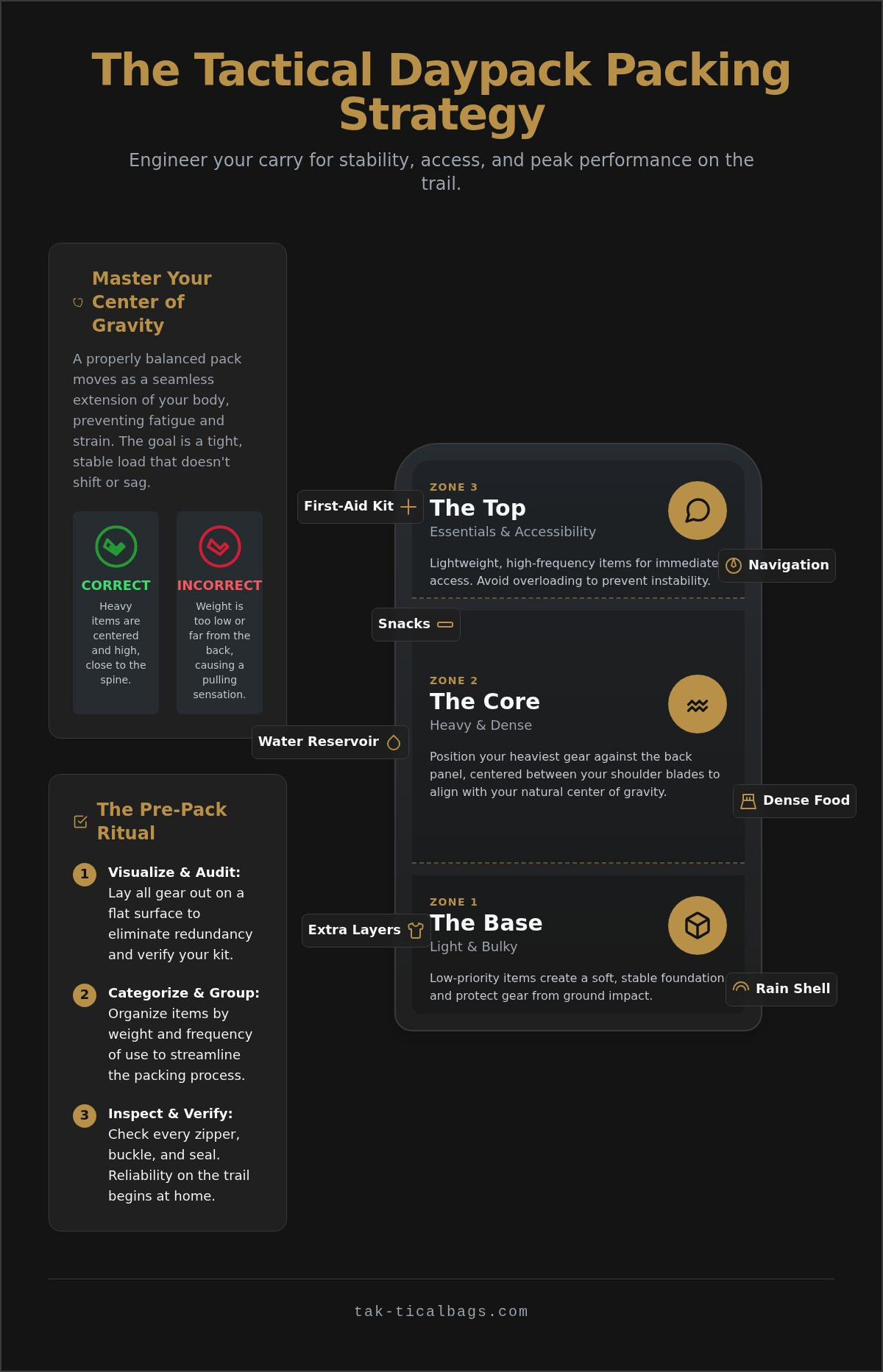
Visualize your carry before it enters the bag. Lay everything out on a flat surface to see the complete picture. This visual audit prevents oversight and redundant packing. It's a moment of intentional organization. Group your items into logical categories based on weight and utility. Tactical organization begins with visibility.
- Frequency of use: Items like navigation tools, sun protection, and snacks stay in reachable pockets.
- Weight: Identify heavy water reserves and tools for central placement near the spine.
- Integrity: Verify the function of every zipper, buckle, and waterproof seal.
A refined kit depends on the total reliability of its components. Inspecting your equipment now prevents critical failure on the trail. This ritual ensures your focus remains on the movement, not the maintenance. High-quality craftsmanship deserves a high-quality packing strategy. By treating your gear with professional respect, you ensure it performs when the environment demands it most.
The Three-Zone Strategy for Optimal Weight Distribution
Packing a daypack requires a different tactical approach than a multi-day rucksack. You aren't carrying a sleeping bag or a tent. The challenge lies in maintaining agility within a 15L to 30L volume range. Vertical weight distribution is your priority. Keep the heaviest mass close to your spine. This prevents the pack from pulling your shoulders back and straining your lower back. Horizontal balance is equally vital. A lopsided bag forces your core to work harder. Understanding how to pack a backpack for a day hike requires a specific focus on these smaller volumes. Use integrated compression straps to lock the load. A tight, compressed pack is a stable pack. It moves with you, not against you.
Zone 1: The Base (Light and Bulky)
Place low-priority items at the very bottom. These are things you won't need until you reach your destination or the weather shifts. Extra layers, a lightweight rain shell, or a sit pad belong here. This creates a soft foundation. It protects more delicate gear from ground impact when you set the bag down. Think of the base as a buffer. It fills the lower corners of the bag to maintain its shape and structure.
Zone 2: The Core (Heavy and Dense)
This is the engine room of your carry. Position your heaviest gear here. Water bladders and dense food containers must sit against the back panel. Center this mass between your shoulder blades. This aligns the weight with your natural center of gravity. Use softer items, like a spare mid-layer, to pad the core. This prevents dense objects from shifting during technical movement. A functional hiking daypack provides the necessary internal structure to keep this weight secure. This strategy is the most efficient way to learn how to pack a backpack for a day hike while maintaining peak agility.
Zone 3: The Top (Essentials and Accessibility)
The top zone is for immediate utility. Store your first aid kit, snacks, and navigation tools here. These items must be accessible in seconds. Don't overload this area with heavy items. Too much weight at the top makes the pack head-heavy. It causes sway and instability on uneven trails. Balance accessibility with stability. If your pack has a lid pocket, reserve it for small, high-frequency items like lip balm or a headlamp. Refine your carry with a precision-engineered hiking bag designed for the modern explorer.
Essential Gear: Curating Your Tactical Day Hike Kit
Success on the trail is defined by what you leave behind as much as what you carry. Curating a tactical kit requires a ruthless focus on utility. You must move beyond a simple checklist. Embrace a system of readiness. Understanding how to pack a backpack for a day hike involves selecting gear that serves multiple functions. The Ten Essentials remain your baseline. However, modern preparation demands a more refined approach. Every item should be lightweight, durable, and integrated into your overall movement. This is not about survival alone. It is about maintaining a state of high-performance efficiency throughout your journey.
Hydration management is a critical factor in load stability. Water bladders offer superior weight distribution by keeping the mass centered in Zone 2. They allow for consistent sipping without breaking your stride. Bottles, conversely, are easier to refill at trailside sources and monitor for volume. Choose the system that fits your route's water availability. Eliminate "dead space" by using soft items like your insulation layer to fill gaps. This prevents heavier gear from shifting and disrupting your balance. Modern 2026 technical fabrics allow for high warmth-to-weight ratios. These materials compress easily. They are perfect for filling voids in your rucksack and ensuring a silent, stable carry.
Navigation and Safety Essentials
Rely on digital tools for primary navigation but never ignore the necessity of analogue backups. A GPS-enabled device or smartphone is efficient until the battery fails or the signal drops. Always carry a physical map and compass. These tools don't require power. Your first aid kit should be compact and tailored. Focus on blister care, minor abrasions, and emergency meds. For fast-paced, high-altitude missions, a small hiking backpack provides the minimalist profile needed for technical summits. Readiness is a calculated balance of technology and tradition.
Nutrition and Hydration Management
Calibrate your fuel for high-density energy. Avoid bulky packaging that creates waste and takes up valuable volume. Focus on nutrient-dense snacks like nuts, dried fruit, or electrolyte-rich bars. When planning your water capacity, consider the environment. If water sources are abundant, carrying a filter and a smaller initial load reduces weight. If the terrain is arid, you must carry your full capacity from the start. Position your primary water source for instant access. You shouldn't have to remove your pack to take a drink. Maintaining hydration is essential for mental clarity and physical endurance on the trail.
Refining the Load: External Attachments and Accessibility
Efficiency is often found in what remains hidden. A minimalist carry philosophy dictates that if an item can fit inside, it should stay inside. External gear creates drag. It snags on brush. It shifts your center of gravity. When you master how to pack a backpack for a day hike, you prioritize a sleek, snag-free profile. Use daisy chains and lash points only for items that cannot be compressed, such as trekking poles or technical tools. Secure these tightly. Movement is the enemy of stability. Every dangling item is a potential distraction from the trail ahead.
Accessibility is the second half of the equation. Your "strike zone" consists of hip belt and shoulder strap pockets. These areas offer instant access without breaking your pace. Reserve them for high-frequency tools: navigation, snacks, or sun protection. Once the bag is full, utilize the compression straps. Pull them tight. This eliminates internal shifting and keeps the load close to your frame. A well-compressed pack feels lighter because it moves in unison with your torso. Refinement is the process of removing anything that doesn't serve your movement.
Managing External Gear Safely
Safety on technical terrain requires a streamlined bag. Loose straps are a liability; they snag on rock faces or dense vegetation. Ensure every buckle is tucked and every tether is taut. Balance any external weight across the pack's centerline. If you carry poles on the left, ensure your hydration or tools on the right provide a counterweight. For moisture protection, prioritize internal dry bags over external rain covers. Dry bags keep your gear organized and dry without the flapping bulk of a cover. Explore the Tak-tical collection for bags engineered with integrated lash points and streamlined profiles.
The Final Hoist: Adjusting for Comfort
Loading the bag is only the first step. The final adjustment ritual ensures the weight transfers to your skeletal structure. This process should be deliberate and sequential. Follow these steps for a perfect fit:
- Hip Belt: Secure this first to transfer the majority of the weight to your hips.
- Shoulder Straps: Pull these down and back to keep the pack flush against your spine.
- Load Lifters: Tension these last to angle the weight forward and stabilize the top of the pack.
Conduct a "jump test" once you're buckled in. If you feel the load shift or hear gear rattling, stop and re-tighten. For a deeper dive into weight transfer mechanics, see how do you pack a backpack for advanced hoisting techniques. A silent, stable carry is the hallmark of a professional hiker. It allows for organized calm in even the most unpredictable environments.
Transitioning from City to Trail with Tak-tical
The modern journey rarely follows a single, predictable path. You require gear that navigates the professional landscape and the alpine with equal composure. A high-performance day hiking rucksack is no longer a specialized tool for the wilderness alone. It is a versatile partner for a mobile, active lifestyle. By applying the principles of how to pack a backpack for a day hike to your daily commute, you achieve a higher standard of organized efficiency. Technical readiness isn't a seasonal activity. It's a daily commitment to functional excellence. Your gear should reflect this integration of utility and style.
Tak-tical design philosophy bridges the gap between urban environments and unpredictable trails. We prioritize materials that withstand the rigours of 2026 global travel. This means utilizing weather-resistant textiles and reinforced stress points that don't compromise on a sleek, minimalist aesthetic. Your carry should remain professional in a boardroom and reliable on a ridge line. This versatility ensures that your investment provides value across every environment you inhabit. When you understand how to pack a backpack for a day hike, you develop a spatial awareness that translates to every bag you own. Efficiency is a habit, not just a packing list.
Why Technical Design Matters
Engineering defines the user experience. Beyond a minimalist exterior lies a complex system of load management and tactical organization. We integrate these features to support your movement, whether you're navigating a busy transit hub or a technical scrambles. Readiness is about having what you need, exactly when you need it. High-performance bags eliminate the friction of a disorganized life. They provide a sense of quiet empowerment through superior craftsmanship and intentional design. Choose gear that works as hard as you do.
Selecting Your Next Daypack
Choosing the right bag is a personal calculation. Consider your torso length and the specific demands of your typical route. A refined, minimalist aesthetic ensures your gear never looks out of place in a city setting. For a comprehensive analysis of current high-performance options, consult our guide to the best hiking backpacks of 2026. Elevate your carry. Refine your movement. Achieve total readiness for every journey, from the office to the summit.
Elevate Your Movement and Readiness
Mastering how to pack a backpack for a day hike is the definitive step toward a seamless outdoor experience. By applying the three-zone strategy, you align your gear with your body's natural center of gravity. This precision eliminates the physical tax of an uneven load and keeps your focus on the terrain. A minimalist approach to curation ensures you carry only what serves your mission. This discipline fosters a state of organized calm that transitions effortlessly from the trail to the city.
Tak-tical provides the engineering required for these high-performance standards. Our bags offer tactical-grade durability and are specifically designed for the modern, mobile lifestyle. We provide global shipping to support your readiness in any environment across the globe. Your gear should be as ambitious as your journey. Efficiency is no longer a luxury; it's a requirement for the contemporary explorer.
Explore the Tak-tical Hiking Collection today. Refine your carry and approach every adventure with total confidence.
Frequently Asked Questions
How do I stop my backpack from hurting my shoulders during a hike?
Transfer the load from your shoulders to your hips by properly securing the hip belt. It should sit directly on your iliac crest to carry about 80% of the pack's weight. If your shoulders still ache, your load lifters might be too loose or the torso length is incorrect. A well-adjusted pack feels like an extension of your body rather than a weight pulling you backward.
Should the heaviest items be at the bottom or top of a daypack?
Position the heaviest items in the core of the bag, flush against the back panel. Placing dense gear like water bladders at the mid-back level prevents the pack from sagging or pulling your center of gravity off-balance. This is a critical step in learning how to pack a backpack for a day hike for maximum stability. Avoid placing heavy mass at the very top or bottom of the bag.
How much water should I carry for a 5-mile day hike?
Carry approximately 0.5 liters of water for every hour of anticipated activity. For a 5-mile hike, which typically takes two to three hours depending on elevation, you should have 1.5 to 2 liters available. Increase this volume during high-heat conditions or technical ascents. Always verify water sources on your map before relying on trailside refills. Proper hydration is essential for maintaining mental clarity and physical performance.
Can I use a regular school backpack for a day hike?
Use a technical daypack instead of a school bag for improved comfort and durability. Standard backpacks lack the internal frames, hip belts, and moisture-wicking materials necessary for trail movement. A dedicated hiking bag provides tactical organization and weight distribution that school bags cannot match. Investing in technical gear ensures you remain prepared for unpredictable environments and technical terrain. It's a choice for functional excellence.
What are the 10 essentials I should always pack for a hike?
Pack the Ten Essentials to ensure total readiness in the wilderness. These include navigation tools, sun protection, extra insulation, a headlamp, first-aid supplies, fire-starting materials, a repair kit, nutrition, hydration, and emergency shelter. These items are non-negotiable for safety. Curate a compact, high-quality version of this kit to maintain a minimalist, high-performance profile. Readiness is the intersection of gear and strategy.
How do I organize small items so they don't get lost at the bottom?
Group small items into accessory pouches or color-coded dry bags to prevent them from migrating. Utilize the "strike zone" pockets on the hip belt and shoulder straps for gear you need instantly. Organizing your carry this way is essential when learning how to pack a backpack for a day hike efficiently. It eliminates the frustration of digging for a headlamp as the light fades and ensures your focus remains on the path.
Is it better to use a hydration bladder or water bottles?
Choose a hydration bladder for superior load distribution and effortless sipping on the move. Bladders keep water weight centered against your spine, which improves balance on technical terrain. Water bottles are useful for monitoring your exact consumption levels and are easier to refill at shallow streams. A hybrid approach using both provides the most versatility for varied environments. It ensures you have a backup system available at all times.
How do I adjust my backpack straps for the best fit?
Tighten your straps in a specific sequence to achieve a professional fit. Start with the hip belt to anchor the weight, then pull the shoulder straps until the pack is flush against your back. Tension the load lifters to pull the top of the bag forward. Finally, secure the sternum strap across your chest to keep the shoulder straps from splaying. This sequence ensures the pack moves in unison with your torso during technical movement.